Results

Wait, SAP has a marketing cloud too?

Wait, SAP has a marketing cloud too?

1

Last week I was at the SAP CRM 2014 conference. I've never been to an SAP conference before but I was told that SAP has an interesting play for the marketing cloud space. What I heard and saw in Las Vegas wasn't a competitor limited to marketing clouds, but instead an offering that's a comprehensive enterprise marketing platform.

The SAP Social Portfolio

SAP is charting a course into the CMO's office via strong existing relationships with CIOs and CFOs, who are long-standing customers of SAP's ERP, financials, and supply chain management offerings. Those are mission-critical systems for the companies that use them, much more so than typical marketing systems like digital asset management and social media publishing. What's the top item on every CMO's agenda right now? Driving business results. And marketing has been building stronger relationships with finance and IT in order to gain business intelligence and track operating impact.

But because of those long standing relatinoships, SAP has a perception challenge that it's not a system for marketers. That's where three points of information come into play, under the umbrella of CRM:

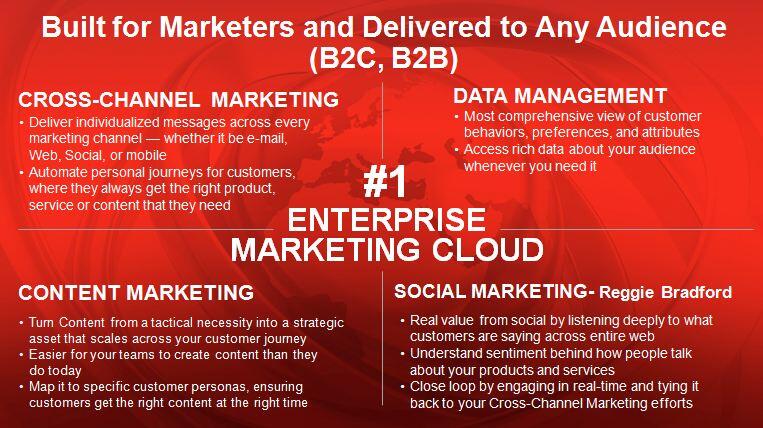
  1. Social media engagement. As pictured above, SAP offers a full suite of products that covers the external and internal aspects of customer engagement.
  2. Customer service use case. T-Mobile provides a compelling client reference, with SAP driving a 15% productivity increase. This is AFTER T-Mobile had been running with Radian6 + Jive as their customer service solution, citing millions of dollars in cost savings.
  3. The Adobe - HANA partnership. SAP and Adobe have inked a partnership where SAP will resell the Adobe marketing cloud in conjunction with HANA analytics and Hybris commerce.

Now, point #3 should be a head scratcher when thinking primarily about marketing clouds. The deal might mean that different SAP business units aren't aware of what the others are doing, creating a conflict of interest. Or the companies have discussed and decided that their marketing cloud offerings aren't meaningfully competitive right now. And may never be -- the combined suite creates an offering as comprehensive as Oracle, that can claim to beat Salesforce (point #2), and broader than any point solution (point #1).

When discussing how marketing technology can support critical needs including analytics, omnichannel, and customer experience, it's critical to evaluate solutions from a comprehensive online + offline point of view. SAP has defaulted to an enterprise-level approach to solve these issues, as opposed to focusing solely on the marketing department, which may prove to be a winning strategy in the long run.

As the big vendors are busy integrating their marketing cloud/platform acquisitions, there's still a market for point solutions. Not all brands are ready for an all-in-one solution, whether because of budget, organizational structure, or ability of vendors to deliver on their sales promises. But the strategic positions in market are becoming clearer and the big players are raising the competitive stakes continually higher.


Marketing Transformation Chief Marketing Officer

News Analysis: Vertical Solutions Extends Customer Experience And Field Service Footprint With Three Partnerships

News Analysis: Vertical Solutions Extends Customer Experience And Field Service Footprint With Three Partnerships

Vertical Solutions Partnerships Showcase Why Complex Field Service Is A Critical Glue Between ERP and CRM In Improving Customer Experience

Announced March 4th, 2014 at the Microsoft Convergence event, Vertical Solutions, made three significant partnerships with Blue Horseshoe Solutions, Cincom, and Vidcie.  The Cincinnati, Ohio based customer experience software vendor provides cloud contact center and service management solutions that bridge the worlds of physical goods with customer experience.  The analysis of the three announcements show:

  • Where after market sales and service creates a strategic differentiator for Cincom. Cincom signed a reseller partnership with Vertical Solutions for integrated Field Service Management and Maintenance Repair Operations.  Cincom is a global Microsoft ISV for manufacturing. The partnership allows Cincom to resell VSI's Service Lifecycle Management Solution with Cincom's Business Suite for Microsoft Dynamics AX.

    Point of View (POV): In the current digital business transformation, manufacturers realize that product margins can no longer sustain growth.  While service revenues, warranty management, and installation can provide additional revenues, organizations must move from selling products to keeping brand promises.  Post sales service is a key component to ensuring that the brand promise is kept for manufacturers.
  • Why supply chain and post sales service should team up to improve customer experience in the Blue Horseshoe partnership. Blue Horseshoe provides a Supply Chain Suite for Microsoft Dynamics AX.  The partnership ties customer support, field service and mobile environments with logistics, supply chain, transportation management, advanced warehousing, and order completion.

    (POV): While the Blue Horseshoe solution provides a robust capability in supply chain, Vertical Solutions provides post sales and complex field service requirements.  These requirements enable customers to deliver on the complete order management cycle.  In speaking with several Blue Horseshoe and Microsoft Dynamics AX customers, they have a need to reduce warranty costs and improve customer satisfaction through improved first visit resolution programs.  Constellation believes that customers do not care what department resolves the issue, just that the issue is resolved across the continuum of customer engagement.
  • How video streaming can provide real-time access to experts through the Vidcie partnership. The partnership with Vidcie allows customers to integrate video streaming technology into the VSI enterprise Service Lifecycle Management solution VServiceManagement.  Vidcie is a Silicon Valley based hands free live streaming, mobile, and wearable technology provider.  Vidcie is a division of Looxcie.

    (POV): The video solution provides a game changer for field service organizations by optimizing skills to issue matching, improving customer resolution and satisfaction, and driving employee satisfaction by reducing outbound travel.  With the continued skills shortage of available techs, organizations can build centralized competency centers for distributed deployment.  Several field service directors noted that this solution could improve their coverage by 33% and drive down costs by 5%.

The Bottom Line: Complex Post Sales and Field Service Delivers A Missing Link In The Customer Experience Continuum

Organizations have had the promise of customer relationship management dangled in front of them over the years.  However, each area, sales, service, marketing, and commerce remained siloed not only in technology strategy, but also internal organizational culture.  The shift to digital business changes how organizations must view CRM.  In fact successful deliver of the customer experience continuum requires organizations to integrate post sales interactions with customer service.  Recurring revenue companies resolve this gap through customer service management or CSM.  For manufacturers and service organizations, advanced field service is the solution.  Organizations must bring together multiple disciplines, technologies, and business processes to ensure brand promises are kept in customer experience.  These recent partnerships show how some forward thinking organizations realize how critical field service solutions are to not only delivering but driving customer experience.

Your POV.


Ready to evaluate how complex post sales and field service solutions can drive down costs and improve customer satisfaction?  Do you need specialized requirements for your industry?  How are you doing this today? Add your comments to the blog or reach me via email: R (at) ConstellationR (dot) com or R (at) SoftwareInsider (dot) com.

Please let us know if you need help with vendor selection efforts.  Here’s how we can assist:

  • Vendor selection
  • Implementation partner selection
  • Connecting with other pioneers
  • Sharing best practices
  • Designing a next gen apps strategy
  • Providing contract negotiations and software licensing support
  • Demystifying software licensing

Related Research:

Reprints

Reprints can be purchased through Constellation Research, Inc. To request official reprints in PDF format, please contact Sales .

Disclosure

Although we work closely with many mega software vendors, we want you to trust us. For the full disclosure policy, stay tuned for the full client list on the Constellation Research website.

* Not responsible for any factual errors or omissions.  However, happy to correct any errors upon email receipt.

Copyright © 2001 – 2014 R Wang and Insider Associates, LLC All rights reserved.
Contact the Sales team to purchase this report on a a la carte basis or join the Constellation Customer Experience!

New C-Suite Next-Generation Customer Experience Tech Optimization Innovation & Product-led Growth Future of Work Data to Decisions SoftwareInsider Microsoft AR Marketing B2B B2C CX Customer Experience EX Employee Experience AI ML Generative AI Analytics Automation Cloud Digital Transformation Disruptive Technology Growth eCommerce Enterprise Software Next Gen Apps Social Customer Service Content Management Collaboration Machine Learning LLMs Agentic AI HR HCM business SaaS PaaS IaaS Supply Chain Enterprise IT Enterprise Acceleration IoT Blockchain CRM ERP Leadership finance M&A Enterprise Service Robotics Metaverse developer Quantum Computing Healthcare VR CCaaS UCaaS Chief Customer Officer Chief Information Officer Chief People Officer Chief Marketing Officer Chief Technology Officer Chief Digital Officer Chief Data Officer Chief Analytics Officer Chief Information Security Officer Chief Executive Officer Chief Operating Officer Chief Supply Chain Officer Chief Financial Officer Chief Revenue Officer Chief Human Resources Officer Chief Experience Officer

LinkedIn Publishing – Where the Personal and Professional Brand Meets

LinkedIn Publishing – Where the Personal and Professional Brand Meets

1
LinkedInPublishing

When LinkedIn started publishing content via its LinkedIn Influencers program, it moved the social network for business professionals in a completely different direction. For many business leaders, this was a great, simple and powerful way to share business philosophy and insight. It was blogging without needing to have or create a blog. And because each item was automatically shared with your LinkedIn connections, there was no extra work required to distribute your writing.

But there was a problem. It was a closed system, and only a select group were granted access.

Taking a leaf out of the book of every digital business launch from Google+ to the now defunct Plurk, LinkedIn relentlessly kept tight control over their publishing platform. The early focus was on high quality insight from big-name business leaders like Virgin’s Richard Branson and Ryan Holmes from Hootsuite. Take a look through their various posts and you’ll notice something interesting – a collapsing of the personal and professional. The most popular articles (and the most interesting) tend to blur the lines between an individual’s business experience and their personal decision making. And I have a feeling that this has set an agenda which will be important to watch.

Eventually, the invitations started to broaden and other voices began to be heard, with new articles and more content filling our LinkedIn streams. LinkedIn Pulse would aggregate and promote the most popular posts, channels and authors – effectively filtering business-related news for us. All we had to do was choose where to focus.

A couple of weeks ago, LinkedIn announced that they were extending their publishing platform to 25,000 more LinkedIn members. So now if you are quick, anyone with a LinkedIn profile can reach an audience – or at least, reach your own connections. For the moment, you have to apply, but no doubt, this system will be extended to others in the near future.

The thing that is most interesting to me is not that LinkedIn is moving in this direction, but that business professionals are flocking to it. Up until recently, convincing executives to engage with social media was almost impossible. Despite widespread adoption of social networks by consumers, many business leaders remain sceptical, unconvinced and unlikely to commit the time required to see the benefit in social media.

But LinkedIn may have solved the challenge by making social media simple and obvious. After all, we all like to be “influencers” – even if there are 25,000 of us.

This is, however, not just about professionals, reputation and publishing. In the mixing of these professional and personal profiles, there could be something greater at play. Is this a way for LinkedIn to stake a claim against Facebook’s social domination? Will we see more insight, personality and flavour in the lives of our business leaders? Will personal and professional brands start to collide in new and exciting ways? One can only hope.

And in the meantime, my first LinkedIn article has just been published. It’s a departure from the marketing and digital focus I have here on ServantOfChaos. Hope you like it.

Marketing Transformation Innovation & Product-led Growth Next-Generation Customer Experience Tech Optimization Future of Work Data to Decisions New C-Suite Digital Safety, Privacy & Cybersecurity AI ML Machine Learning Generative AI Analytics Automation B2B B2C CX EX Employee Experience business Marketing SaaS PaaS Growth Cloud Digital Transformation eCommerce Enterprise Software CRM ERP Leadership Social Customer Service Content Management Collaboration Customer Experience Disruptive Technology Next Gen Apps Chief Marketing Officer

Event Report - Microsoft Build - Azure grows and blossoms - enough for enterprises (yet)?

Event Report - Microsoft Build - Azure grows and blossoms - enough for enterprises (yet)?

On the second day of Microsoft’s Build developer conference it was time for getting serious about the cloud, in Microsoft’s case to get serious about Azure.


And there can be no question that Microsoft is committed to Azure. What a difference a year makes. It wasn’t even a year – as Build 2013 was in June – and we had a completely different format and group of executives. Ballmer, Larson-Green, Leblond and Pall were on stage then on Day 1 – Ballmer and Leblond are gone, Larson-Green is now Chief Experience Officer and Pall is heading Skype. Both could have been on stage at Build 2014, too – but I guess the agenda was too packed. And contrary to Ballmer who presented and introduced big news a year ago (the Start button is back), Nadella only did a 30 minute or so Q&A of previously recorded video questions. Symbolically, he was introduced by Elop on stage. 


Nadella took video questions on stage at Day 1 of Build 2014

But most keynote time went to executives whose teams delivered products for Build and that was Belfiore (Windows Phone Mobile) and Guthrie (Azure) – accompanied by developer advocate Myerson and demo guru Guggenheimer. So significant change in presenters, but it seems not to have slowed down Microsoft.

The difference to Build 2013 was that last year it was all the other Microsoft products (Windows, Office, Bing etc.) coming to help of Azure, by exposing services and APIs. That led me to call the blog post ‘Princess Azure and the 7 dwarfs’. Well nothing like that this year. While Office was shortly on stage – it was more about supporting touch than Azure. And Bing wasn’t even directly on stage (though indirectly as a huge contributor to Cortana’s intelligence). And not a single word of Biztalk.


My Visual takeaway of Build 2013 - all to the help of Princess Azure

I have blogged on my top 3 takeaways for the enterprise from Day 1 already here – so let’s take a look at the enterprise takeaways from Day 2:


Azure momentum


Microsoft invests in Azure and had 44 new announcements of capabilities in store. Tough to keep the overview – but let’s start comparing the Azure live stats – using the Build 2013 and 2014 information shared. Unfortunately Microsoft – like other cloud vendors, too – makes it hard to compare progress by offering different metrics – but the following three could be deducted from slides and statements:


  • Azure sees increased usage from 50 to 57% with the Fortune500
  • Storage objects have increased from 8.5T+ to over 20T
  • Microsoft stay with the story that Azure doubles every 6 months

A comparison of Azure stats - Build 2014 (left) and Build 2013 (right)

No surprise the stats Microsoft presented are pretty impressive. In a Q&A an executive gave up the number of US3B+ being invested into Azure CAPEX in the coming quarters.

So how do you test and explain that scale bewww.titanfall.comst? Games and media events and Microsoft are two good showcases with the Titanfall game (over 100k VMs used) and the streaming coverage of the Sochi Olympics by NBC. Then NBC’s Cordella made the perfect example for elasticity – he mentioned how you go from almost no streaming demand from a curling match to the peak of the Olympics for NBC this year – the USA vs. Canada hockey match.


Azure Data Center locations as presented at Build 2014
On the data center location topic, Microsoft has made progress – now with 16 regions worldwide. It also holds the first data center in China prize, but Amazon was quick to follow (last week). Guthrie made a key point though – redundant data centers are in the 500 mile range from each other, so fail over backup against natural disaster is realistic – but the overall jurisdiction does not have to change. With more and more sensitivity on data security, privacy and big brother watching you, quite an argument pro Azure.


Improved tooling

Similar like Google the other week, Microsoft showed programmatic control for VMs, right from Visual Studio – a key requirement, almost table stake today. Cloud customers want to have direct control on elasticity, auto-scaling is a great feature, but running it yourself is the preferred choice. The remote dynamic debug capability is a very powerful new feature, too. And with the addition of Puppet, Chef and Powershell Microsoft has given developers the access to configuration control with their favorite tools. There can be no question that Microsoft wants (and needs) Visual Studio to remain the development tool of choice.

But Microsoft needs to balance its own ambitions with the reality where developer populations live now, so the addition of Java to the popular Azure Websites is a tribute to that. And in an acknowledgement of Internet Explorer ruling the world, the BrowserLink and F12 debugging can synch CSS changes across browsers of competitors. Moreover Microsoft gives away a SSL security certificate for each Azure Website – making it easier for developers to build secure sites…


All 44 Azure announcements by IaaS, Web, Data and Mobile

On the mobile side Microsoft makes it easier to get users ramped up, with improved AD support – either supporting on premise or Office365 / Sharepoint repositories. And with AD Microsoft has a ‘higher ground’ in regards of giving (known) users quickly access to newly built applications, mobile being a prominent example. And again Microsoft straddles beyond its platforms with the Xamarin capabilities of Visual Studio to build mobile applications for iOS and Android. And with Docusign and Vesper there were two good reference on stage for using Azure without living completely in the Microsoft ecosystem.

On the data side Microsoft moved the MS SQL limit from 150 to 500 GB, and while this if perfectly enough for 90%+ of applications, the question is why that limitation is needed and exists in the first place. Raising the SLA for MS SQL to 99.95% is definitively going to be a head scratcher for any local on premise SQL Server install. As mentioned before the active geo-replication across the data centers in the same legal, statutory zone is a key addition.


Big shift to open source

One of the major (positive) surprises was the significant push towards open source, and while that part of the keynote started nicely with developer legend Hejlsberg on stage announcing the open sourcing of the Roslyn compiler, Guthrie topped that the .Net foundation announcement with a long list of products being contributed. In an ironic course of the developer tool industry, the company that took out most of the competition (Microsoft) – at the end of the day needs to acknowledge the power of open source and with that the significant revenue deflation happening in the tool space.


All contributions to the .Net Foundation

On the flipside of the argument Microsoft announced the online version of Visual Studio – and while introductory rates are attractive, developers (or their managers) will pay more beyond the traditional purchase of a development tool that ran locally sometime in the 2nd year of usage. But then with an online development environment systems, developers receive more than a tool – its storage, networking, sandboxes, backup etc. – all costs hidden in the traditional on premise tool installation.


A new face for Azure

Azure is getting a new face with a band new Azure Portal. .Impressively the portal went live same day for Azure customers. It looks clean and easy to use, is extensible through the Azure Gallery. What Microsoft missed to mention in the keynote but clarified in a subsequent Q&A was that the new Portal works well with Systems Manager and can with that show both on premise and cloud resources. In fact it can even be deployed locally to monitor cloud resources, or in the cloud to monitor on premise resources. And with that it will make the transition to more Azure emotionally and practically easier for most traditional on premise Windows customers – as you don’t have to ‘leave the living room’ anymore. 


The new Azure Portal

But administrators need to learn a new user interface, and as well as it demoed and looked like to be intuitively usable – I’d love to know why Microsoft thinks that a Metro style user interfaced that has proven to be unpopular with most of its user base, will appeal to a technical audience.


Death by Demo - 20 Demos in 60 minutes

And then we were off to Guggenheimer’s rapid demo show, all centered on partners building applications on Azure with Windows tools. And while Guggenheimer framed the presentation with desirable goals (investment protection, build for cloud and mobile, platform portability) – the rapid demo sequence never tied back to these three value propositions. Probably Microsoft could have achieved more with less demos.


All 20 partners features in the demo hour


Implications, Implications... 

Implications for developers

While Microsoft tools and platforms may not be the most popular places to start with – Microsoft has done a big step ahead with a bounty of 44 announcements. Adding Java support last year and adding it for websites should make it an interesting option for deploying cloud loads. If the Xamarin capability – though innovative and powerful – will make developers jump ship is doubtful. But for an existing Microsoft developer the tooling and capabilities have vastly improved. Developers should certainly look at the value proposition of the new cloud based development tools.

What a Microsoft developer may not be able to make up in sizzle factor in meeting with peers, she / he may well be able to make up in productivity. And developers respect that – at the end of the day everybody wants to get work done.


Implications for CIOs

Microsoft has made it more compelling to use its platform and tools with this Build conference. On the pure IaaS side geo-replication will be of significant value for a number of enterprises. Using the AD and Office investments will move most enterprises to a certain extent of using Azure, and Microsoft certainly makes it compelling with a lot of ease of use to move to Azure. With Microsoft giving proof of its price match commitment to Amazon (Microsoft just reacted to the 42nd AWS price reduction) – cost is not a reason not to use Azure. If enterprises use 3rd party pieces of technology that Microsoft is not supporting, seek the dialogue with Microsoft.

On the tools and PaaS side Microsoft has made it easier to build next generation cloud applications. And with Xamarin there is less of a platform lock-in and easier access to other Microsoft products. Microsoft has also done a good job showing migration of older .Net and even a VB6 application. And while these migrations are never as easy in the real world as on a demo stage – it is good to see Microsoft paying attention and making these migrations easier.


Implication for ISVs

Azure remains a cost competitive platform with potential data center location advantages. The extension of MS SQL storage makes Azure more palatable for SaaS ISVs segregating tenancy by database. ISVs with their technology stack running on Microsoft have more good reasons to look at new tools and capabilities in Azure. It’s likely the new Azure Portal will give them better instrumentation and diagnosis tools from the get go than what they have right now.


Implications for competitors

Cross platform arguments are getting weaker and weaker to be used against Microsoft as the ‘new’ Microsoft has no fear to provide that and has a strong self-interest to succeed here (e.g. Office on iPad). Apart from Amazon and Google, competitors need to take a hard look at infrastructure costs and differentiating value services. With the build announcements Microsoft is moving the yard stick in regards of platform capabilities at low costs – with a strong pitch and benefits to the Microsoft eco system. When Microsoft gets traction I’d expect the usual competitors to ramp up corresponding offerings – but it may be too late for that already.


Implications for Microsoft

Microsoft needs to go down the path of ‘open, but’ path. With that I mean that the openness and standard messages are key to attract developers, but then the tie into higher productivity and other Microsoft assets need to be balanced out. To match Amazon, Microsoft needs to continue to add popular 3rd party products to its platform – last year Oracle and Java were a huge step – but more steps need to follow. The open source move now needs to be lived and Microsoft needs to show that it listens and works well with the open source community.


MyPOV

A build conference with a huge number of announcements that will take the ecosystem quarters to dissect, evaluate and measure on. Key milestones for Microsoft on the value side were the universal Windows apps (to get to these platforms – amazingly less prominent on day 2), significant advances in Azure and developer tooling and a huge contribution to open source. On the cost side the landmark takeaways are the re-confirmed price match to AWS (notably not mentioned at build) and the free licensing of Windows on small devices (which extends the Windows platform reach). Well done by Microsoft which keeps adding attractive value propositions for all its constituents. Not an easy task to balance.

-------------

A tweet stream in Storify can be found here.

--------------

More about Microsoft:


  • Event Report - Microsoft Build Day 1 Keynote - Top Enterprise Takeaways - read here.
  • Microsoft gets even more serious about devices - acquire Nokia - read here.
  • Microsoft does not need one new CEO - but six - read here.
  • Microsoft makes the cloud a platform play - Or: Azure and her 7 friends - read here.
  • How the Cloud can make the unlikeliest bedfellows - read here.
  • How hard is multi-channel CRM in 2013? - Read here.
  • How hard is it to install Office 365? Or: The harsh reality of customer support - read here.


Tech Optimization Innovation & Product-led Growth Future of Work Data to Decisions New C-Suite Event Report Google amazon Microsoft SaaS PaaS IaaS Cloud Digital Transformation Disruptive Technology Enterprise IT Enterprise Acceleration Enterprise Software Next Gen Apps IoT Blockchain CRM ERP CCaaS UCaaS Collaboration Enterprise Service Executive Events Chief Information Officer Chief Technology Officer Chief Digital Officer Chief Data Officer Chief Analytics Officer Chief Information Security Officer Chief Executive Officer Chief Operating Officer

Lead, Follow, and Get Out of the Way -- Leadership Supports the Final Four

Lead, Follow, and Get Out of the Way -- Leadership Supports the Final Four

1

This weekend is the 2014 NCAA Men’s Basketball Final Four. Thousands will be watching in the stadium and millions will watch worldwide. Like any event of this type, there is a team behind the scenes, setting the stage for the great performances on the court. Temporary facilities are built, operations plans laid down, credentials and security operations put in place, and a temporary workforce brought up to speed at a breakneck speed.

Lead, follow, and get out of the way is how I describe the management style used by Marc Klein, Event Manager and Associate Principal at Populous, the company tasked with the event planning and design for the Final Four.

Lead

Highlight the goal and make sure it matches the customer’s needs. Provide the resources to get the work done.

Follow

Follow as in pay attention and coach. This is where work design and technology support come into play. Klein’s team uses cloud-based shared documents to keep their work aligned. He gave me the example of how they use Smartsheet to get the most out of their numerous trips to an event site.

“Everybody has access,” and it’s simple. Team members developed their own tools in the shared spreadsheets, expanding and enhancing their workflow. The transparency helps the team coordinate their limited time on the ground, and Klein can keep a handle on what’s going on without being in the way -- the final dimension of this leadership model.

Get Out of the Way

“On the day of the event, they’re going to be the ones on the field.” You can’t be an expert in everything, so hire people smarter than yourself and step out of the way. Klein highlights the ownership people gain when they are given the freedom to follow their own path.

I expect you’re nodding your head at this. Management classes have taught this approach for decades. In 1973, we used Vroom & Yetton’s model on when to take a decision on your own and the conditions when you should involve your subordinates. In 1997 we upgraded to Tom Malone’s version, acknowledging the role that information technology plays in making more and better information available throughout of the organization.

And yet, many managers don’t practice this approach. They have a decision making meeting but lead with the answer they want to hear. They ask for revisions to work until they might as well have written it themselves.

I asked Klein if he had a thought as to why some can’t seem to get out of the way.

Some people just feel the need to have their own touch on everything. Not sure if it’s ego our just being able to say they had input…. All it does is undermine the confidence of the people who do the work. Even if something doesn’t look the way I envisioned, if it meets the customer needs, step out of the way. It takes an ‘ego check,’ but the team gets the glory.

A Modernization of a Leadership Standard

Perhaps the transparency made possible by tools like Smartsheet, Work.com, and other collaborative work systems will give more leaders the confidence to follow rather than meddle, loosen their grip, lead with a lighter touch -- however they might think about getting out of the way of work to be done. Leaders have critical roles to play as visionaries, resource providers, and coaches. Leaders can also look to enhanced roles as work architects as we begin to have work done as a blend of traditional employees, contract workers, “task rabbits” and the crowd.

Photo courtesy of Rich Smith.

Future of Work Innovation & Product-led Growth Chief People Officer

Event Report - Microsoft Build Day 1 Keynote - Top Enterprise Takeaways

Event Report - Microsoft Build Day 1 Keynote - Top Enterprise Takeaways

Microsoft’s build developer conference kicked off today in San Francisco – it’s well attended with over 5000 guests - and sold out since months. Day 1 was all about Windows Phone 8.1, the launch of Cortana, support for developers, a little Internet of Things and Nokia Lumia phones


Nonetheless there are some takeaways for the enterprise – here are my Top3:

  • Universal Windows App – The dividend of running an OS from the same software vendor are synergies. So Microsoft creation of the universal Windows app is not of a surprise (more – why only now?). So one application can re-use most of its code artefacts (Microsoft says up to 90%) and be shared across smartphones, tablets and PCs running Windows 8.1. With the addition of xBox and Kinect there are new applications in store - as well as opportunity for enterprise applications to get on the first screen.
    For enterprises this means that achieving a consistent and familiar user experience is now in reach – even for in house custom apps. For purchased apps the informed enterprise buyer will ask their ISV in regards of ETA of bringing their applications to the universal Windows App platform.

  • Nokia Lumia 63x – Stephen Elop presented a number of new phones and while the high end ones are surely interesting in richer markets around the world, the Lumia 6.3x will make an impact around the world (interesting it is not launching in the US early). It matters for enterprises as the price point of under $200 makes this an affordable, but powerful device to be deployed across the world.

    A common, worldwide user experience with all its benefits is now in reach for enterprise deployments. And the dual SIM card will make telecom procurement managers in enterprises really happy – as an elegant way to easily control and reduce roaming costs. 

  • Free Windows for smartphones and small tablets – Microsoft also announced that it will make Windows available for no license cost – as long as it is supposed to run on phones or tablets with less than 9 inches screen diagonal. It matters for enterprises as now you not only have the software tools to build universal Windows apps, a price effective hardware device, you will also see even lower device prices going forward across the board due to no operation royalty costs.

    In one of the more ironic twists of the smartphone wars, Microsoft makes more in royalty from the sales of some Android phones from IP loyalties - than from selling Windows Phone. 


MyPOV


A more consumer and developer focused start of Build – but with plenty of repercussions and implications for the enterprise. More consistent user experience across more powerful and cost effective devices is a good news for enterprises.


New C-Suite Tech Optimization Microsoft Chief Executive Officer Chief Information Officer

Spredfast and Mass Relevance merger: What it means for marketing clouds

Spredfast and Mass Relevance merger: What it means for marketing clouds

1

On April 2, 2014, social relationship platform Spredfast announced that it had merged with content curation platform Mass Relevance. I spoke with CEO Rod Favaron about the deal and what it means for the rapidly changing marketing technology space.

The New Spredfast

The facts

  • The new company will be called Spredfast
  • Mass Relevance stock will be converted into Spredfast stock
  • Spredfast has 200 employees and Mass Relevance has 150 employees; both companies are headquartered in Austin, Texas
  • Spredfast has raised over $60 million in venture capital funding and Mass Relevance has raised just under $6 million; both companies have Austin Ventures in common as an investor

The companies have at least a half dozen common clients and they had already been working on integration pathways between the two solutions. So this deal is good news for 1% of the new firm’s client base and great news for the Spredfast sales team that now has over 600 new cross-sell opportunities.

But what exactly is this thing?

My take is that it’s a bit different than what I’ve been hearing from the massive marketing cloud vendors (Adobe, Oracle, Salesforce), that are focused primarily on integrating owned content across digital marketing channels.

In contrast, Spredfast is focused primarily on earned content, allowing “marketers to display [social media] content on every screen that matters, whether scheduled or unscheduled.” Mass Relevance helps brands curate the social web outside-in; Spredfast enables brands to publish owned content inside-out. The combined company enables content discovery, optimization, and distribution.

A content marketing platform powerhouse

My take: Spredfast has just created a formidable solution in the white-hot content marketing space. There are players here including Percolate and RebelMouse, potentially Sprinklr (+Dachis Group), and segments of the big three Marketing Clouds. One big advantage Spredfast may have over other firms is Mass Relevance’s native access to the full Twitter firehose, which has allowed it to make huge inroads with major media companies.

Favaron tells me that Spredfast intends to become a consolidator in the marketing technology space — which means the company needs to raise capital via a new funding round or IPO. In the case of the latter, given the amount of funding taken so far, the company’s valuation would need to be close to unicorn club territory to make sense. (Which, by the way, is not too far off from where Sprinklr stands financially as well.)

A native advertising play

Even if Spredfast gains access to a huge amount of capital, competing head on with the likes of Adobe, Oracle, Salesforce, and SAP may not make much sense given the headstart the others have on integrating broad marketing cloud solutions. Instead, the firm might decide to double down on its strong installed base of media clients and own the market for a new breed of native advertising solutions, combining large broadcast networks with major brand advertisers and user-generated content. 

This way to the egress

I’ll be keeping an eye on how competitors respond, especially Hootsuite which raised $165 million last year and acquired analytics firm uberVU last quarter. All firms remaining in the SMMS space need to map out a path to the exit because it’s clear that standalones won’t survive much longer.

Marketing Transformation Tech Optimization Data to Decisions Digital Safety, Privacy & Cybersecurity Innovation & Product-led Growth Future of Work Marketing B2B B2C CX Customer Experience EX Employee Experience AI ML Generative AI Analytics Automation Cloud Digital Transformation Disruptive Technology Growth eCommerce Enterprise Software Next Gen Apps Social Customer Service Content Management Collaboration Chief Marketing Officer

Bridgette Chambers Joins Constellation's Advisory Board

Bridgette Chambers Joins Constellation's Advisory Board

Constellation Research, Inc. announced today that Constellation Chief Executive Officer, Bridgette Chambers will transition from the CEO role to a position on the firm's board of advisors. Chambers will launch and operate EmpoweredW, a community dedicated to advancing women into leadership and influencer roles. Constellation Research founder, R “Ray” Wang reassumes the CEO role and will continue to drive the company’s research and advisory strategy.

“Chambers spearheaded a strategic endeavor to build and launch a community of entrepreneurs and innovators during her tenure as CEO. As the community started taking shape, it became clear that a Constellation-independent structure with dedicated leadership would best serve the community’s broader set of interests that includes the need to transform their business models through the innovative use and adoption of disruptive technologies.  Thus, we are pleased to announce that Bridgette will continue on with that focus and formally launch and operate the EmpoweredW community”, said Chairman and Founder R “Ray Wang.

EmpoweredW is a fast growing, global community of entrepreneurs, innovators, and thought leaders sharing a passion for collective female success.  EmpoweredW works with established professionals and millennials to share best practices, content, insight, and networking experiences that propel women into leadership and influencer roles. I could not be more proud to be part of this important and vital community. Moreover, I’d like to thank Ray for stepping up and offering Constellation Research as the community’s preferred content provider”, said Chambers

Chambers received her B.S. from The University of Houston and her MBA from Texas A&M University.  Chambers is a well-known keynote speaker and presenter.  Chambers honed her leadership skills while proudly serving in the U.S. Army Reserves and Texas Army National Guard.

Constellation Research is hosting its successful Connected Enterprise event, The Executive Innovation Conference October 29th to October 31st at the Ritz Carlton in Half Moon Bay, CA.  The 2014 event theme will focus on helping brands, enterprises, and organizations dominate digital disruption.  Agenda and keynotes will be released in April 2014. 

Data to Decisions Future of Work Marketing Transformation Matrix Commerce New C-Suite Next-Generation Customer Experience Tech Optimization Innovation & Product-led Growth Chief Customer Officer Chief Executive Officer Chief Financial Officer Chief Information Officer Chief Marketing Officer Chief People Officer Chief Procurement Officer Chief Supply Chain Officer

What's in a name? #gTLD

What's in a name? #gTLD

1

What’s in a name? that which we call a rose
By any other name would smell as sweet;

Shakespeare, Romeo and Juliet

With the rollout of new gTLDs, it's just a matter of time until the .com addresses we have grown familiar with over the past 15 - 20 years start to disappear. Here are the domains that are available today and coming soon, via IANA.

Major brands and organizations have already lawyered up and brands like Gucci, Ralph Lauren, Oakley, USPS, Google, Amazon, and others are battling it out in the courts over new domains. I spoke with DomainSkate last week and their blog is a good resource; the company estimates that over 1,400 new domains will become available in 2014.

As if digital marketing didn't change fast enough -- here's one more issue that marketers need to add to the to-do list; file under brand + SEO.


Marketing Transformation New C-Suite Data to Decisions Innovation & Product-led Growth Revenue & Growth Effectiveness Future of Work Tech Optimization Leadership Chief Marketing Officer

Event Report - Equifax Workforce - Preventive Medicine for the HR department and a silver lining of DaaS

Event Report - Equifax Workforce - Preventive Medicine for the HR department and a silver lining of DaaS

Earlier this week I had the opportunity to attend Equifax Workforce Solutions annual user conference in Scottsdale. It was an almost intimate affair with a little more than 200 customers attending – with its great advantages for all attending – like direct access to executives, a lot of networking opportunities and a great opportunity for Equifax customer to look at other Equifax products and offerings. Customers were overall very positive on products and direction, and even more open to exchange experience and best practices, when it comes to compliance HR professionals are (literally) all in the same boat.


Equifax Workforce Solutions (EFX WS) was started with the Equifax acquisition of TALX, which today forms the backbone of the Equifax employment verification business. Coupled with strong offerings in compliance, largely centered on the hiring process and subsequent onboarding, EFX WS helps to automate the hard part of the process with I-9 services, background checks, WOTC data capture, call outs to benefits etc. With employment verification and unemployment insurance validation EFX WS has equally strong offerings in later phases of an employee life cycle. And not surprisingly EFX WS customers are in high turnover and / or industries that show a lot of seasonal hiring (e.g. retailers, food and beverage etc.).


Compliance is the game

As general guidance, EFX WS seems to seek out areas of automation in the HR process landscape that are hard and unpleasant to automate and execute – but enterprises could get in significant trouble if they do not execute and run them well. Hence the headline that EFX WS is like preventive medicine for the HR department – similar as many people take their vitamins and minerals to prevent from disease taking over, EFX WS is happy to be the partner of taking care of all the ugly and hard compliance processes. Enterprises using EFX WS are generally buying automation of a vital, but not strategic service – unless it fails, so basically peace of mind and time to focus on other – often more deemed strategic HR activities.


And beyond Compliance


It was good to see that EFX WS is not resting on its laurels in the compliance area – but also looking at other strategic applications. And there are 2 key areas EFX WS is looking at:


  • Analytics – With the acquisition of eThority EFX WS has a strong ETL and BI tool, but is looking at creating (true) analytics now, based on the TALX employment and more data. With over 70% coverage of the FT500 employments on file, there is a very attractive set of data to come up with insights that HR practitioners have been craving for since a long time.
An example of bench marking Equifax can provide. 
  • Credit – EFX WS sees an opportunity to become a source of credit for consumers. The scenarios goes along the lines that FICO scores of consumers have no recovered (yet) from the last financial crisis, and employment verification (coupled with salary), can be a strong (or good enough) indicator to extend credit to a consumer. The purchase of automotive vehicles is the use case at hand. 
Value to consumer and merchant of employment verification is obvious in this example. 
 

MyPOV

This event showed once again the value of small events – great access, experience and best practice exchange. Equifax has a great track record of helping enterprises with the hard things most HR practitioners do not want to spend too much time on. But these things can be mines that enterprises may step on and then the damage could be catastrophic, just consider reputational damage. Moreover Equifax has all the data to its disposal to become a key analytical benchmark provider and information solutions provider, two areas with a lot of appeal and value – both for Equifax and its customers. The credit provider play has probably the most potential, though EFX WS has to overcome the fears of data being shared with its holding company, Equifax the credit bureau.


Future of Work Next-Generation Customer Experience Digital Safety, Privacy & Cybersecurity Data to Decisions Tech Optimization AI Analytics Automation CX EX Employee Experience HCM Machine Learning ML SaaS PaaS Cloud Digital Transformation Enterprise Software Enterprise IT Leadership HR LLMs Agentic AI Generative AI business Marketing IaaS Disruptive Technology Enterprise Acceleration Next Gen Apps IoT Blockchain CRM ERP finance Healthcare Customer Service Content Management Collaboration Chief People Officer Chief Customer Officer Chief Human Resources Officer Chief Information Officer Chief Technology Officer Chief Information Security Officer Chief Data Officer