


Salesforce lays out growth plans: What customers need to know
Salesforce is targeting $63 billion in revenue by 2030 and laid out a plan to deliver AI value to enterprises as well as capture a good bit of its own. Here's a look at what customers need to know.
At its Wall Street analyst meeting at Dreamforce, the company featured a Claudeforce demo, talk about an interface free existence for users and an outline of a go-to-market strategy that'll feature a lot of pricing flexibility and upsell.
First the numbers. CFO Robin Washington laid out the path to $63 billion by 2030. Chief Revenue Officer Alexa Vignone outlined how Salesforce plans to get there. In two slides, here's Salesforce's master plan.
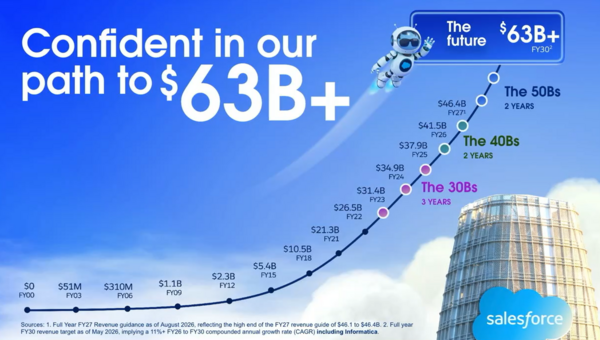
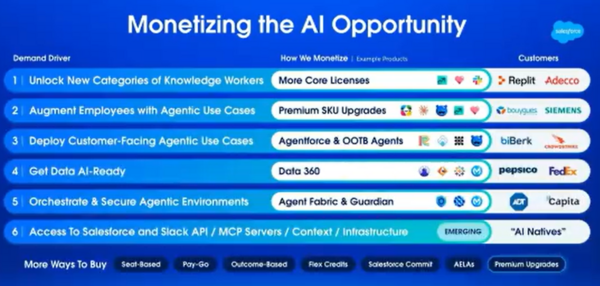
On the technology side, Salesforce said its framework will revolve around bringing on AI lab talent via acquisition and creating a flywheel of innovation. The goal is to be a platform.
There will be glitches, however. Salesforce's Claudeforce demo was plagued by an "over-reasoning" Claude and latency. Tuning will matter to enterprises or you'll burn tokens just talking to Claude.
The Dreamforce stack
- Salesforce launches Koa CRM reasoning model built on Nvidia's Nemotron
- Salesforce launches AIforce, fleshes out platform play
- Anthropic CEO Amodei: Think of AI safety like car safety
- Salesforce still has pricing work to do
The bigger theme here will be Salesforce's ongoing conversation and negotiations with customers so it can hit its growth targets and enterprises get value.
The back and forth with customers
Where things get interesting with Salesforce will be the value equation with customers. Salesforce seemed to bask in its pricing strategy that includes a little bit of everything. The bet is that customers will go for a new AIforce Max+ plan that includes a large buffet of platform usage and Flex Credits.
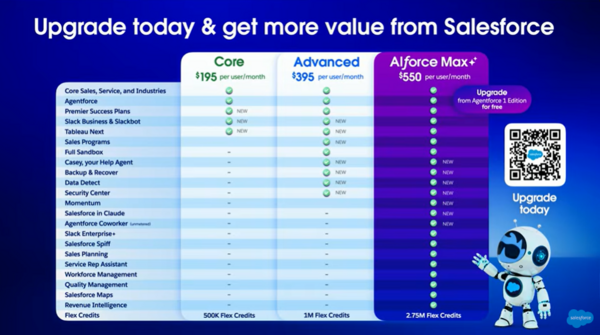
CEO Marc Benioff said Salesforce is hearing from customers that they don't want to be token arbitrage experts. Benioff said that most enterprise AI will be consumed through packaged software.
The strategy for Salesforce is relatively simple--grow annual recurring revenue. Chief Operating Officer Miguel Milano, who now has go-to-market, customer success and partnerships, and Vignone will double down on the nine markets where AI grows the fastest and build prototypes instead of a deck.
The progression for Salesforce's growth will include employee sees and then an adoption driven in consumption. Slack is surging as an agentic operating system.
Here are the takeaways customers need to know from Salesforce's Wall Street meetup at Dreamforce.
AI will be consumed through enterprise vendors and the decision will be about trust. "Whatever your model preference you know enterprises in particular are looking for trust and they need to understand that whatever I do from a model perspective I need my other enterprise vendors to make sure that my data is safe the workflows," said Benioff. "The vast majority of customers will purchase their AI through package software. That's where the value will get provided through packaged software like ours, not in some bespoke. They're not. They don't have the expertise or capability to do that."
How much does it cost? Salesforce's answer: It depends. Benioff said customers want per-user, per-agent, consumption, usage and outcome-based pricing. Salesforce's sales army has been given the "ultimate flexibility to write the best deal for that customer," said Benioff.
"Every customer wants something slightly different on pricing," said Benioff. "We have a brand new product line and we have a brand new approach to pricing."
Milano noted that Adecco is scaling Agentforce usage and signed an unlimited credit two-year deal seven months ago. Incremental consumption is free until renegotiation. Milano will expect more revenue when Adecco renegotiations. "We've been able to monetize part of the value," said Milano. "That's the trick of AI."
Outcome-based proposals are starting. Benioff said the company is starting to see outcome-based pricing. A private equity firm signed a portfolio deal that includes a percentage of the value. The bet is that Salesforce stays in that company over time.
Salesforce is prioritizing CRM first but has broader ambitions. "The most important thing for our company is we must be the number one CRM. Nothing is more important than that," said Benioff. "Then number two is if we get there ahead of all the other companies, and we can show that through the flexibility and nimbleness of our platform, we can deliver this total enterprise transformation for you."
But Salesforce sees the opportunity in front-office and CRM. "In software, if everything is important, nothing is important. You have to choose," said Benioff.
Here come the upgrades. Benioff said: "We want to motivate the enterprise transformation CRM first, but across the board. We want to motivate the upgrade also. We also want to make it clear that we want customers to step into the higher version to be able to get the full value. We know for customers who've already done that, they feel a huge amount of value by stepping into our higher version."
Salesforce will be a token reseller to some degree. Benioff touted Nvidia's Nemotron models because it can now engineer better models "without spending an exorbitant cost." Benioff said:
"We want to be monetizing, the token spend as part of our product line. Our goal is to provide smart routing technology that we'll be able to monetize to be able to kind of sell you the tokens as well. But you can imagine that's an example of companies want to buy their AI through package software, so we should be able to distribute those tokens through Slack. We should be able to distribute those tokens through all of our enterprise applications as well. Initially, it's doesn’t have to be step one for what we're doing. The most important thing is to deliver the base functionality that lets customers get the value, and then step two is the ability for us to distribute the tokens."
Larry Dignan is Editor in Chief of Constellation Insights at Constellation Research, where he leads editorial coverage focused on enterprise technology, digital transformation, and emerging trends shaping the future of business. He oversees research-driven news, analysis, interviews, and event coverage designed to help technology buyers and vendors navigate complex markets with clarity and context. ...
Read morePublished
Author
