


TSMC, the largest chip foundry, said second quarter revenue surged 36% to $40.2 billion. Net income surged more than 77%.
The company said third quarter revenue will be between $44.6 billion and $45.8 billion.
July 16, 2026 3:56:21 AM




TSMC, the largest chip foundry, said second quarter revenue surged 36% to $40.2 billion. Net income surged more than 77%.
The company said third quarter revenue will be between $44.6 billion and $45.8 billion.
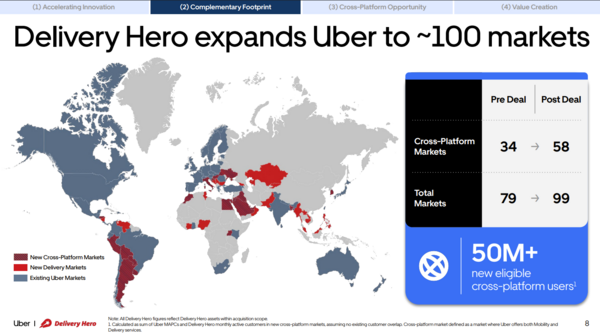
Uber said it will acquire Delivery Hero for $13.7 billion. Uber already owned a stake in the company. The deal, which is expected to boost non-GAAP earnings when the deal closes, expands Uber's international delivery services.
Delivery Hero said it will sell units operating in 14 markets to SSW Partners.
Thinking Machines launched Inkling, an open-weight mixture-of-experts model that's trained for broad usage rather than optimized. The company outlined the details in a blog post. Inkling is welcome given that enterprises in the US need more options.
Amazon said that Dave Brown, a 19-year vet of AWS, is retiring from the company to pursue another role. Brown was a key part of Amazon's inner management circle and SVP, AWS Compute & Machine Learning Services. Brown will be replaced by Dave Treadwell, current Senior Vice President of eCommerce Foundation at Amazon, effective Aug. 1.
CrowdStrike named AJ Shipley Chief Product Officer to oversee the development of the company's Falcon platform. Shipley joins CrowdStrike from Splunk Security where he was Chief Product Officer. Shipley also previously led product management for Cisco's Threat Detection and Response portfolio and helped drive the company's acquisition of Splunk.
G42, an AI company based in the United Arab Emirates, plans to become a US company mostly owned by US investors. The development was outlined in a Wall Street Journal story detailing that UAE has been cleared to buy US AI chips to power its models.
OpenAI is creating a smart speaker that's designed to be a human AI companion, according to Bloomberg. The company appears to be leaning into connecting its AI to humans and go beyond what smart speakers do today. It's all a bit like the movie "Her."

Quantinuum, Rolls-Royce, Riverlane and EPCC, the UK National Supercomputing Centre based at the University of Edinburgh inked an agreement to gauge quantum computing's impact on industrial design and workflows. Quantinuum will provide access to its Helios systems with Rolls-Royce providing industrial design use cases and expertise. Riverlane will provide quantum error correction knowhow. EPCC will provide supercomputing expertise.
Quantinuum recently completed an IPO.
Economists are urging policymakers to understand and respond to AI job disruptions.
The full text of this letter is here:
AI may become radically more powerful over the next 10 years.
This could drive an unprecedented transformation of our economy, larger than the Industrial Revolution, but unfolding over a vastly shorter time frame. It could bring risks, including large-scale job displacement, as well as opportunities such as major gains in living standards.
Economists, policymakers and technology leaders must act now to understand the economics of transformative AI and to build the incentives, guardrails, and institutions needed to steer AI in a direction that complements humans and benefits society.
Boy, that's a touch academic.
This letter got a lot of press and frankly I'm not sure why. There's a bit of alarm ringing and that's great if job displacement actually happens because you can say "I told you so." If it doesn't rest assured we'll forget these three paragraphs.
A few thoughts:
1. The key words here are "could" and "may."
2. We don't know how this turns out or whether AI can live up to its hype.
3. AI has been blamed for layoffs, but honestly most of the cuts were due to overhiring during Covid.
4. Timing is everything. We don't know if we're talking job displacement in 4 months, 4 years or 40 years.
Bottom line: AI job displacement should be studied, but the jury is out on what needs to happen. Can you really "build the incentives, guardrails, and institutions" based on what you hope AI will do?
Meta is expanding its Richland Parish, Louisiana data center to 5GW. The expansion will run the tab to $50 billion or so. Meta broke ground on the data center in December 2024. Meta has a deal with Entergy to fund seven new natural-gas fueled generating plants, three grid-scale batteries, nuclear uprates and other purchased power.
That's the news, but it was a bit hard to find since Meta went way fluffy in its press release. It was so sappy I threw up in my mouth a bit.
In a move that highlights how unpopular AI infrastructure has become politically, Meta completely overdid it. Some choice quotes:
Now the annual bonus paid out to teachers of $50,000 is legit, but the PR was so flowery my innate Spidey senses perked up (some would say that's just cynicism but it's a part of my job). Maybe Meta is the second coming to Northeast Louisiana, but time will tell. Let's fire up those natural gas generating plants first.
Anthropic said it will extend Claude Fable 5 access on all paid plans and keep Claude Code's weekly rate limits 50% higher through July 19. I'm sure this move has nothing to do with OpenAI's ChatGPT Work release and SpaceXAI's Grok 4.5's launch. The amateurish promo approach from Anthropic is confusing.
Apple is suing OpenAI over IP theft and trade secrets and its lawsuit revolves mostly around former employee Tang Tan, who worked on the iPhone. This case is going to be covered extensively and Sam Altman and Elon Musk are exchanging jabs. The big takeaway is that OpenAI's hardware ambitions can be delayed no matter how the case turns out. Discovery should be interesting. Keep in mind that this court battle will take time to play out. Settlement? Unlikely. Will this be entertaining? Definitely. We'll see how this plays out, but for now it's just a lot of noise.