
Results

Coupa and the MIT Data Science Lab published the 2026 Business Spend Index Report using Coupa's data on actual business spending. The index is designed to be an economic indicator that is predictive.

According to Coupa and MIT, the BSI caught an April spending pullback before surveys. Current findings include:

  • Procurement spend in technology, financial services and healthcare and life sciences are expected to contract over the summer.
  • Technology procurement spend has climbed 40% since mid-2024 to a four-year high.
  • Enterprise AI demand appears to be catching up to the AI infrastructure build-out.

Knowledge at Wharton has a good post on whether AI is killing UX. The post is worth a read given that UX is allegedly disappearing and being replaced with an all-encompassing chat interface.

The authors, Scott A. Snyder, a senior fellow at the Wharton School and author of Your AI Life, and Mike Welsh, chief storyteller at Bridgenext and author of The Backstory on Storytelling, write:

"The more AI accelerates the making of experiences, the more important it becomes to understand who those experiences are for. We can generate customer journeys, personas, screens, content, and front-end code faster than ever. None of that guarantees we have understood the end user’s moment or the context around it and the emotion underneath it.

So the question is not really whether AI is killing user experience (UX). The better question is whether AI is exposing the parts of UX that organizations have been treating as optional."

Alphabet said it will raise $80 billion in equity to fund AI infrastructure. The offering consists of $30 billion in Class A and Class C shares and $40 billion in at-the-market offerings where Alphabet will sell stock beginning in the third quarter. The remaining $10 billion is a private placement with Berkshire Hathaway.

The details are here. A few thoughts:

  • This equity offering is huge, but Alphabet has Google and Google Cloud as well as a real business delivering results.
  • The timing of this equity offering lands as there are three IPOs coming that will likely suck up capital.
  • Alphabet was smart to bring in Berkshire Hathaway.
  • Nevertheless, Alphabet shareholders are going to see dilution ahead.

D-Wave Quantum is spreading its bets on quantum computing systems. The company is best known for its annealing systems, but now is launching a roadmap for gate-model systems.

Quantum computing has multiple flavors and it's unclear which technology will win out. Most experts are betting on superconducting systems. What's interesting is that D-Wave is among the first pure play quantum plays to target two platforms.

D-Wave said it will target 100 logical qubits able to perform more than 1 million operations by 2032.

Here's D-Wave's roadmap:

D-Wave roadmap

Intel is taking aim at more efficient AI inference. At Computex, Intel outlined the following:

  • Intel Xeon 6+ processors with efficient cores.
  • Intel expanded its 800 Series Ethernet lineup with Intel Ethernet E835 controllers and network adapters, scaling up to 200GbE. The goal is to reduce AI networking bottlenecks.
  • The chipmaker is looking to attract small and mid-sized businesses with a new 12-core Xeon 6300 series for entry level servers.
  • Intel teased its Crescent Island GPU, which is designed for agentic systems and their power and memory bottlenecks.

Given Intel's recent comeback amid the CPU renaissance, it's worth noting the new products. But Intel remains a prove it story and it's unclear whether it can fend off Arm's encroachment in the data center and PC.

In my recap of Nvidia's Computex launches, there were a few big names supporting Vera CPUs missing. Nvidia said:

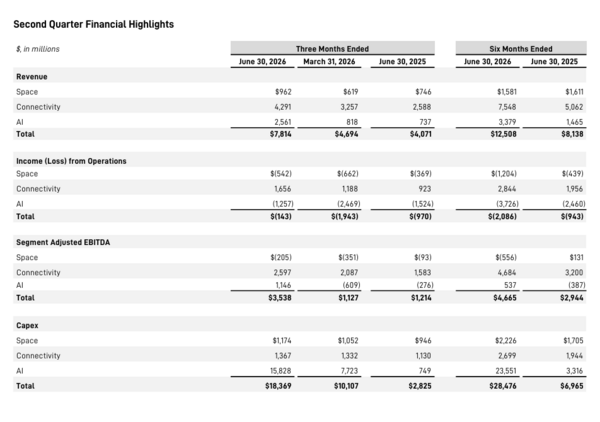
"Global AI labs planning to adopt Vera to transform their AI factories include Anthropic, OpenAI and SpaceXAI, and hyperscalers ByteDance, CoreWeave and Oracle Cloud Infrastructure."

Hmm. Where's Google Cloud, AWS and Microsoft Azure? The latter will come at Microsfot Build most likely.

All the hyperscalers will support Vera just like they do every other CPU, but the reality is they have their own custom silicon. Also worth noting that Nvidia compared Vera CPUs to x86 options. How does it compare to Arm-based options?

UiPath's first quarter featured its first ever net profit and revenue growth of 17%.

The company reported first quarter net income of $22.52 million, or 4 cents a share, on revenue of $418.4 million, up 17%. Non-GAAP earnings were 15 cents a share, a penny short of estimates. Revenue topped estimates.

The second quarter and fiscal 2027 revenue outlook was above estimates. UiPath is targeting fiscal 2027 revenue of $1.776 billion to $1.781 billion.

UiPath's earnings call takeways were:

  • A six month old FDE program is faring well.
  • UiPath cited multiple customer and use case examples.
  • Analysts were generally neutral to slightly skeptical and were concerned that ARR growth trailed revenue growth. Concerns revolved around AI revenue vs core robotics process automation.

CEO Daniel Dines said:

"Customers are no longer asking us simply to deploy more agents or generate more code. They are asking us to transform our entire business functions operate through end-to-end workflows that span departments, connect systems and deliver measurable operational outcomes. And delivering that kind of transformation requires more than individual AI agents. It requires a platform that can orchestrate agents, automation, APIs, systems and people together within secure, governed enterprise workflows."

Elastic reported a strong fourth quarter with non-GAAP earnings of 61 cents a share, a nickel a share above estimates, on revenue of $450.7 million, up 16%. The company said first quarter revenue will be between $469 million and $470 million with non-GAAP earnings of 57 cents a share to 59 cents a share.

The first quarter outlook was mixed relative to estimates. The fiscal year view is revenue of $1.98 billion and $2 billion, up 14.6% from a year ago. Non-GAAP earnings are expected to be between $3.21 a share and $3.29 a share, well above the $2.84 a share estimate.

CEO Ashutosh Kulkarni said:

"The broader AI cycle is actively driving our growth. Customers rely on us not only as a context platform for AI, but to modernize their operations with our AI-driven SOC and SRE for security and observability, respectively. Our customers using our AI solutions continue to grow. We now have over 600 customers with an ACV of over $100,000 or greater using our AI capabilities. This includes more than 40 serverless customers who were previously not captured in this count. Cumulatively, AI use cases have now penetrated more than 1/3 of our $100,000 ACV customer cohort. We see demand ranging from the largest global organizations to AI-native companies.

We believe the adoption of AI will be universal, spanning across organizations of every scale. This represents a fundamental market evolution that provides a consistent tailwind for our growth over the long term. The software stack is being rewritten. Large language models are emerging as the new operating system, and agentic automation is becoming the prerequisite for every mission-critical business process."

Will you pay to rid yourself of the AI slop on Meta? Maybe.

The company plans on selling subscriptions to its chatbot under a $7.99 per month plan called Meta One Plus, which will enable you to generate images and video and use extended reasoning. Meta One Plus will go for $19.99 a month with more functionality.

Meta is also testing subscriptions for WhatsApp, Instagram and Facebook with tiers focused on businesses as well as creators. Price points range from $2.99 to $49.99. The highest prices would go for Meta One Essential and Meta One Advanced.

Needless to say this subscription effort raised a lot of discussion among the tech chattering class, but the reality is Meta has to monetize that AI capex somehow. The big question is whether you'll bite.

Nutanix's third quarter results handily topped estimates. The company delivered fiscal third quarter earnings of $72.09 million, or 27 cents a share, on revenue of $703.07 million. Non-GAAP earnings of 47 cents a share topped estimates by 12 cents a share.

For the fourth quarter, Nutanix is projecting revenue of $725 million to $745 million, which was ahead of estimates. We'll follow this earnings report in the days ahead.