


CCE 2025: What the CxOs are saying about CX, AI, process
Agentic AI will alter processes, customer experience flows and enterprise structures.
Those are some of the conclusions from the buy side. Here are some of the takeaways from CxOs speaking at Constellation Research's Connected Enterprise 2025.
More from CCE 2025:
- So long, annual IT budget. Hello, 6 month IT budget
- Among CxOs, SaaS platform fatigue setting in
- Boomi, IBM point to AI agent orchestration inflection point
- Constellation Research’s sneak peek at 2026
- AI, CxO recruiting and boards: What matters now
Customer Experience
Ashley Hart, Chief Marketing Officer at Intellect, leads go-to-market strategy and brand transformation for the company's AI-powered Quality Management Systems platform. She said customer journeys have to be efficient but also include content so they can manage through adversity. Hart said:
"When I think about 2026 it's about being able to provide the right customer journey and then being able to bring them through that kind of funnel. How do I make sure that I'm getting the right content and right experience?
"Everything we've been in tech has been about becoming more efficient. Our big industry is manufacturing and everything is being impacted by tariffs. So if they're going to invest in this technology, then they have to be able to understand it well now."
Keri Dawson is the Global Head of Designit, an award-winning experience innovation company that helps organizations build competitive advantage and deliver positive change through strategy, design, marketing, and technology. Dawson said:
"Brands have an opportunity to pivot on human experience, customer experience, employee experience, product experience, service experience. If we start thinking through the lens of human experience we understand the interaction between the employee and the customer and the products and the service. We then drive towards a decomposition of that experience that becomes less technical and more humanistic. We talk about journeys, buyer personas and customer personas, but the reality is the persona is misleading because it also has to do with mindset. It has to do with context, it has to do with motivation, it has to do with emotion, and it has to do with empathy. Increasingly, customers want empathy in their experience."
Leadership
Ash Rangan, CEO of DoubleCheck Solutions, is a rare executive that has made the jump from CIO to CEO. He recapped the transition.
"Of all the transformations, there are two major transitions I think of. One is my own and going from being the guy who was managing technology to being the guy managing the business.
We can't manufacture time. So I keep pushing on people saying I need more, faster, better all the time. And that's new behavior for me. That transition is hard. The other transition is for my team. They are going through a cultural shift because the technology environment is transitioning so fast. It's like I'm constantly behind already, and that's pressure, not only to run the business, keep up as much as possible, and push the art of possible.
You may be good, you may actually be brilliant, but you have to keep up, and that's hard."
Organization and AI
Corregan Brown, Director of Engineering, CTS Restaurant Experience at Chick-fil-A, said:
"Organizational history is all about expanding the power of what you can do. If we look at it, we've been increasing these layers of abstraction with process, with more advanced technologies and so on. And I think that with AI agents, we're going to see the same thing. Agents are going to come in on the ground floor, and they're going to replace a lot of entry level tasks. But what is also going to happen is your first level humans are going to start to think more like managers.
A software engineer has to change a little bit with more managerial skill, more procedural thinking and abstraction, and a little bit more organizational psychology."
Manish Gupta, CIO and Managing Director at Nagarro, said:
"AI companies have abandoned legacy organizations. What we need now is the fusion of CIO, CMO, CTO, to drive this technology. Because the biggest problem right now is the innovation cycle. It's quicker than one cycle, so you can be really flexible, and gaps, you need people with that experience to understand the organization."
AI agents and process
Andrew Nebus, Senior Director, Defense Programs at ASRC Federal, said:
"We've always dealt with process improvements and technology in the instance. Now agents allow us to do more things that we can't scale easily. As that happens it forces us to really focus on the person, culture, and who we want to be in the room."
Kristina Chambers, Chief Data and Analytics Officer at TTX Company, said:
"We're fundamentally saying, replace the business process. Do we understand that process? What do you need to successfully achieve that process? It's also important to think about the maturity, the success or failure or accuracy of the existing environment. We all expect computers to be 100%. What's tolerable? If it's 95% you'll take the 5% hit because the speed of AI will be much faster.
I think one challenge most enterprises face right now is that as you're starting to incorporate a lot of these copilots in your daily work, and the context at different levels varies significantly, and that that increases or decreases the quality of the output that you're getting. I could put together a prompt and get a really nice summary of a large scale project that was completed over three years, and it will provide very accurate with thorough responses. Someone else in my team is not going to have access to the same level of information and so the context will be very different.“
Indy Cho, VP Analytics and Data Products at Costco, said:
"Understanding the demand at a localized level is an incredibly challenging task. Every time you shop that's a demand signal. We get that back to buyers, and we they go through a tremendous amount of analysis to figure out how much product needs to get to the right location.
The bar for a higher level of accuracy is absolutely necessary but that doesn't mean we don't stop experimenting."
Innovation and AI
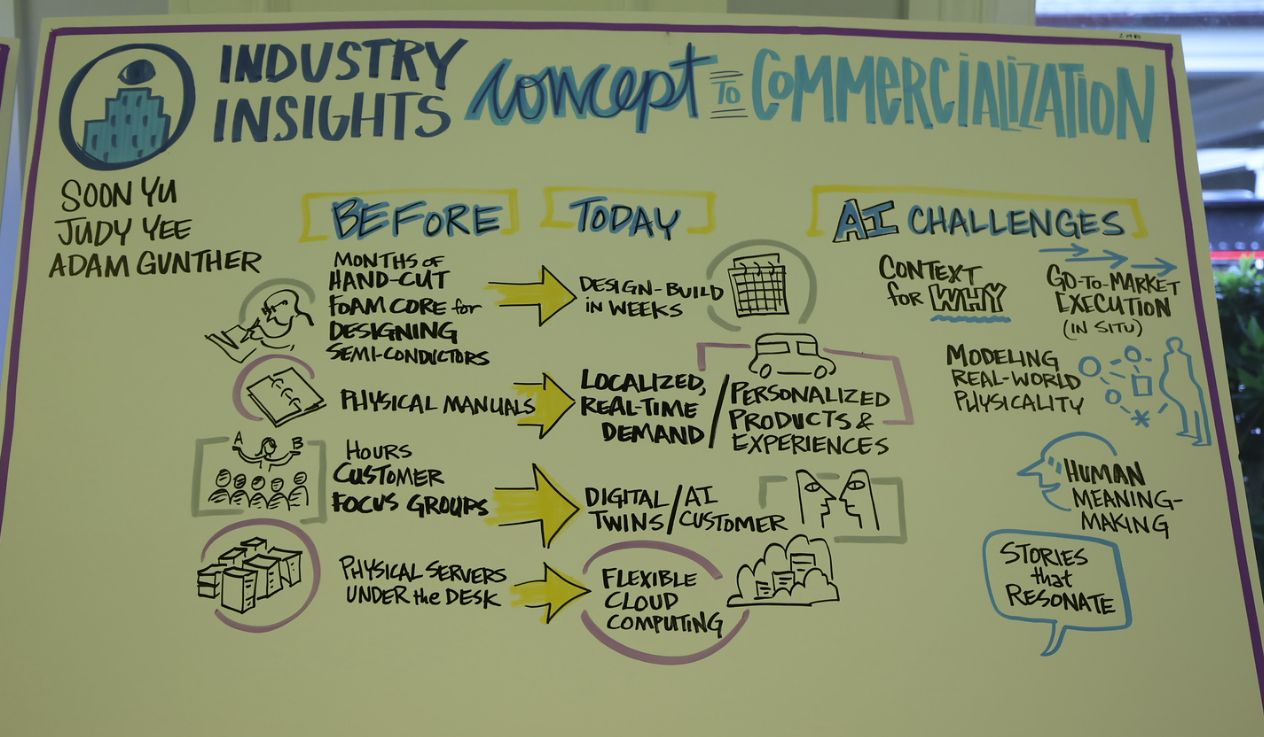
Judy Yee, Director of Marketing Innovation, at The Clorox Company, said AI is speeding up the innovation cycle.
"AI is a partner in our discovery journey. We're able to shave off two-thirds of the innovation cycle and get faster with better predictability and base decisions on more signals.
We can get a signal within minutes and shaves time. We're then able to ideate within the AI platform and come an idea and its articulation. An idea can become a concept that's developed and tested in real time with both live consumers and AI.
Right now we have a patchwork of tools, but we'll get to an entire enterprise platform where you go from trends to a prototype to flight on one system."
Larry Dignan is Editor in Chief of Constellation Insights at Constellation Research, where he leads editorial coverage focused on enterprise technology, digital transformation, and emerging trends shaping the future of business. He oversees research-driven news, analysis, interviews, and event coverage designed to help technology buyers and vendors navigate complex markets with clarity and context. ...
Read morePublished
Author
