


AI, CxO recruiting and boards: What matters now
AI is fundamentally changing executive recruiting, what boards of directors look for and creating a boom market for PhDs.
Here's a look at a few job market vignettes across two panels at Constellation Research's Connected Enterprise 2025.
"What are you doing in AI?"
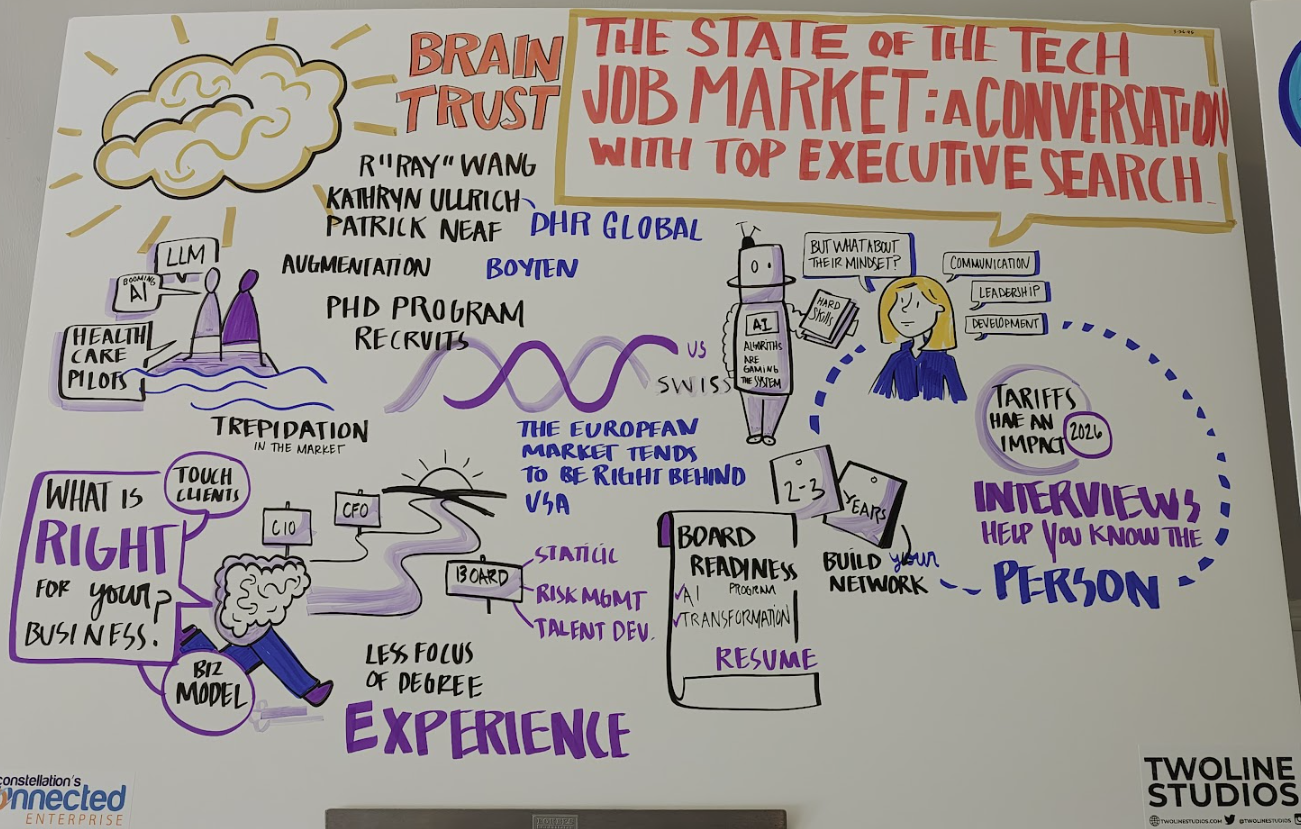
Kathryn Ullrich, Managing Partner - Technology, Private Equity and Diversity at DHR Global, has an executive recruiting firm that's been a bit busy due to AI and CIO job searches.
Ullrich said there are definitely good and bad answers when it comes to AI.
"I ask everybody what you are doing in AI because I can tell you what a good answer, what a great answer is and what you shouldn't do because you won't get the job," said Ullrich.
For starters, don't mansplain LLMs.
Ullrich said she interviewed a healthcare candidate and he said the AI project was deploying ambient listening. "That's just table stakes in healthcare and AI," she said.
Ullrich added:
"The better answer is, well, we looked at everything from when you come in and get admitted to when you're discharged, and the 25 different workflows and touch points that AI could affect. And here are the 12 different pilots we're doing, and we're looking at, should we add AI, augment our people, or will it cause a nuisance? And then go into that level of detail."
More from CCE 2025:
- So long, annual IT budget. Hello, 6 month IT budget
- Among CxOs, SaaS platform fatigue setting in
- Boomi, IBM point to AI agent orchestration inflection point
- Constellation Research’s sneak peak at 2026
What's an AI PhD worth?
Ullrich said people coming out of PhD programs in AI are getting $50 million packages in some cases.
Other executive job searches are tepid.
Patrick Naef, Managing Partner at Boyden Global Executive Search, agreed that PhDs are being snapped up in Europe. "There's a war for talent in AI," he said.
And if you're not a PhD?
Naef said he has been looking for executives with a set of projects in their portfolio. He said:
"I think we need to look at people who are open to learn, have curiosity and can understand quickly new technologies and how they can adopt the technology for their business. The people who will be successful in the future are ones that don't just move services but make a real impact in their business and explore new business opportunities and new business models."
His main takeaway is that enterprises need to look at experience and downgrade the degree.
How technology is changing CEO succession, boards
Naef said that most boards are lacking technology knowhow. Technology will define the future of the business and CIOs are increasingly in a better position to know the business than the CFO.
"You don't need a degree to be on a board. You need the experience. When you get to the board you have to shift your resume to the value you deliver to the board," said Ullrich. "It's strategic risk management and things like that instead of functional nature."
Ullrich added that there's no substitute for domain knowledge in a category like manufacturing, retail and other industries and technologies like cybersecurity and AI.
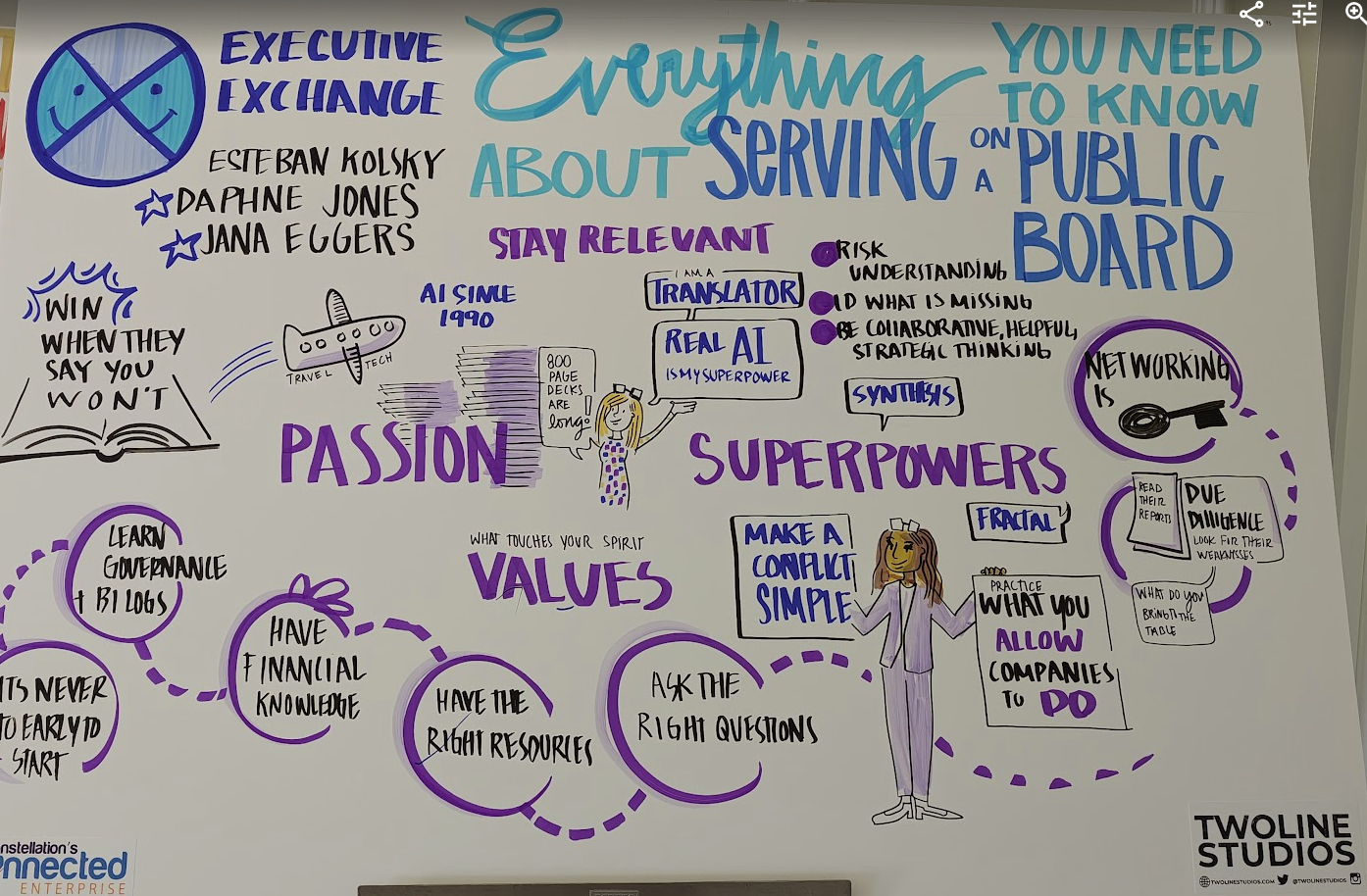
Daphne Jones, Founder and CEO, The Board Curators; Independent Director, AMN Healthcare, said boards need to realize that every company is a technology company. "Every company is a technology company or is digital," said Jones. "If they don't believe it they won't be in business very long."
Be a translator
Jana Eggers, CEO, Nara Logics, Non Executive Director at Amadeus, said she has landed a board role due to expertise in AI. However, Eggers said you have to translate AI into other domains.
"I've always said I'm a translator," said Eggers. "I understand technology and understand business. I was brought onto the board because of my AI expertise, but wouldn't have been able to get on that board if I didn't have a solid understanding of the financial side."
Jones said it's critical that technologists know how to speak business. "A lot of mistakes that technologists make is they talk about the things that they've done, that they've done cloud migration with serverless computing, but what if you're talking to a CEO of a retail company or CFO of healthcare company?" said Jones. "You want to be that person that talks about growth acceleration, efficiency, cost savings and revenue. Show you understand the flow of business, information, data, money, and all that stuff. Technology is just something that enables you."
AI and recruiting
Ullrich said job search experts are telling everyone to put their job specs and resume into ChatGPT to tailor you for that job.
"Guess what? If people are using those algorithms they'll get the answer absolutely correct, but are you getting that best candidates," said Ullrich. "A client posted for a high-level IT position and about 300 to 400 applications came in. We might have talked to two to five of those people. They were interesting but not the best fit. The AI can game the system."
Naef added that his firm uses AI to identify profiles, but there's more than just skill sets. Naef said:
"I feel that the mindset is at least as important as a skill set. AI will match a CV with a profile, but there's nothing I've seen that can judge whether the person fits within that management, has the right culture and clicks. With AI you're getting 10x the number of resumes you were before and they all sound great, but you need to do the interviews and hard work."
Ullrich also said that AI screening can surface competency and hard skills but soft skills land you the gig. "AI will over index on the hard skills, but you've got to interview for soft skills and cultural fit," she said.
Larry Dignan is Editor in Chief of Constellation Insights at Constellation Research, where he leads editorial coverage focused on enterprise technology, digital transformation, and emerging trends shaping the future of business. He oversees research-driven news, analysis, interviews, and event coverage designed to help technology buyers and vendors navigate complex markets with clarity and context. ...
Read morePublished
Author
