


Cognizant CEO Kumar: Agentic AI will create a reinforcing flywheel of ROI
Cognizant CEO Ravi Kumar said agentic AI use cases can create a self-funding flywheel for enterprises starting with the software development cycle and moving through other processes.
Speaking at the Goldman Sachs Communacopia + Technology Conference, Kumar laid out a framework for AI agents across multiple vectors. He added that Cognizant is seeing benefits now that 30% of its code is written by machines, up from 18% just a quarter ago.
"There is a unique opportunity to transfer that productivity and share the savings with our clients, especially at a time when interest rates are high, you have a unique opportunity to unlock discretionary," said Kumar, who noted machine-written code can lower the cost of deployment.
Cognizant reported strong second quarter earnings of $1.31 a share on revenue of $5.24 billion, up 8.1% from a year ago. For fiscal 2025, Cognizant is projecting revenue of $20.7 billion to $21.1 billion.
Kumar said these early agentic AI efforts are a multi-year trend that's just starting. "CIOs across the world are not seeing their budgets are going to be lower than before because of productivity. They're either keeping the budgets flat or they're actually increasing the budgets for the upcoming AI spend, which is happening. So what CIOs are doing is they're taking the savings, underwriting it for innovation, which is powered by agentic cycles," said Kumar.
Constellation Research CEO R "Ray" Wang argued in a research report that enterprises need to rethink old models in enable AI and shed tech debt. Wang also recently examined AI exponentials and their potential.
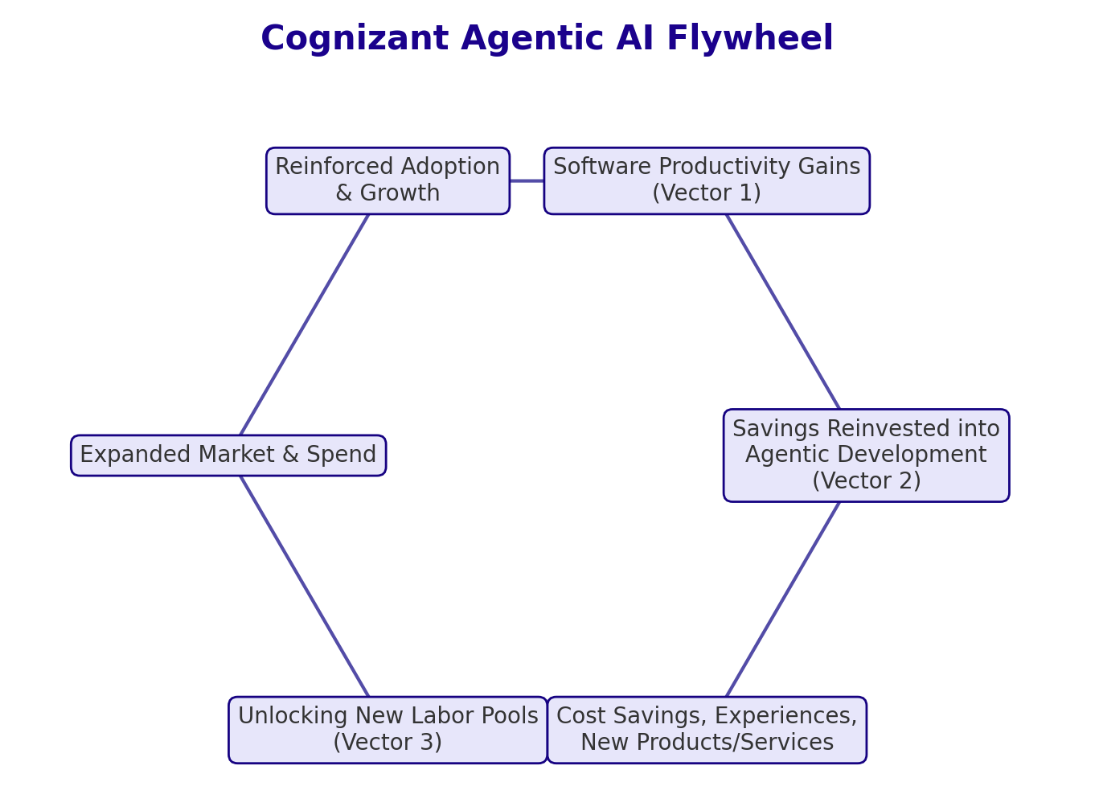
The Cognizant CEO broke down the agentic AI flywheel like this.
Vector 1: Software Development Productivity
- Apply AI to software cycles to increase productivity.
- Savings from this productivity are shared with clients or reinvested.
- These savings fund innovation projects powered by agentic AI.
Kumar noted that the first vector is really about consolidating platforms and eliminating tech debt (to some extent). Vector 1 isn't characterized by net new IT spending, but making existing spend more productive. "CIOs are saying give me savings to use for AI. If the macro changes that will accelerate the CapEx spend on agentic," said Kumar.
Vector 2: Migration to the Agentic layer
- Move business logic from traditional SaaS layers into an agentic layer (either SaaS-native or custom).
- Agents integrate with human capital + structured/unstructured data, creating larger surface areas of opportunity.
- Compared to software cycles, agentic cycles have a multiplier effect, since each employee may work with multiple agents.
- Development is outcome- and behavior-driven, iterative, and requires ongoing supervision, unlike traditional maintenance.
Kumar said:
"In agentic tech, you scope for outcomes, you design for behavior, you do iterative development because agents actually improve over time. They change their behavior. And then after you scale them, you supervise them. You don't just keep your lights on. And supervising is a much bigger task than maintaining software."
However, vector 2 will take time to develop. "There will be transition of deterministic logic sitting in SaaS layers into the agentic layer. There'll be new Agentic layers built. It could be on existing software stacks. It could be direct with frontier model companies like OpenAI and Anthropic, who also want to go direct to the enterprise, and they would use us to get there. That hockey stick is on the way," said Kumar.
- Pondering the future of enterprise software
- Lessons from early AI agent efforts so far
- Every vendor wants to be your AI agent orchestrator: Here's how you pick
Vector 3: Unlocking New Labor Pools
- Combining agentic capital and human capital can create new outsourcing cycles.
- Example: customer care was transformed into a 65–35 agentic-to-human model, after which a client asked Cognizant to run the entire function.
- This extends Cognizant's market beyond technology services into operations of enterprises, massively expanding the total addressable spend.
Kumar said:
"Agentic layer is going to be a multiplier to the software layer. So it's a much bigger growth opportunity. And then you're going to see unlock of new labor pools. And those labor pools are not related to technology. Those labor pools are related to operations of enterprises, and that total addressable spend is a much bigger spend than what we saw before."
Add it up and agentic AI becomes a self-reinforcing loop, according to Kumar.
- Software-led productivity gains (vector 1) generate cost savings.
- Those savings are reallocated into agentic development cycles (vector 2).
- Agentic cycles deliver further cost savings, better experiences, and eventually new products and services.
- This unlocks new labor pools and operational outsourcing opportunities (vector 3).
- Operations-led transformation expands Cognizant's addressable market (especially in BPO, now its fastest-growing service line).
- Expanded spend fuels more adoption and reinvestment in agentic cycles — creating a growth flywheel.
Larry Dignan is Editor in Chief of Constellation Insights at Constellation Research, where he leads editorial coverage focused on enterprise technology, digital transformation, and emerging trends shaping the future of business. He oversees research-driven news, analysis, interviews, and event coverage designed to help technology buyers and vendors navigate complex markets with clarity and context. ...
Read morePublished
Author
