


CrowdStrike: Data flywheel gives it moat vs AI agents, adds tailwind
CrowdStrike CEO George Kurtz was upbeat about the company's prospects and addressed questions about AI competition with a simple message: "We have a massive opportunity to protect AI agents."
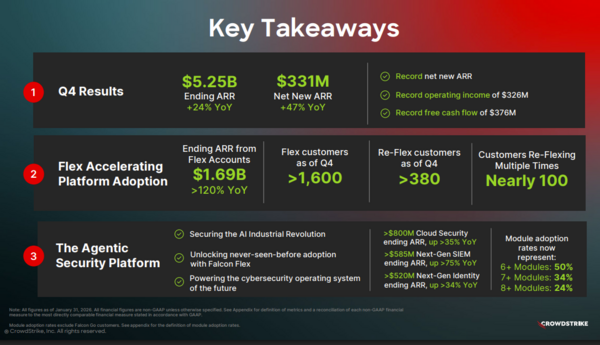
The security vendor reported fourth quarter earnings of $38.7 million, or 115 cents a share, on revenue of $1.31 billion, up 23% from a year ago. Non-GAAP earnings were $1.12 a share, two cents ahead of Wall Street estimates. For fiscal 2026, CrowdStrike reported a net loss of $162.5 million on revenue of $4.81 billion, up 22%.
CrowdStrike's outlook was also better than expected. CrowdStrike projected first quarter revenue of $1.36 billion, above estimates, with non-GAAP earnings of $1.06 a share to $1.07 a share. For fiscal 2027, CrowdStrike projected revenue of $5.87 billion to $5.93 billion compared to estimates of $5.86 billion. Non-GAAP earnings for fiscal 2027 will be between $4.78 a share to $4.90 a share.
In the quarter, CrowdStrike showed platform momentum with cloud security ARR up 35%, next-gen identity up 34% and next-gen SIEM up 75%.
Naturally, CrowdStrike's Kurtz was pelted with questions about competition from LLMs, AI natives as well as cloud hyperscalers. Kurtz's big argument is that CrowdStrike is valuable because it's a "vertically integrated net data creator."
"Novel discoveries are often interpreted as the death knells of existing categories. The market is questioning enterprise software's role in an agentic world," said Kurtz. "It's in moments like these where opportunity is created. In the same way that we anticipated the cloud revolution, we pioneered and built for the agentic revolution."
Kurtz said AI is creating software companies that are "existentially vulnerable" and a group that will thrive because they have deep IP and data. The argument is that CrowdStrike will thrive, said Kurtz, in a take that surprised no one.
"One, our competitive moat is becoming an opportunity ocean. Falcon is a vertically integrated net data creator and third-party data aggregator. We generate real-time data that no one else has from customer environments and our world-class threat intelligence. What frontier AI labs cannot do, we've been doing for over a decade," said Kurtz.
The feedback loop is that data improves, the platform improves and CrowdStrike's AI agents get better. It's all about the proprietary data.
The moat
Kurtz's argument is that AI will need security and it's not likely to come from LLM players. AI will evolve similar to the way the cloud did. Kurtz noted he's had to answer cloud questions before too.
"As cloud was maturing, I heard a lot about the hyperscalers actually providing all the security services," said Kurtz. "Well, that didn't happen. In fact, as you've seen with our results and our partnership with AWS, as an example, we transact billions through these platforms, and they're a great partner, and there's a lot more exposure in the cloud. So, we see the same thing happening what I call AI hyperscalers, being able to actually partner with these hyperscalers leveraging AI and their LLMs and also being able to leverage the technology to provide better outcomes within the platform of record for our customers, which is Falcon."
CrowdStrike will leverage its own small language models and curated data sets as well as LLMs. Kurtz said LLMs are "certainly good at a lot of things" and the security industry is leveraging them, but "what you have to remember is that what customers want is real-time prevention. You have to be in line. You have to be able to get the data in milliseconds, and you have to make a decision."
The argument is that AI agent adoption only means more security and that's a tailwind to CrowdStrike.
The big question is whether Wall Street will believe it.
Larry Dignan is Editor in Chief of Constellation Insights at Constellation Research, where he leads editorial coverage focused on enterprise technology, digital transformation, and emerging trends shaping the future of business. He oversees research-driven news, analysis, interviews, and event coverage designed to help technology buyers and vendors navigate complex markets with clarity and context. ...
Read morePublished
Author
