


Zoho Analyst Summit 2020: What the Full Tech Stack Really Means for Customer Relationships
It was another thought-provoking and insightful analyst summit with the Zoho team outside Austin last week. No, they haven’t got every feature and function perfectly formed, yes there are plenty of spots in the portfolio that still need work. Even so, as I’ve said elsewhere, Zoho’s leadership has the audacity to dream big, the skills to focus that vision, and the tenacity to see it realized.
That combination of ambition, strategy, and ability to execute came through particularly clearly in Raju Vegesna’s overview of Zoho’s product strategy. In order for Zoho to be “the operating system for business,” the company must, he explained, own the full technology stack, from data center and networks through data, platform, and applications. In Zoho’s view, only by owning and managing the full tech stack can the company deliver a seamless, superior customer experience.
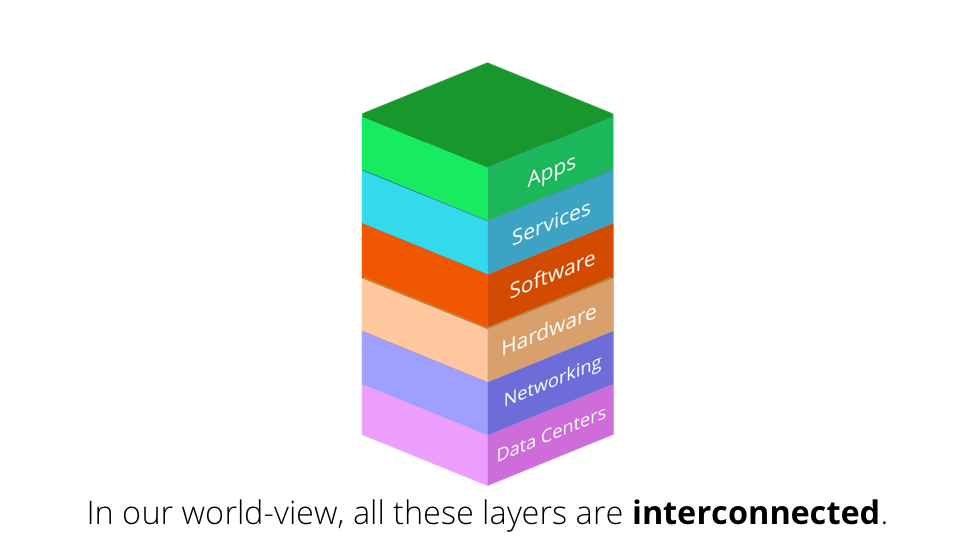
Source: Zoho Analyst Day, 2020
Note that in this context, “customer experience” refers to Zoho’s customers. In effect, this is really the Zoho “user experience”—and for the sake of clarity, that’s how I’ll refer to it from here on out. Because there’s an important connection between how Zoho is building a superior experience for its customers (UX) and how that enables those customers to do the same for their customers (CX).
This is Raju’s point: Purpose-built systems are always more efficient and effective. No matter how “cheap” and accessible things like generic compute capacity and storage have become, they will never beat the performance of systems designed for a particular use. That’s equally true for data center and network design, hardware and software interfaces, even software platforms, applications, and (my addition) business processes. For Zoho to realize the objective of being the operating system for business, all of these layers must be considered and designed together as part of a holistic system. Importantly, this includes things like a unified data model, databases, microservices, and a development platform.
Here is mine: If you want to grow a business through durable customer relationships built on great customer experiences, purpose-built systems are essential. In order to operate an entire business that is centered around customers, your applications and systems must be designed specifically to support a shared, consistent understanding of customers. Every employee in the organization can make the best decisions and take the right action to support customers when they have the information and insights they need. Where applications are easy and intuitive to use (UX), adoption isn’t an issue. Individual employees benefit directly from using these applications because they help them do their jobs better (CX). Merely using such tools validates and updates the data they contain. This is how systems become self-reinforcing and self-sustaining—essential to delivering consistently great customer experiences over time.
What’s so compelling about Zoho’s “full stack” approach to building business applications is that for customers (users), it just works. Zoho has tackled the challenge of creating a unified data model, along with a custom database, that feeds all of its applications. This solves the biggest problems that most companies face when either creating a unified view of their customers or integrating additional applications. Crack this nut and everything else becomes relatively easy.
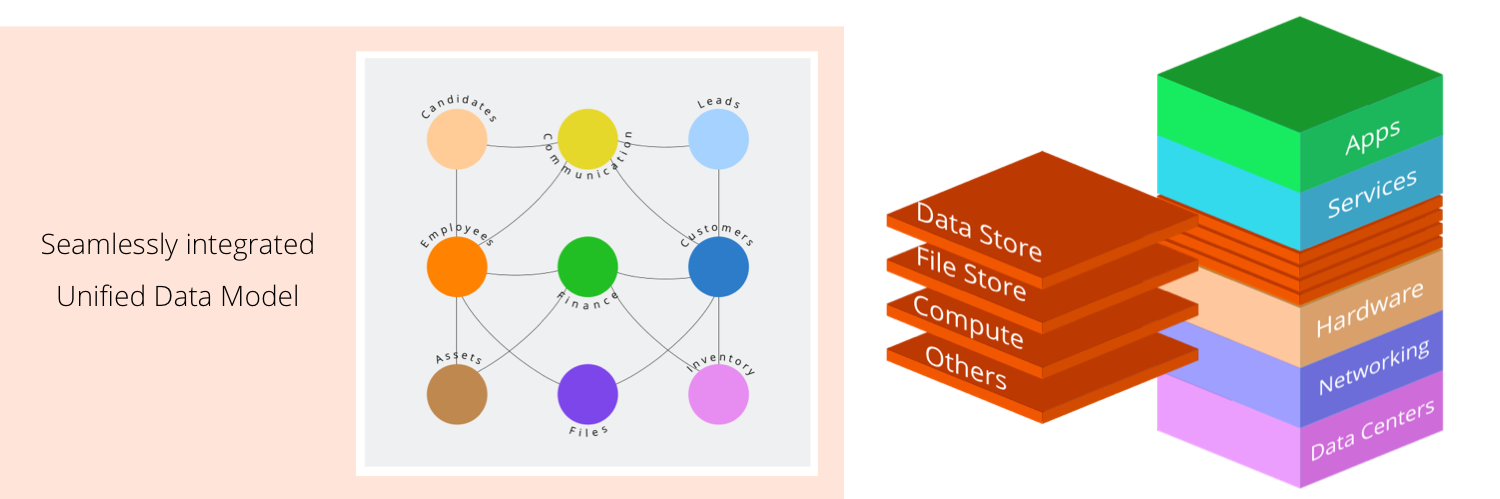
Source: Zoho Analyst Summit, 2020
The common data model issue alone makes Zoho a strong contender for any company that wants to change the way it operates in order to be truly customer centric. The range and depth of Zoho’s application portfolio, as well as the ease of integration with other applications outside of Zoho, increases the value considerably. Catalyst, Zoho’s recently announced serverless development environment, should add another multiple as well. Both independent developers and Zoho customers now have the means to develop their own microservices and apps, for themselves and for the wider community of Zoho users.
There are some drawbacks of course. Zoho’s comfort zone is still small and medium-size businesses. The company has the scale to support larger companies, but it is in the early days of developing the support infrastructure for these customers. The challenges here are less about the technology implementation and much more about issues of internal coordination, managing politics, and change management—on a much larger scale.
Creating a whole technology stack also limits some of the benefits of broader development communities as well. There will undoubtedly be developers attracted to the opportunities within the Zoho customer base, but those opportunities today are nowhere near the size and scale of other ecosystems.
Here’s the bottom line: Zoho’s leaders understand what’s required to operate a business in the experience economy and they design their offerings to deliver it. It won’t be the right fit for every business, but for those it does, Zoho offers the potential to redefine best practices in business operations—and what it means to be customer-centric—well into the future. The direction Zoho’s taking will undoubtedly influence many others in the enterprise application market as well. I’d say that’s a pretty compelling proposition.