AI Doesn't Just Need More Data. It Needs Business Context.
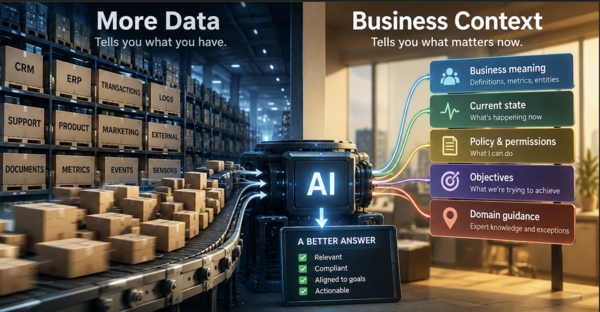
Why Semantic and Context Management Is Becoming Its Own Category
Most executives probably could not give you a clean definition of enterprise context.
But they know when it is missing.
A sales leader sees pipeline down 12%. That number alone is not enough to act. The next questions come quickly:
Which accounts matter? Which deals are really at risk? What does qualified pipeline mean here? Are there open service issues? What discounts are allowed? Who has to approve the next move?
A good operator fills in those gaps almost automatically. Experience, process knowledge, business priorities, policy, company norms, and judgment all get applied to the number.
While AI is getting better at inferring some of that context, AI doesn't infer answers cheaply, consistently, or accurately enough for enterprises to move many POCs to production.
That gap is one reason Constellation Research created a separate Semantic & Context Management ShortList.
AI changes the job of the data stack
For years, enterprise data management centered on three questions::
- What data do we have?
- Can we trust it?
- What does it mean?
Catalogs, metadata management, governance, quality tools, and business glossaries were built around those problems. Those problems have not gone away. Most enterprises are still working through discovery, ownership, lineage, governance, and semantic consistency.
What is changing is the consumer. Historically, people interpreted the information and supplied missing context themselves. Now AI is moving further into the work:
Search → summarize → recommend → route → approve → act
A dashboard can stop at insight. A copilot can stop at a recommendation. Once a system participates in execution, trusted data is no longer enough.
It also needs business meaning, current state, policy, decision rights, constraints, and a clear understanding of what actions are allowed.
That changes the job of the infrastructure underneath AI.
Why a separate ShortList?
Catalogs are not going away. As architects have quickly discovered, catalogs and context technologies are not even cleanly separable.
The distinction is the job catalogs and context were optimized for.
- Metadata/catalog semantics: help find and consistently interpret governed data.
- Semantic/context semantics: provide shared business meaning that applications and AI can use as part of a decision.
That difference shows up in the ShortList criteria. Beyond definitions, metrics, entities, and lineage, the new category extends into AI grounding, policy-aware context, explainability, machine consumption, interoperability, feedback signals, and early forms of context delivery.
A simple way to see the progression:
- Catalogs and metadata: What data exists, and can I trust it?
- Semantics: What does this data mean?
- Context: What matters here and now, and under which constraints?
- Decision infrastructure: What should happen next?
The category boundary is moving because the job-to-be-done is moving.
The metric of success moves downstream
The category shift matters because the rise of AI-enabled decisioning has changed how enterprises should measure value.
Traditional data-management metrics still matter:
- Time To Find Data
- Governance Coverage
- Lineage Coverage
- Data Quality
- Administrative Productivity
But once semantics and context support operational decisions, traditional measures are no longer enough.
The KPI starts moving toward the decision itself.
- How long does it take to get from a signal to action?
- Are similar decisions handled consistently?
- How many people and handoffs are still involved?
- What does it cost to make the decision?
- How many decisions can safely move from recommendation into execution?
The new metrics focus on decision velocity. The goal is no longer just a more efficient data team. It is faster, more consistent decisions with the right controls.
Context should ultimately be judged by whether it helps important decisions happen faster, with less variance, fewer unnecessary handoffs, and the right controls.
That is a different economic objective than building a better catalog.
The next scaling problem is reuse
Most jobs-to-be-done are not one giant decision. They are a series of smaller ones.
Those decisions may be:
- Deterministic, where a rule is enough
- Probabilistic, where a model scores risk, relevance, or likelihood
- Reasoning-based, where a system diagnoses, plans, or weighs options
Sometimes mixed in, but should be separate, is the question of who has authority: a person, a machine, or some combination of both.
As organizations mature, they can automate more repeatable parts of those decisions, and then begin to collapse sets of decision trees. Take customer retention as an example:
Classify churn risk → recommend treatment → check eligibility/guardrails → act within bounds
Over time, those 4 branches can run automatically, collapsing the customer retention decision tree. Meanwhile, people focus on exceptions and judgment calls.
But each of those decisions needs context to guide decision-making. That includes some combination of:
- Semantics: what does something mean, how do the concepts relate
- Current State: what matters right now
- Policy and permissions: what may the system do, who has decision rights
Today, developers often rebuild that context inside each prompt, agent, retrieval pipeline, and custom integration. That works for a few projects. It does not scale.
“The context problem becomes a reuse problem.”
Business meaning and governed context need to become reusable across decisions, models, and applications rather than being rebuilt inside each one. If every agent develops its own interpretation of how the business works, decision automation will remain inconsistent, expensive to manage, and difficult to trust and scale.
Documented context shifts to served context
Over the last few years, enterprises have adopted better ways to retrieve information for AI, including vector search and RAG, hybrid retrieval, and GraphRAG. Those approaches help systems find relevant information. But finding information is not the same as knowing what applies to a decision.
Let’s consider a simple approval policy:
- Orders above $100,000 require finance approval
- Restricted customers require compliance review
- Margins below 15% require approval
While useful documentation, an automated approval needs the current decision context:
- This order is $125,000
- This customer is in a restricted segment
- Projected margin is 12%
- These approvals apply
- The system may prepare the approval packet but may not release the order
Retrieval can find the rule. Served context assembles the rules, facts, state, and constraints that apply to this decision now.
That is the move from context documentation to decision-time assembly and serving.
How much infrastructure you need depends on how much authority you plan to delegate (see Figure 1).
|
Need |
Infrastructure Focus |
| Aligned metrics and entities | Semantics |
| Trusted data for users | Discovery, ownership, lineage, quality |
| Aligned metrics and entities | Semantics |
|
Consistent co-pilots |
Machine-consumable definitions, relationships, policy, provenance |
|
AI recommendations and routing |
Current state, norms/standard approaches, decision-specific constraints |
|
AI approval or action |
Runtime policy, escalation, decision rights, accountability |
“Build context in proportion to the decision authority you intend to delegate.”
Why the market looks so messy
Market attention has moved quickly. Google Trends (see Figure 1) shows a ramp of search interest around semantics and context management over the last 12 months, even as metadata and catalog management remain active topics.
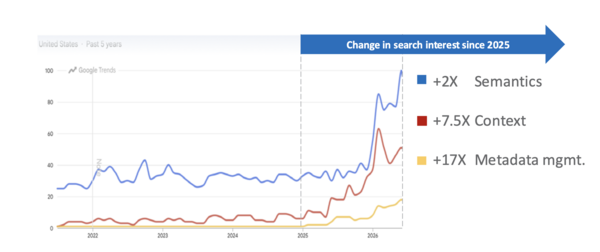
Figure 1: Google Trends, 2026 shows a ramp of interest in Semantics and Context Management.
Market attention on semantics and context comes from several directions creating “messiness” in understanding the market need..
- Data and AI platforms start closest to data, analytics, semantic models, compute, and AI execution. Their move is to embed semantics, governance, and context into the data and AI platform and serve that context directly to models and agents.
- Process, orchestration, and application platforms start closest to execution, with workflow state, business objects, rules, and operational context. Their natural move is to orchestrate more of the decision loop and assemble the context needed to recommend, route, approve, act, and learn.
- Data intelligence and catalog platforms start with metadata, lineage, governance, and discovery. Their focus is to extend cross-system visibility into machine-readable, governed knowledge.
- Semantic and knowledge-oriented platforms start with business meaning, metrics, entities, relationships, ontologies, and knowledge models that cut across systems. Their move is to make meaning machine-consumable and usable at runtime.
Different architectural choices involve trade-offs, but all must address the underlying problem: context will remain distributed across CRM, ERP, workflow systems, semantic layers, data platforms, agent memory, and policy systems.
That is why the answer to fragmented context will not be another central silo. The answer will focus on a more federated approach that preserves domain authority, then assembles the right context when a decision needs it.
One consideration data and leaders need to consider is lock-in. Vendors decreasingly try to control where your data lives, but are pushing to define and own where your operating logic is managed. Initial projects can typically move faster by using embedded capabilities from one application stack, decisioning layer, or agentic platform. The cost shows up later when models, workflows, or execution platforms change.
What matters in a semantic and context platform
With the accelerating use of AI-driven automation and Agentic AI solutions, enterprise buyers need semantic and context platforms that both keep business meaning and enterprise knowledge current and put context to work.
The Constellation Research ShortList details needed capabilities and threshold criteria, but as a buyer, I would ask six questions:
- Can it define how the business works?
Metrics, entities, relationships, definitions, and business rules. - Can it keep that understanding current?
As systems, schemas, policies, and relationships change, can the platform detect those changes and reduce the amount of manual stewardship required? - Can applications and AI actually use it?
Not just retrieve better documentation, but make business meaning usable by analytics, copilots, agents, and decision workflows. - Can it keep that context governed?
Lineage, quality, permissions, policy, and explainability matter even more with AI. - Can it get context to where work happens?
That means Business Intelligence, natural-language analytics, applications, agents, and decision automation. - Can it work across systems without creating another silo?
Context will remain distributed. Buyers should look for strong APIs, semantic interfaces, metadata exchange, and portability.
Even though the marketing around semantics and platforms is loud, the market for semantic and context management is still early.
Most enterprises are still working through data discovery, governance, lineage, semantic consistency, and trusted analytics initiatives. Newer initiatives like “ask my data” and early agentic applications are exposing gaps in those foundations, sparking a renewed wave of investment in semantics and context.
This creates a practical problem for data and AI leaders. Solving each new AI use case with custom semantics, custom retrieval, and custom policy logic creates a backlog of data debt and rework. At the same time, adopting one vendor’s context model creates potential lock-in.
Constellation Research sees leading data and AI leaders making low-regret choices around definitions, relationships, policies, interfaces, and spending more resources on portability now while waiting for the market for semantic and context management to stabilize.
Actian: example of where the market is heading
Data Intelligence platforms like Actian illustrate the evolution from semantics and knowledge to context management. Data Intelligence platforms often add depth in ontologies, entities, relationships, and business meaning, providing broad visibility across the enterprise data estate, governance, lineage, and the machinery to keep that information current.
First, context has to work across systems. Actian supports a federated approach. Its platform connects metadata, lineage, business definitions, quality signals, policies, and relationships across distributed systems without requiring the underlying data to move, leveraging its support for more than 100 native data sources, automated metadata discovery, and cross-platform lineage.
Second, the platform has to represent meaning, not just inventory data assets. Actian combines semantic modeling with knowledge graph capabilities that make entities, relationships, dependencies and business definitions more explicit (see Figure 1 below). That helps move from “find the data” toward representing how customers, metrics, policies, and other business concepts relate to one another.
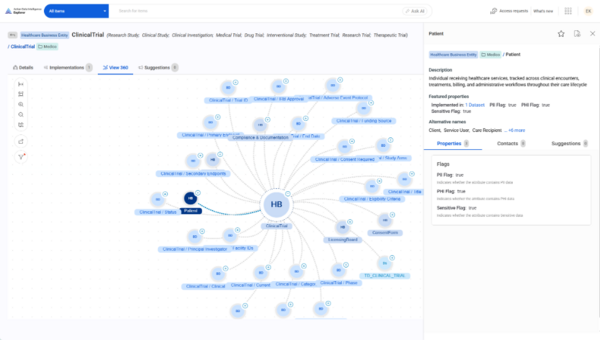
Figure 2: example Actian knowledge graph providing the basis for AI reasoning.
Third, context has to become active and activated. The need is to simplify managing an increasingly complex set of enterprise semantics and context, and to leverage that context in applications, AI decisioning, and agentic AI solutions.
Actian supports simplified data management with automated metadata discovery and enrichment, ownership recommendations, governance workflows, data and quality monitoring and remediation, sensitive-data classification, and knowledge graph updates. That shifts people from building and maintaining semantics and context manually, toward reviewing and correcting what the system discovers.
But keeping context current is only half the problem. Context must be consumable at the point of use. Actian supports machine-readable data contracts, APIs, MCP, and agent interfaces that can expose governed metadata and context to analytics tools, applications, and AI systems.
Federate the context. Make the meaning explicit. Automate its maintenance. Then make it consumable where decisions happen.
The question for data and AI leaders
Catalogs and Metadata Management solved an important problem. They helped enterprises inventory, govern, and trust data.
AI introduces the next problem: making business meaning and context reusable across many small decisions, whether rules, models, agents, or people make those decisions.
So the question driving this new category is also the question data and AI leaders should be asking:
Are your metadata investments simply documenting how the business works, or are they becoming reusable operating context that can help the business decide and act?
Michael Ni is Vice President and Principal Analyst at Constellation Research, covering the evolving Data-to-Decisions landscape—where CDOs, CIOs, and CPOs must modernize data infrastructure, integrate AI into decision-making, and scale automation to improve business outcomes. Ni’s research examines how enterprises operationalize AI, automate decision-making, and integrate data management and analytics into core business processes. He focuses on the challenges of scaling AI-driven decision systems, aligning data strategy with business goals, and the growing role of data and decisioning “products” in enterprise ecosystems. With 25+ years as a product and GTM executive across enterprise software, AI platforms, and analytics-driven technologies, Ni brings a practitioner’s perspective to…...
Read morePublished
Author