


Qlik aims to gauge trust of the data underneath agentic AI
Qlik is looking to give the data used by AI agents a trust score to make agentic systems more reliable.
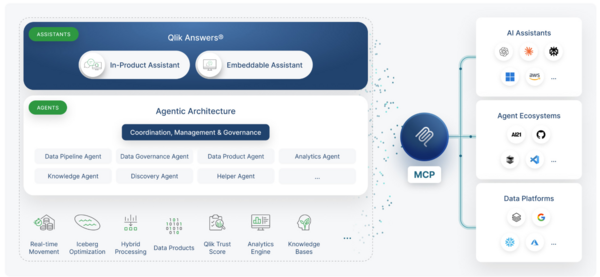
The company announced a series of news items as it aims to tie its data and analytics platform to agentic AI. Qlik said it has added new capabilities to Qlik Analytics so teams can create, manage and evaluate the datasets humans and AI use for decisions.
Qlik, which kicked off its Qlik Connect 2026 conference, will measure trust via a Trust Score, which looks at contracts, service levels, alerting and anomalies to aggregate signals and determine whether a data product is ready to be used.
According to Qlik, agentic AI ups the pressure on the data underneath AI workflows. Weak data typically means weak execution, said Qlik CEO Mike Capone. "Data products need the same accountability as any other production asset, with clear signals for what humans and AI can safely rely on. That is how enterprises scale AI without scaling risk," said Capone.
Qlik added the following to Qlik Analytics:
- Data Products in Qlik Analytics to create AI-ready units for workflows.
- Data Product Agent, which helps create data products in natural language and generate Trust Scores.
- Trust Scores, which evaluate data products based on accuracy, timeliness, diversity and completeness.
- Data contracts and operating expectations, a contract layer that sets expectations and standards.
- Service levels, alerting and anomaly detection.
- Data Quality Agent for workflows.
Qlik also announced the following:
- Agentic AI tools for data engineering execution. Data engineers will be able to use natural language to develop and evolve data pipelines. In addition, Qlik's Talend Studio gets an AI assistant for developers and real-time routing of data flows.
- The general availability of Open Lakehouse Streaming.
- Qlik Answers now includes structured and unstructured content together in one experience.
- Analytics Agent moves data engineers and teams through workflows more efficiently.
- Automate Agent, which enables teams to move from analysis to execution via natural language workflows.
- Predict Agent, which will make predictions based on machine learning models.
- Model Context Server to enable third-party AI agents to use Qlik analytics.
Constellation Research's point of view
Constellation Research's Mike Ni said:
"Together, these announcements are significant for Qlik users because they move Qlik closer to a governed data-to-decision platform, extending analytics to action, and not stopping at AI answer generation. The real story is not another AI assistant. It is Qlik connecting trusted data products, analytics, data engineering, and action so customers can operationalize AI with more control and less assembly work.
Qlik is not winning the AI arms race on size or being first, but it may win more than its share of enterprise battles because it understands the real problem: AI doesn’t fail in the demo, it fails in production. Qlik’s edge is bringing its recent acquisitions and new capabilities to deliver trusted data, governed context, and open paths to action.
To take on the next phase of the market, Qlik has to build out capabilities to support the decision itself. Not the data, not the dashboard, but the decision. That means building systems that don’t just recommend actions, but execute, learn, and optimize outcomes over time."
Larry Dignan is Editor in Chief of Constellation Insights at Constellation Research, where he leads editorial coverage focused on enterprise technology, digital transformation, and emerging trends shaping the future of business. He oversees research-driven news, analysis, interviews, and event coverage designed to help technology buyers and vendors navigate complex markets with clarity and context. ...
Read morePublished
Author
