


Nvidia's Vera CPU, DGX Station, Windows PCs all go to the same place: AI agents running locally
Nvidia CEO Jensen Huang's keynote at Computex featured Nvidia RTX Spark, DGX Station for Windows, a parade of PCs, the debut of the Vera CPU, a processor that could spread Nvidia's reach further.
After years of hearing GPUs are everything, the idea that Nvidia is so CPU-happy is quite ironic. Nevertheless, Huang is sprinkling some agentic AI pixie dust on Microsoft Windows.
Huang rolled out the usual barrage of news including his often repeated riff on tokens turning into revenue. Yet, Nvidia's PC-happy news day reveals what has become obvious for companies and developers trying to scale AI agents--you'll need to optimize your agentic AI on-premises or you will kill your budget.
Nvidia's CEO noted that the Vera-powered CPU overhaul for Windows amounts to "the first across-the-lineup PC reinvention in 40 years," highlighted a desktop that's a "personal agent box," and said Nvidia DGX Station for Windows is a "deskside AP supercomputer."
Over time, the PC will mean "there's actually an AI supercomputer in your house" that's "a lot more like R2D2 and C-3PO to you than it feels like a PC," said Huang.
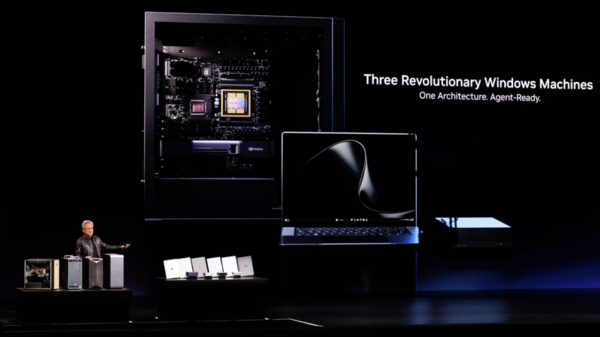
"This is the beginning of the journey," said Huang, who added that every generation of Nvidia architecture will include a desktop, laptop and workstation.
From a CxO perspective, this lineup of systems may equate to a distributed on-premises buildout. At least Nvidia is getting ahead of the AI inference cost backlash.
- BT150 zeitgeist: In search of AI agent ROI
- CIOs see AI agents as journey, token budgets a concern, says Box CEO Levie
- AI inference costs are going to be a big concern: What's the fix?
- AI Forum 2026: There isn’t an easy button for AI
- Constellation Research's Futures Forum: What CEOs are thinking
- Where’s tokenomics for the rest of us?
Who knew that all these AI factories would now need a massive PC refresh just to make tokenomics work?
Here's a look at what Nvidia announced at Computex.
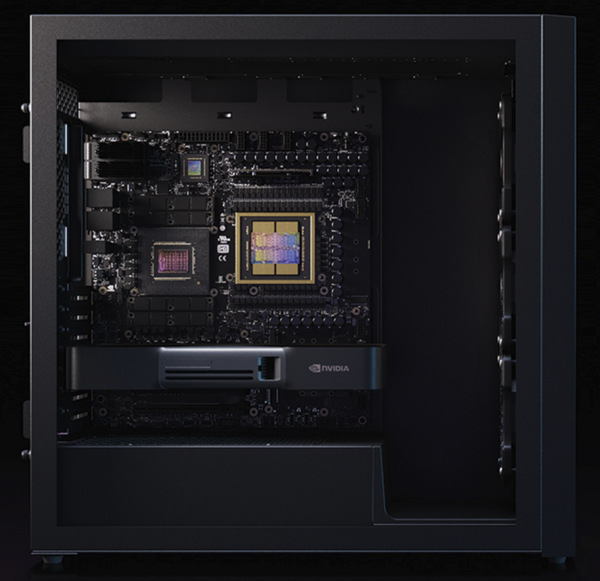
Nvidia announced DGX Station for Windows
The system pulls Windows into the agentic AI era for developers. DGX Station for Windows is built on the Nvidia GB300 Grace Blackwell Ultra Desktop Superchip, coming in the fourth quarter this year.
Enterprises can use DGX Station to build AI agents without the cloud costs. DGX Station will support Nvidia OpenShell on Windows. The system is capable of running frontier AI models of up to 1 trillion parameters locally.
For Microsoft, Nvidia's help is a big deal. Nvidia noted:
"Historically, heavy-duty enterprise AI workloads — training, fine-tuning, large-scale inference and multi-agent development — have required powerful AI systems in the data center that run on Linux, while the vast majority of Fortune 500 companies use Windows for everyday productivity, creative, design and engineering applications."
Nvidia's DGX Station may bring Windows developers and more enterprises to the AI agent party.
Simply put, Microsoft needs Nvidia's help to make Windows an AI agent platform.
Vera CPU
Nvidia isn't going to cede the CPUs to the usual suspects including Intel, AMD and lately Qualcomm, which has a head start on Windows systems powered by Arm processors.
Huang touted Vera CPUs to power AI agents on the desktop, but perhaps the biggest play is to ensure that Nvidia has a full stack in data centers. After all, enterprises are using a lot of CPUs for AI inference and the biggest threat is custom silicon from hyperscalers. Think Google TPUs and AWS Graviton.
Vera will power Nvidia standalone servers, Nvidia Vera Rubin systems, which are now in full production and AI storage platforms. Nvidia was sure to mention that Vera is being added to AI factories for Anthropic, OpenAI and SpaceX and by ByteDance, CoreWeave and Oracle Cloud Infrastructure.
Dell Technologies, HPE, Lenovo and a bevy of others will also build Vera CPU systems.
Nvidia said Vera is 1.8x faster than x86 alternatives. What wasn't compared was how Vera compares to Arm processors in AI factories.
Nvidia RTX Spark
Nvidia announced RTX Spark, a 1-petaflop superchip that supports the Nvidia AI stack in a thin laptop.
The system is designed to deliver a Windows experience that'll appeal to AI developers, creators and gamers. That latter audience covers Nvidia's flank since it has been focused on AI infrastructure.
ASUS, Dell, HP, Lenovo, Microsoft Surface and MSI will be out first with PCs based on RTX Spark with models from Acer and Gigabyte to follow.
Huang said these Windows laptops and desktops are designed to be "purpose-built for personal agents" and give developers compact systems for OpenClaw and Hermes Agent. RTX Spark will include Nvidia OpenShell and Windows security primitives.
Key items:
- The systems are expected to be 14 millimeters and as light as 3 pounds.
- RTX Spark laptops will be in 14-inch and 16-inch versions.
- Microsoft will plug the RTX Spark systems and outline the Windows angle at Microsoft Build.
The local AI agent push
Huang touted the ability to build personal agents locally and open-weight models were mentioned repeatedly.
The big idea from Nvidia is that its infrastructure can roll from AI factory to the desktop. Agents will interact with applications, generate content and automate processes locally.
This approach will also ease AI inference costs.
Ultimately, this Nvidia CPU and local system is going to extend to robotics and other form factors. Nvidia announced Cosmos 3, a new physical AI foundation model that features native vision reasoning.
Nvidia has championed open models. Cosmos 3 is supported by Agile Robots, Black Forest Labs, Generalist, LTX, Runway and Skild AI. Cosmos 3 includes three versions:
- Cosmos 3 Super for post-training robotics and AV models
- Cosmos 3 Nano for fast reasoning.
- Cosmos 3 Edge for real-time inference.
Nvidia also outlined Alphamayo 2 for robotaxis and an open Nvidia-Groot humanoid robot reference design.
Larry Dignan is Editor in Chief of Constellation Insights at Constellation Research, where he leads editorial coverage focused on enterprise technology, digital transformation, and emerging trends shaping the future of business. He oversees research-driven news, analysis, interviews, and event coverage designed to help technology buyers and vendors navigate complex markets with clarity and context. ...
Read morePublished
Author
