


OpenAI's Altman on fully AI companies, open source, infrastructure
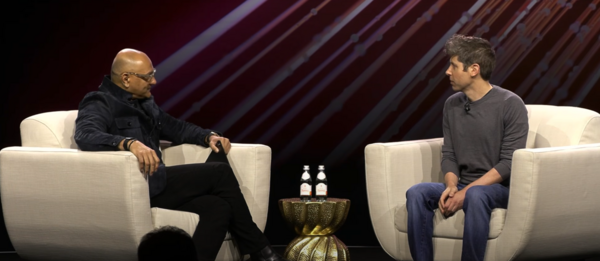
OpenAI CEO Sam Altman said there will be fully AI companies that will emerge where software can interact with the rest of the world and create services.
This vision, along with a bevy of other ideas, was outlined at Cisco's AI Summit in San Francisco. Altman was a headliner along with other AI-adjacent CEOs.
In an interview with Cisco's Jeetu Patel, President and Chief Product Officer, Altman said he often thinks through how OpenAI can be fully AI. "I think we'll see full AI companies," said Altman. "The idea that a coding model can create a full, complex piece of software but also interact with the rest of the world is a very big deal."
Getting to a fully AI company will require some rethinking of enterprises. He noted that when he first installed OpenAI's Codex his plan was never to give it full control of his computer. "That lasted two hours because it was too useful," said Altman.
What's holding this vision back? Altman said security and data access will need to be weighed against the utility of the models. "I don't think anyone has a great answer to this yet. It feels to me like there is a new kind of security or data access paradigm that needs to be invented for this. Another is, how are we going to rewrite all software to be equally usable by humans and AIs. There's like, a bunch of weird quirks right now," said Altman.
He said it's unclear whether software architecture needs to change completely where you'll optimize more for agents than humans.
For instance, Altman said he'd love his AI agent to use Slack on his behalf, but it typically uses the web interface and read threads but often breaks his workflow. Altman acknowledged that example is a bit silly, but said there needs to be an effort to rewrite software to be equally usable by humans and AI.
"I think the companies that are not set up to be able to adopt, let's call them AI coworkers, very quickly will be at a huge disadvantage," said Altman.
Here's a look at Altman on other topics.
Infrastructure: "We are planning for a world where AI usage grows at an accelerated pace each year. Now people are underestimating the capacity that's going to be needed. I think it's also possible that along the way, we have some supply gluts temporarily, but over a period of decades it seems certain to me that the world is going to need a lot more tokens," said Altman. "There will be drive for more and more. The world has come to realize this and capitalism is doing its thing."
Altman added that AI demand will be like energy.
Open source: Altman said, "I think we should do more." When asked why OpenAI hasn't created open source models, he said it was a function of focus and time, but that needs to change. "I think we need to solve that somehow," said Altman.
"I think it's most important that we lead on frontier models, and I expect those to be accessed via APIs and other products. So it would be okay, but not great if we didn't also have the open source lead. People want their own models. People want control of their own models. People want to run models locally, especially if you think about a world where you have a model that is going to see your whole life," said Altman.
OpenAI's business model: Altman said subscriptions and advertising are obvious revenue wins, but he noted that there are new models that can observe.
Altman added:
"Businesses increasingly want something like an AI cloud subscription where they're like, I want to partner with an AI company. I want you to handle security and context, linking and access, and I want to be able to run lots of agents on it. I want a general purpose platform there. There's potential for all sorts of incredible new services and scientific discoveries."
Tailwinds and headwinds: Altman said tailwinds to the business are improving models. Headwinds would be global destabilization and supply chain disruptions.
OpenClaw: "OpenClaw did an incredible job bringing many ideas together to make that feel usable and real. And that seems certain to be part of our future."
Moltbook points to something "that could be real."
"There will be new kinds of social interaction where you have many agents in a space interacting with each other on behalf of people, leading to all sorts of new things," said Altman. "I think the future of social may look a lot different than the current ones."
Larry Dignan is Editor in Chief of Constellation Insights at Constellation Research, where he leads editorial coverage focused on enterprise technology, digital transformation, and emerging trends shaping the future of business. He oversees research-driven news, analysis, interviews, and event coverage designed to help technology buyers and vendors navigate complex markets with clarity and context. ...
Read morePublished
Author
