


Nvidia Q4 shines, sees strong hyperscaler, enterprise demand
Nvidia's fourth quarter results surged on data center demand as CEO Jensen Huang said, "computing demand is growing exponentially."
The company reported fourth quarter earnings of $1.76 a share and $1.62 a share non-GAAP. Revenue for the fourth quarter was $68.1 billion, up 73% from a year ago.
Wall Street was looking for non-GAAP earnings of $1.54 a share on revenue of $66.23 billion.
For fiscal 2026, Nvidia delivered earnings of $4.90 a share on revenue of $215.9 billion, up 65% from a year ago.
Huang said in a statement:
"Grace Blackwell with NVLink is the king of inference today — delivering an order-of-magnitude lower cost per token — and Vera Rubin will extend that leadership even further. Enterprise adoption of agents is skyrocketing. Our customers are racing to invest in AI compute."
- Constellation ShortList™ AI Factory Providers
- Constellation ShortList™ AI Application Development Platforms
- Meta to double down on Nvidia's AI stack, including CPUs
- Nvidia touts Rubin platform production, hardware advances
- A look at how Mercedes Benz, Nvidia collaborated on autonomous vehicles
- Nvidia highlights its robotics momentum as Qualcomm makes its platform case
As for the outlook, Nvidia projected revenue of $78 billion not assuming any sales from China. Non-GAAP margins will be about 75%.
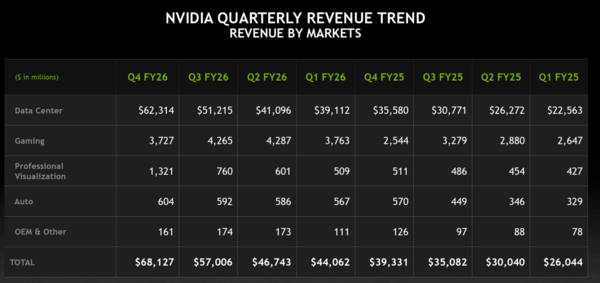
Data enter demand continues to drive Nvidia's results. Data center fourth quarter revenue was $62.3 billion, up 75% from a year ago. Gaming revenue was $3.7 billion, up 47% from a year ago. Professional visualization revenue was $1.3 billion in the fourth quarter, up 74% from a year ago.
Automotive revenue was $604 million, up 6% from a year ago.
In prepared remarks, CFO Colette Kress said the following:
- "For the fourth quarter, hyperscaler revenue increased and remained our largest customer category at slightly over 50% of Data Center revenue, while growth was led by the rest of our Data Center customers as revenue diversified."
- "Data Center compute revenue was a record $51.3 billion, up 58% from a year ago and up 19% sequentially. Networking revenue was a record $11.0 billion, up 263% from a year ago and up 34% sequentially from the introduction and continued ramp of NVLink compute fabric for GB200 and GB300 systems and the growth of Ethernet and InfiniBand platforms."
- "Inventory was $21.4 billion, up from $19.8 billion sequentially, and total supply-related commitments were $95.2 billion. We have strategically secured inventory and capacity to meet demand beyond the next several quarters."
On the conference call, Kress said: "Agentic and physical AI applications built on increasingly smarter and multimodal models are beginning to drive our financial performance on a full year basis. We have now scaled our data center business by nearly 13x since the emergence of chat GPT in fiscal 2023."
Kress added that data center workloads will also start to transition to AI infrastructure. "Over the long run, we expect our sovereign opportunity to grow at least in line with the AI infrastructure market," she said.
Constellation Research analyst Holger Mueller said:
"Nvidia delivered another outstanding quarter the margins are unheard of for a hardware company at that revenue level. The remarkable and unique development is that Jensen Huang and team managed to deliver that growth without any noticeable supply chain and production hiccups. With strategic deals signed up and down the stack, the party will keep going for Nvidia. Things are bright for Nvidia."
On the conference call, Huang said the following:
- "We have now seen the inflection of agentic AI and the usefulness of agents across the world and enterprises everywhere. You're seeing incredible compute demand because of it and in this new world of AI, compute is revenues. Without compute, there's no way to generate tokens. Without tokens, there's no way to grow revenues."
- "As we build out the entire AI ecosystem, whether it's an AI for language or physical AI or AI physics or biology or robotics or manufacturing, we want all of these ecosystems to be built on top of Nvidia. This is such a wonderful opportunity for us to invest into the ecosystem across the entire stack. Our ecosystem is also richer today than it used to be. We used to be largely a computing platform on GPUs, but now we're computing AI infrastructure company."
- "If you look at Nvidia, people call it our software advantage. But you know, where software starts and architecture starts and ends is kind of hard to tell. Our software is effective because our architecture is so good, and so the CUDA architecture is unquestionably more effective, more efficient."
Larry Dignan is Editor in Chief of Constellation Insights at Constellation Research, where he leads editorial coverage focused on enterprise technology, digital transformation, and emerging trends shaping the future of business. He oversees research-driven news, analysis, interviews, and event coverage designed to help technology buyers and vendors navigate complex markets with clarity and context. ...
Read morePublished
Author
