


A look at how Mercedes Benz, Nvidia collaborated on autonomous vehicles
Nvidia outlined its Alpamayo open AI models and datasets to bring reasoning to autonomous vehicles. At CES 2026, Nvidia CEO Jensen Huang said Mercedes Benz with Alpamayo will hit the road in the first quarter.
Huang said Alpamayo and its collaboration with Mercedes Benz is its first full-stack effort for autonomous vehicles (AVs). The approach with Alpamayo revolves around reasoning-based vision language action (VLA) models that bring human thinking to autonomous vehicle designs.
"Our vision is that someday, every single car, every single truck, will be autonomous," said Huang.
It's a vision shared by Ola Kallenius, CEO of Mercedes-Benz Group AG, spoke on a panel about the company's AV efforts with Nvidia.
"I had a chance with the combined Mercedes and Nvidia team to drive it through San Francisco and down into Silicon Valley is point to point navigation," said Kallenius, who noted the AV was operated by "a very sophisticated level two system.
Kallenius noted that the system with Nvidia is more like level 2 plus. "It feels that the car is on rails you're just driving, and it does everything. I drove uninterrupted for more than an hour through pretty heavy traffic," he said.
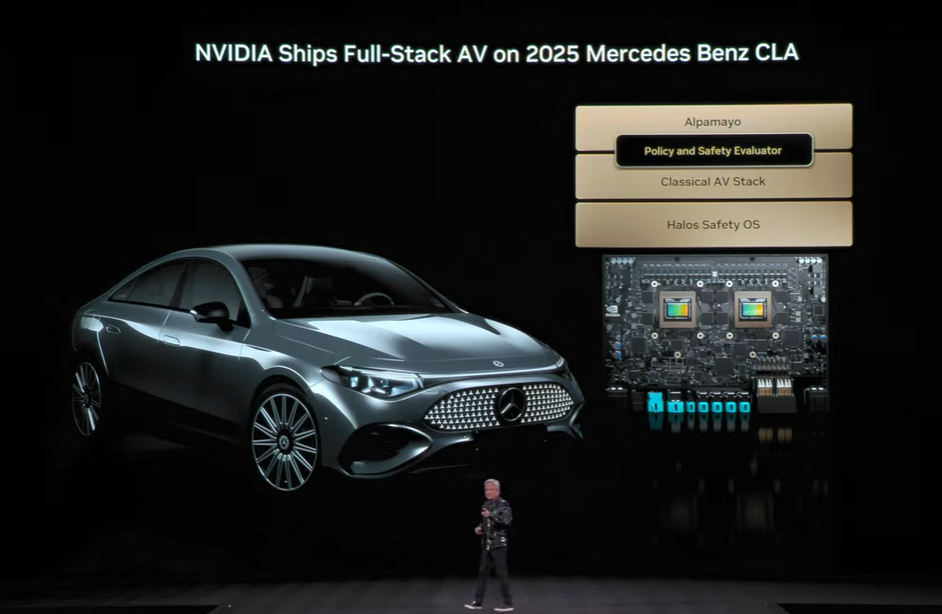
The general idea behind Alpamayo is to create a model and system that can handle novel or rare driving scenarios. Huang said Nvidia will support the models and AV systems on a long-term basis. For Nvidia, the AV effort is a bridge to robotics.
Nvidia released:
- Alpamayo 1, a chain-of-thought VLA model for AV researchers. The model is on Hugging Face and has a 10-billion parameter architecture. The model uses video input to reason and show its logic.
- AlpaSim, an open source end-to-end simulation framework.
- Physical AI open datasets with more than 1,700 hours of driving data.
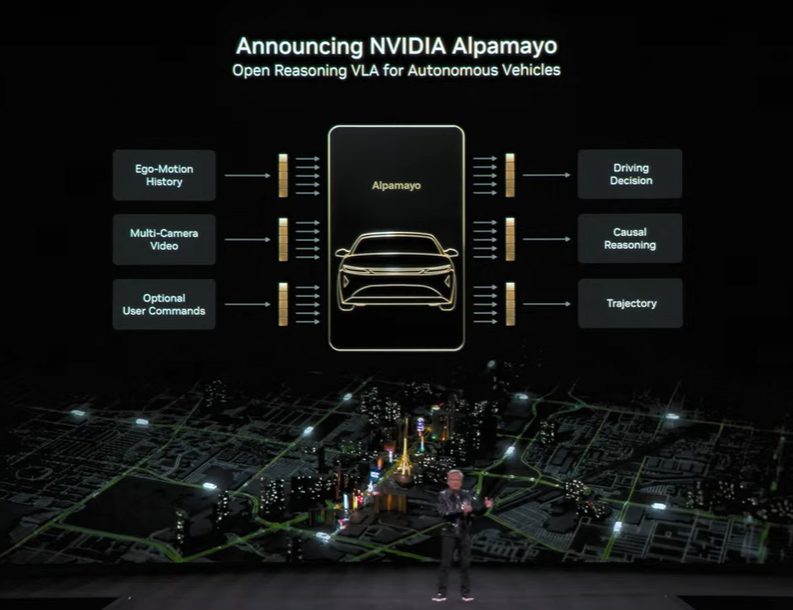
Nvidia said Lucid, JLR, Uber and Berkeley DeepDrive were showing interest in Alpamayo. Huang added that Nvidia's full autonomous driving stack includes Alpamayo, a policy and safety evaluator, classical AV tools and Halos Safety OS.
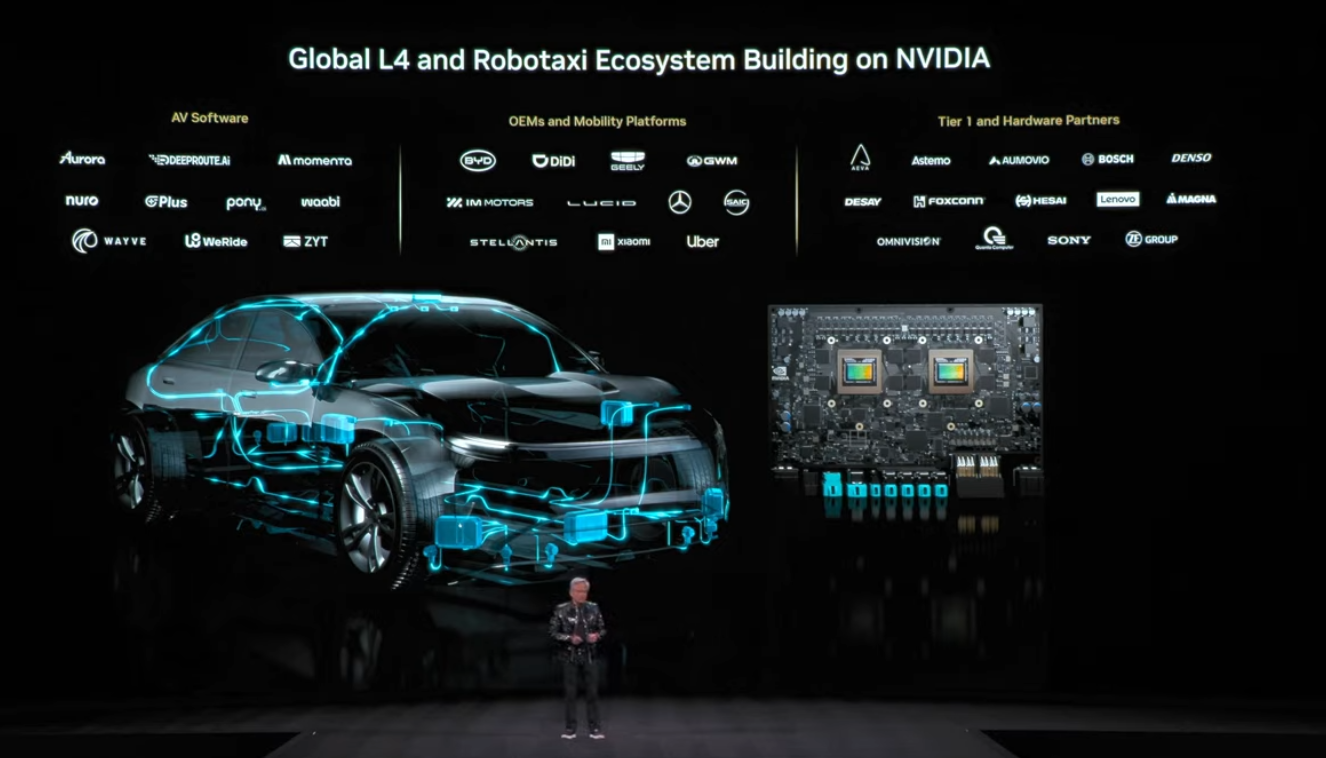
According to Huang, the effort with Mercedes Benz took several thousand people and at least five years of work. "This entire stack is vertically integrated. Of course, in the case of Mercedes Benz, we built the entire stack together. We're going to deploy the carbon, operate the stack, and maintain the stack for as long as we shall live," said Huang.
Kallenius said the Nvidia collaboration with Mercedes Benz revolves around safety.
"If you're moving an object that weighs 4,000 pounds, and it's moving at 50 miles an hour, sorry is not going to cut it. There needs to be a higher level of certainty and safety. You don't have to rush into the market. You don't have to be the first but you got to make sure that what you do is robust," said Kallenius.
Larry Dignan is Editor in Chief of Constellation Insights at Constellation Research, where he leads editorial coverage focused on enterprise technology, digital transformation, and emerging trends shaping the future of business. He oversees research-driven news, analysis, interviews, and event coverage designed to help technology buyers and vendors navigate complex markets with clarity and context. ...
Read morePublished
Author
