


Estée Lauder: A look at its AI and data transformation plan
Estée Lauder is best known for its Tom Ford fragrances, skin care and hair care products and makeup brands such as MAC, but behind the scenes, the company is betting on a streamlined operating model enabled by infusing artificial intelligence throughout its operations.
Stéphane de La Faverie, CEO of Estée Lauder, touted the company's One ELC (Estée Lauder Companies) plan that includes a retooling of its technology stack.
The stack includes a consolidation of e-commerce on Shopify, usage of Profound, an AI marketing platform, and partnerships with Accenture, WPP, Microsoft and Google.
"This One ELC model is really the backbone of how we are operating for the company. And it is designed for us to just bring efficiencies over time," said de La Faverie. "Transformation is a new way for us to operate for the future of the company, and it's going to give us efficiency in media, efficiency in the back of house, much more agility around the company. We are really focusing on harnessing the power of our brand, the power of our innovation and really investing to drive growth in the future."
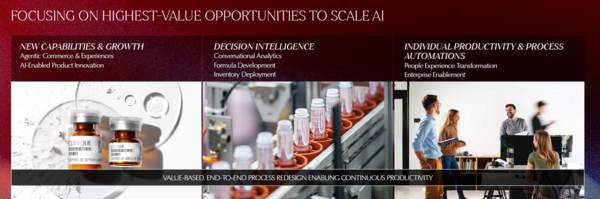
Estée Lauder's AI efforts ride along with a broader company restructuring under the multiyear Profit Recovery and Growth Plan (PRGP). The plan is aimed at boosting gross margins, improving supply chain and inventory efficiency, consolidating central functions and reinvesting in growth.
According to Estée Lauder, PRGP is a one-time event whose cost savings and efficiencies will be mostly realized through fiscal 2027, while One ELC will focus on continual improvement, with some returns reinvested in growth.
Akhil Shrivastava, CFO of Estée Lauder, said One ELC is about efficiency and leveraging global best practices so there's no duplication across brands and regions. “It's really culture, it's system, process and one team," he said. "We are going to the best-in-class solutions for all of them. Combined, these things are improving not only our top line, our bottom line and overall well-being of our people."
The early results are promising as Estée Lauder raised its fiscal 2027 outlook following a strong first quarter. The company is projecting organic sales growth of 4% to 5.5%, up from previous guidance of 3% to 5%. Organic sales grew 3% in fiscal 2026.
Estée Lauder's efforts revolve around maximizing consumer lifetime value in the beauty category. "The consumer lifetime value is expanding. The younger generation is entering beauty category earlier, and the older generation is living longer. Both create exciting opportunities for the industry," said de La Faverie. "Our longer expected lifetime is especially compelling as we increasingly innovate for longevity. The global population aged 65 and over is expected to more than double through 2050 to 1.5 billion people. Second, the middle class is in emerging markets as defined by households is set to increase by over 80% in the next decade."
The company is targeting mid-single-digit organic sales growth annually through fiscal 2030 with operating margins of 16.5% to 18.5%. Shrivastava said operating margin improvements will come from changes in material pricing, freight and various product inputs, as well as packaging design, inventory management and a zero-waste mentality.
"We are setting up a continuous transformation platform across procurement, organizational effectiveness, design, and AI leverage, to name a few," said Shrivastava.
The plan
Estée Lauder's focus on one operating model enabled by AI is necessary to manage through consumer volatility, multiple economies with different characteristics and a sprawling brand portfolio that includes The Ordinary, La Mer, Bobbi Brown and Clinique, to name a few.
Shrivastava said retail is surging, but there are disruptions in the Middle East to navigate, strength in the U.S. and China, and supply chain volatility. Meanwhile, Estée Lauder is betting on product innovation to drive demand too.
De La Faverie, speaking at Estée Lauder's Capital Markets Day in China two days after the company's first-quarter earnings report, outlined the steps in building "a simpler, more connected, scalable and AI-enabled enterprise." The steps included the following:
- Selecting Accenture as a strategic partner to deliver shared services. De La Faverie said it made sense to have one integrated partner with greater consistency, efficiency and governance. Through October, Estée Lauder had transitioned 85% of its shared services to Accenture.
- Consolidating more than 30 agencies into one global media partnership with WPP. "This is about far more than simplifying our agency landscape. It is about leveraging our scale, improving efficiency, and moving resources faster towards the opportunities that create the greatest consumer demand," said de La Faverie.
- Building the company's direct-to-consumer commerce efforts. Shopify will be the back end for Estée Lauder's stores and omnichannel experiences. The company said it is on track to move 80% of its sales operations to Shopify, including 300 stores through fiscal 2027. The Shopify implementation will move Estée Lauder from managing individual channels and systems to focusing on consumer relationships.
Brian Franz, chief technology and transformation officer, walked through how the company is leveraging AI. The efforts to embed continuous optimization across Estée Lauder start with the data set.
"Our competitive advantage is our ability to harness our most strategic asset, 80 plus years of rich data and insights. This data, coupled with our scale and the power of AI as an enterprise capability, enables us to make the best decisions, simplify how we work, and drive productivity," said Franz.
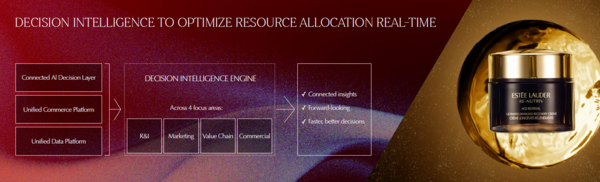
Estée Lauder's AI priorities fall into the following buckets:
- A platform strategy focused on unified commerce and data running on a rebuilt technology, data and analytics foundation.
- Scaling the highest-impact AI initiatives based on productivity, returns and business impact.
- Creating differentiated experiences and products with personalization. Estée Lauder is one of the first Shopify customers of its size to standardize on the platform.
- Decision intelligence using data and insights via a conversational, natural-language interface.
- Automation that uses AI to simplify and drive efficiency.
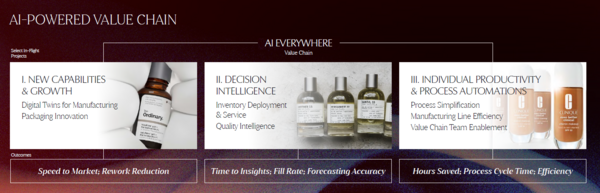
Franz also illustrated how some of those AI initiatives will come together.
Agentic experiences will be a core sales channel.
"We're developing agentic experiences that connect personalized discovery, recommendations, and commerce. For example, our consumer could go to MAC.com, chat with an AI agent and ask, 'I need a full glam look for an event I'm going to this summer.' The agent, which is trained by our expert MAC artists, will recommend products tailored to her skin tone and type, the weather, and any other inputs she might have shared. She can then add those products straight to the cart and eventually purchase them directly through LLMs like ChatGPT, Gemini, or others," said Franz.
Estée Lauder also built a formula navigator that enables scientists to compare formulation options earlier and reduce iterations and development time.
Also see:
- Enterprises prep for influx of personal AI agents
- Does Airbnb have the blueprint for the AI enterprise rewrite?
- Shopify: Personal AI agent traffic starting to surge
The company is also rolling out AI-driven inventory tools that evaluate demand, supply and constraints and automate allocation decisions.
"Finally, to advance personal productivity and enterprise automation, we're equipping employees with secure AI tools while automating repetitive manual tasks at enterprise scale. We've deployed an AI-powered assistant called Ask ELC, which answers routine questions and guides employees through actions," said Franz.
Ask ELC has addressed more than 45,000 queries in 49 countries, with more than 90% of questions answered without human intervention.
Franz added that the Shopify effort is already delivering returns. He said checkout completion has increased 12% and Shop Pay adoption has reached 60%. Reusable data, services and APIs have cut capital spending by 60%, and the time to launch brand site features has fallen from five to six months to six to eight weeks.
Procurement is another area ripe for AI-driven efficiency. "We're implementing one global procurement model and making the process simpler, compliant, and AI-enabled, from purchase order to supplier payment. A standard process gives us full visibility of our spend, reduces manual work, and lets us use our global scale when we negotiate with suppliers," said Franz, who added that these optimization efforts will cut spending and use scale to get better terms.
The plan for Estée Lauder is to use consumer insights, supply chain signals and data from its partners to continually optimize. "Process really is one of the underpinnings, and to have really good, clean data as well, and then finding that golden source data across the organization, so we can invest in the strategies that are much faster at yielding results and getting the right ROI," said Franz.
Customer experience
Estée Lauder is reaching customers globally through multiple channels. CEO de La Faverie touted U.S. TikTok Shop sales for MAC, single-digit organic online sales growth and retail experiences in travel hubs as well as department stores and stand-alone venues.
Franz noted that the company's transformation efforts have enabled it to launch about 700 marketing campaigns in 90 days through a unified briefing model and the redesign of more than 230 global processes.
Aude Gandon, Estée Lauder's chief digital and marketing officer, outlined the company's strategy to build an integrated growth engine around consumer demand. The strategy depends on combining consumer intelligence, culture and commerce signals, media transformation and AI.
Gandon added that the marketing model is designed to balance global scale and efficiencies with local relevance. "Our goal is not about reporting," she said. "Our goal is better business decisions. Where should we invest? Which consumer segment are growing the fastest? Which demand spaces are emerging? Where do our brands have the strongest right to win? By creating a shared enterprise view of demand, we can improve resource allocation. We can identify growth opportunities faster, and we can strengthen our return on investment."
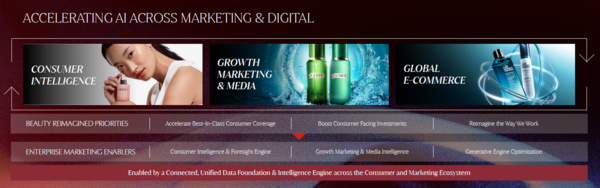
Regions such as China are being used to identify specific demand opportunities in skin health, cosmetics and personalized fragrance. The insights "directly influence where we invest in innovation, marketing resources and commercial support," said Gandon.
Estée Lauder is also building a customer engagement model that reflects a nonlinear path to purchase. "Culture creates relevance and conversation. Community builds participation, trust and advocacy. Commerce converts engagement into action," said Gandon.
The partnership with WPP is in part about creating a more efficient data loop and improving audience intelligence, measurement and learning across markets. Ultimately, Gandon said there should be a data flywheel that accelerates discovery, improves speed to market and innovation quality and connects to Estée Lauder's global research network.
AI is an enabler, explained Gandon. "We do not view AI as a standalone initiative, but a capability that amplifies every part of the growth engine," Gandon said.
The tech stack
Estée Lauder’s approach was to consolidate its vendors into a smaller group of strategic partners. Here’s the lineup.
Microsoft: The cloud and software giant and Estée Lauder expanded a partnership in October to advance the beauty company's unified data platform. Copilot access was also expanded to more than 14,000 office-based employees. Estée Lauder also built ConsumerIQ, an internal agent that analyzes research documents and data. The agent uses Copilot Studio, OpenAI via Azure and Azure Functions.
Shopify: Estée Lauder's decision to standardize on Shopify is a big win for the vendor. Shopify has multiple similar consolidations underway.
Adobe: Estée Lauder is using Adobe's Firefly services, Creative Cloud and experience offerings. Firefly's APIs are used to automate marketing production work.
Google Cloud: The company has said Google Cloud's Gemini and Vertex AI are powering Jo Malone's AI Scent Advisor. Customers describe preferences and get recommended scents.
Accenture: Estée Lauder is betting on Accenture to standardize shared services for technology infrastructure and other enterprise business services.
WPP: Estée Lauder consolidated its media partners so it could better track audiences, media consumption and cultural intelligence.
Profound: Profound tracks Estée Lauder's global brand portfolio and how the company appears in AI answers and recommendations across a broad range of outlets.
SAP: Estée Lauder's hiring pages frequently cite SAP as its core enterprise resource planning system with modernization efforts toward S/4HANA. Estée Lauder presented at ASUG Tech Connect 2026 and referenced Datasphere, Joule Studio and process automation. Exact modernization details are unclear.
Anaplan: Estée Lauder references using Anaplan for pricing, product classification and assortment decisions.
Larry Dignan is Editor in Chief of Constellation Insights at Constellation Research, where he leads editorial coverage focused on enterprise technology, digital transformation, and emerging trends shaping the future of business. He oversees research-driven news, analysis, interviews, and event coverage designed to help technology buyers and vendors navigate complex markets with clarity and context. ...
Read morePublished
Author
