


Cognizant aims to underwrite AI enterprise results
Cognizant is betting that the next chapter of AI adoption will revolve around harnesses, production value and model routing.
Speaking during Cognizant's second quarter earnings call, CEO Ravi Kumar built on comments from the company's investor day.
He said the company is looking to bridge AI capabilities with enterprise value. "Our research shows two thirds of the Global 2000 have not yet realized measurable AI productivity gains and 1 in 4 have paused AI deployments and billions of dollars in potential value remain unrealized," said Kumar. "The opportunity to address this gap is enormous. We estimate the $1 trillion system integration market can expand into $5 trillion to $6 trillion enterprise operations market with $4.5 trillion of operational labor exposed to AI."
Kumar said the launch of Cognizant AI Delivery Operating System, which aims to combine human expertise, AI, context and organizational knowledge, has engineering and business operational harnesses and context.
- Modernizing Cyber Defense With Cognizant Cybersecurity Services
- How Cognizant aims to bridge the AI value gap
- Cognizant buys Astreya, eyes AI infrastructure services
- Constellation ShortList™ Cross-Platform Agentic AI
Cognizant is looking to move from a labor-based model to an agentic and platform model where it underwrites results and outcomes.
"We are also moving beyond delivery to underwriting results. We signed a major engagement with a leading insurance brokerage committing to more than 50% productivity improvement over 5 years through AI and operating model redesign," said Kumar.
Underwriting results also means Cognizant will leverage AI internally for its own productivity gains.
Chapters of AI adoption
Kumar said Cognizant is navigating strong demand in a more mature AI market. Kumar laid out the following:
- "The first chapter of AI adoption was broad-based, open-ended experimental and this is a magical -- the technology was magical. So, everybody tried to use it in a way that they could find some magic coming out of outcomes."
- Enterprises are now productizing AI in a second chapter that will be more nuanced. "You're going to go very nuanced; you want to start to focus on not token consumption, but token economics, and you're going to start to optimize where you use advanced reasoning and where you don't use advanced reasoning," said Kumar.
- The next phase will be about production value, guardrails, optimization and feedback loops.
Kumar added:
"We have a big role to play in starting from building the harnesses where you can capture the context so that when you do the transactions on a regular basis, you can create repeatability, model routing, which means depending on the kind of task, you could use an open weight model, you could use a costly/expensive closed frontier model or you could use a cheaper closed frontier model or you may not use a model."
Those harnesses then enable learning loops that reinvent processes repeatedly.
"Some of our clients are starting to ask us to deliver an AI-infused rate card, which means you embed the pretraining costs and you embed the inference costs into that process. Software engineering is very mature. Business operations are actually evolving now. And we have a third harness for physical AI, which we are preparing, which we think will be the future as we go forward," said Kumar.
The numbers
Cognizant reported second quarter earnings of $1.36 a share on revenue of $5.5 billion, up 4.5% from a year ago. Non-GAAP earnings were $1.37 a share.
Wall Street was expecting Cognizant to report second quarter non-GAAP earnings of $1.38 a share on revenue of $5.48 billion.
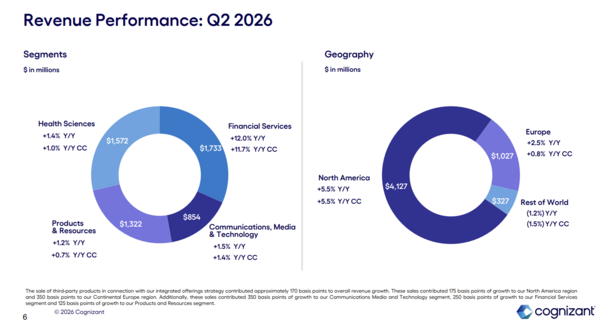
Other indicators include:
- 40% of Cognizant's software development is now AI assisted.
- The company has more than 8,000 AI engagements.
- Financial services have strong demand largely because they are technically strong and a leading indicator for adoption. "Financial services are well ahead with AI initiatives and advanced AI adoption," said Kumar.
As for the outlook, Cognizant projected non-GAAP 2026 earnings of $5.70 a share to $5.82 a share compared to estimates of $5.71 a share. The company projected third quarter revenue of $5.60 billion to $5.68 billion relative to estimates of $5.70 billion.
Larry Dignan is Editor in Chief of Constellation Insights at Constellation Research, where he leads editorial coverage focused on enterprise technology, digital transformation, and emerging trends shaping the future of business. He oversees research-driven news, analysis, interviews, and event coverage designed to help technology buyers and vendors navigate complex markets with clarity and context. ...
Read morePublished
Author
