


Oracle Q1 strong and so is capital expenditures
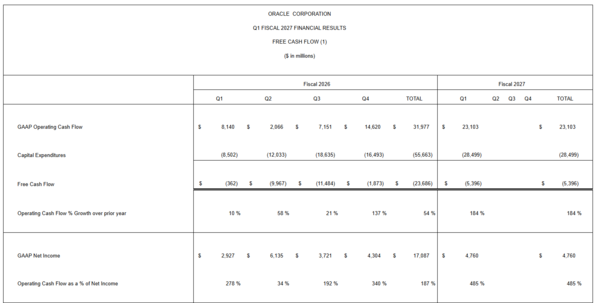
Oracle's fiscal first quarter results were better than expected as cloud infrastructure demand surged, but the company had negative free cash flow of nearly $5.4 billion.
The company reported first quarter earnings of $1.56 a share on revenue of $19.3 billion, up 30% from a year ago. Non-GAAP earnings were $1.92 a share. Wall Street was expecting Oracle to report non-GAAP earnings of $1.74 a share on revenue of $19.13 billion.
Oracle said its total first quarter cloud revenue was up 62% from a year ago to $11.6 billion. Infrastructure as a service revenue was up 121% from a year ago to $7.4 billion. SaaS revenue was up 10% to $4.2 billion.
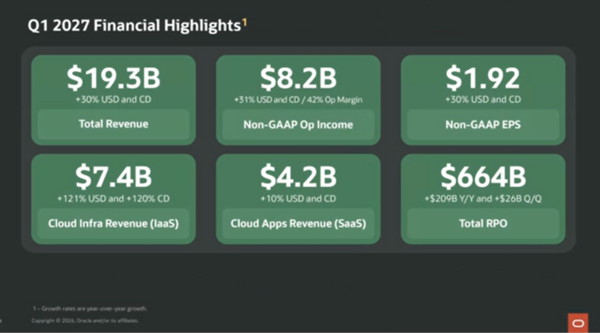
According to Oracle, customer demand for AI cloud training and inference services "continues to grow faster than supply." Oracle said it booked more than $30 billion of additional cloud contracts in the first quarter and had RPO of $664 billion.
- How Oracle Is Reinventing the Database for the AI Era
- Agentic AI Washing: The Oracle Data Report Card
- Oracle: Takeaways on AI value, outcome pricing, managing AI spend
- Oracle Redefines the Data Foundation of the AI Era With Oracle Autonomous AI Lakehouse
- Oracle eyes outcome-based pricing: Does it stand a chance?
The key line in the earnings release was this: "Based on the structuring of those new contracts, the Company confirms there is no incremental impact on its plans to raise capital. Since the end of Q4, Oracle also delivered more than 300,000 GPUs to its AI Cloud customers and almost triple the capacity delivered in Q4 FY26."
On a conference call, CFO Hilary Maxson said "if I wanted to describe this quarter in one word, it would be acceleration, as we're seeing an acceleration in execution across the company translating into our top and bottom line results."
Maxson said the company is making "continued progress in building scaled infrastructure" and becoming more efficient.
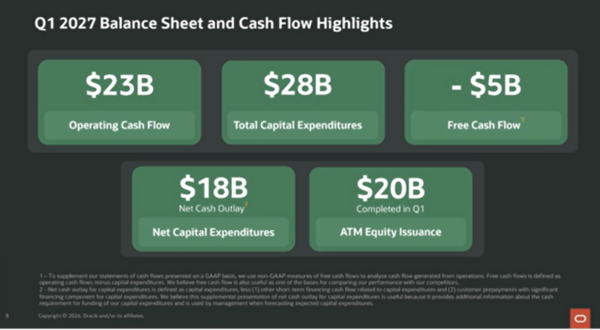
Nevertheless, the company's capital expenditures in the first quarter were $28.45 billion. Net cash outlay for capex after customer prepayments were $17.97 billion. Free cash flow in the quarter remained solidly under water. Oracle said it completed the sale of $20 billion in common stock to raise capital.
Here's the breakdown of the balance sheet moves in the first quarter.
And here's the historical free cash flow figures.
As for the outlook, Oracle is projecting second quarter revenue growth of 30% to 34% with cloud revenue growth of 65% to 71%. Non-GAAP earnings for the second quarter will be between $1.85 a share to $1.93 a share. For fiscal 2027, Oracle is projecting revenue of at least $90 billion with non-GAAP earnings of $8.10 a share.
Here's what Oracle's two CEOs had to say on the earnings call.
CEO Mike Sicilia said the general availability of NetSuite Next, an AI version of the midmarket ERP suite, is generally available with an agentic experience. Other comments include:
- "The introduction of AI is an accelerator, not a replacement, for packaged applications. As such, our decades of experience and expertise running business processes across every industry in every geography for organizations of any size gives us the understanding of how to help them succeed."
- "Something that many struggle to achieve consistently across functions, teams, and regions. AI changes this dynamic. Rather than asking every employee to navigate and execute a process exactly as the system expects, AI agents can perform tasks using the organization's established workflows and business rules. Employees then shift to overseeing agents, resolving exceptions, and applying human judgment where it matters most by combining applied AI with decades of sophisticated business rules, regulatory compliance, security models, data models, and customer configurations."
- "We are incredibly confident in the potential for this new paradigm to deliver much more rapid ROI for our customers. At AI World in October, we will unveil a new agentic AI accelerator, poised to redefine how customers deploy Oracle applications faster, simpler, and at a dramatically lower cost. Working alongside Oracle and customer teams, AI agents will automate and orchestrate implementation at an unprecedented scale."
- "Our Oracle Health business continued to accelerate, and although we don't specifically call it out, our industry applications grew at greater than 20% in Q1."
- "Customers used our embedded AI capabilities more than 150 million times during the quarter, with usage growing 42% sequentially. Our AI agents executed more than 3.5 million times in production during the quarter, nearly doubling quarter over quarter. Customers have over 2,300 AI agents in production, and that's up 90% quarter over quarter."
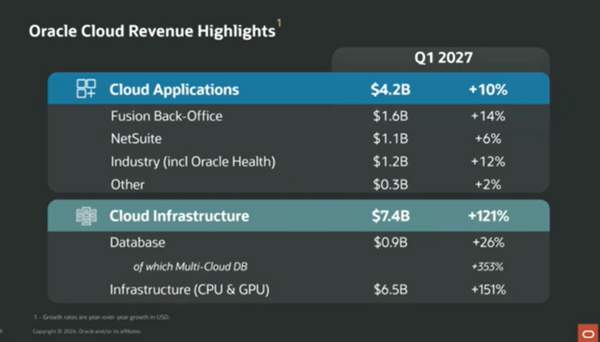
CEO Clay Magouyrk said the following on cloud infrastructure:
- "We delivered 850 megawatts of AI capacity containing more than 300,000 GPUs to customers since the end of Q4. Delivery in Q1 is almost three times what we delivered in all of Q4, and 73% of the total capacity we delivered last fiscal year."
- "Our ability to operate a large multi-tenant fleet remains a significant advantage. GPU utilization remains extremely high at 97.9% in Q1. GPU longevity and value continue to impress. Of all the GPUs that came up for renewal in Q1, that capacity was renewed or resold at a 20% premium to prior contracts. The majority of those GPUs are four years or older. We see a long, useful life with increasing value for the AI capacity we're deploying."
- "Abilene (TX) continues to deliver at an extraordinary pace. We delivered 131,000 GPUs there in Q1, 1.9 times the volume delivered in Q4. Six of the eight campus buildings representing 618 megawatts and 75% of total capacity have now been delivered to the customer. The recently released GPT-6 Astra was trained at our site in Abilene."
- "Shackleford is our next gigawatt-scale campus and is progressing well. NVIDIA Vera Rubin systems are performing better than expected across hardware quality, manufacturing yield, and performance. We will deliver our first Vera Rubin systems to customers in Q2."
- "We are delivering data center and GPU capacity at a pace that would have seemed impossible only a year ago. Customers were signing new contracts, renewing capacity at higher prices, and keeping the fleet almost fully utilized. We are placing Oracle AI Database in every major cloud and making more proprietary and open models available on OCI. We are then connecting those models to enterprise data, applications, and developer workflows. That combination is why demand continues to grow."
The big question is whether Oracle's capex investment will continue or accelerate going forward. Executives didn't have much to say. Magouyrk said:
"We're constantly finding interesting ways to fund the business, and one of the mechanisms that we have to fund our business is obviously that that we go out and we spend our own capital, but we've invested very heavily in relationships with different suppliers and vendors, invented new business models, including bring your own hardware. All of which have different ways of spreading out that capital. I think that we have to separate out in our minds what Oracle spends as capex directly, uncouple that directly from how we think about how the business can grow."
Maxson added:
"Each of these projects that we're doing, by nature, is a strong free cash flow generating project. So, as soon as they ramp up, very shortly thereafter, they're delivering a free cash flow conversion ratio of something like 100% to post-tax EBITDA."
Constellation Research’s point of view
Holger Mueller, a Constellation Research analyst, said the following about Oracle’s quarter.
Positives
- “With the recent Q1 earnings, Oracle is clearly a cloud vendor.”
- “Investment continues. Oracle’s capex in the first quarter was more than 50% of the combined capex of the previous fiscal year. But Oracle customers are paying for Oracle equipment upfront for about 40% of capex. That’s a strong sign that Oracle’s massive buildout will succeed.”
- “Oracle’s equity raise strengthens the balance sheet.”
Concerns
- “Oracle’s growth is almost entirely attributed to North America. The challenge will be the geographical revenue mix over time. We will see if it’s Oracle cloud skepticism or a slower rollout there.”
- The Oracle’s value proposition is appealing to CxOs and the company will have to sell it globally.”
Larry Dignan is Editor in Chief of Constellation Insights at Constellation Research, where he leads editorial coverage focused on enterprise technology, digital transformation, and emerging trends shaping the future of business. He oversees research-driven news, analysis, interviews, and event coverage designed to help technology buyers and vendors navigate complex markets with clarity and context. ...
Read morePublished
Author
