Cloudflare said it will acquire VoidZero, the JavaScript tooling company behind Vite, Vitest, Rolldown, Oxc, and Vite+. Cloudflare said VoidZero's applications will remain open source and will remain vendor agnostic.
June 4, 2026 1:15:59 PM




Cloudflare said it will acquire VoidZero, the JavaScript tooling company behind Vite, Vitest, Rolldown, Oxc, and Vite+. Cloudflare said VoidZero's applications will remain open source and will remain vendor agnostic.
Palantir said it is available on Google Cloud Marketplace and now has two-way integrations between Google Cloud BigQuery and Palantir's Foundry platform. AIP and Gemini are also connected for enterprise use.
The news lands as Palantir launches its latest AIPCon, which is a look at what customers are doing with enterprise use cases.
IBM and Google Cloud inked a deal that ties IBM Consulting Advantage with Google Cloud Gemini Enterprise. Under the deal, IBM will use Consulting Advantage, its AI delivery platform, with Gemini Enterprise industry agents.
The companies also said it will launch a new global Google Cloud practice with "thousands of IBM consultants."
Google has another open model. The company launched Gemma 4 12TB. According to Google, the open model is "designed to bring high-performance multimodal intelligence directly to your laptop, combining mobile-first efficiency with advanced reasoning."
Alphabet initially wanted to raise $80 billion for AI infrastructure via equity offering. Instead it raised $85 billion. Here's a look at the transcript and deck as pitched to investors.
SpaceX is pricing for $135 a share looking to raise close to $2 trillion in its market debut.
In its latest update, SpaceX said it is offering 555,555,555 of its Class A common stock at $135 each. Elon Musk will hold 84.2% of SpaceX after the IPO.
I updated my previous take on the financials: SpaceX's IPO: Do you believe in space data centers, xAI's potential?
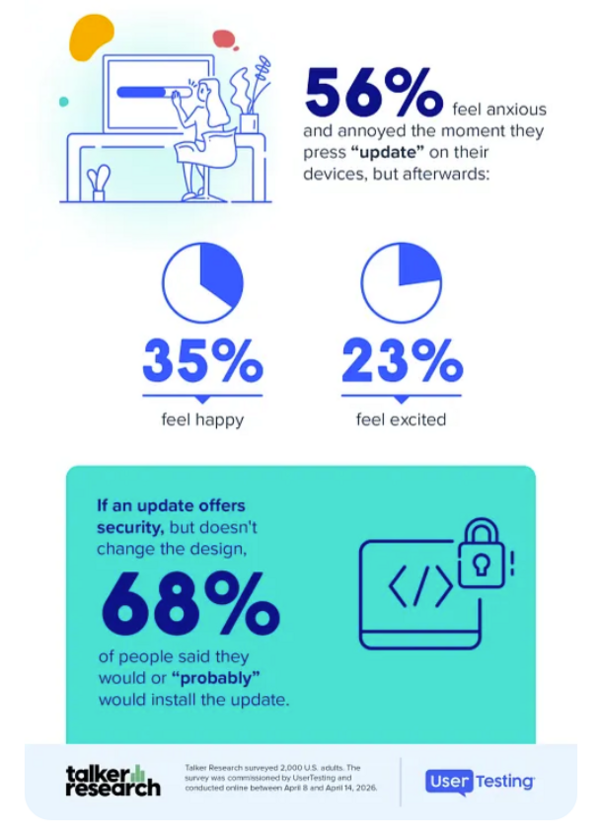
A UserTesting report has some damning findings when it comes to software updates. In fact, we hate them.
According to a survey from UserTesting, there's widespread anxiety and frustration with software updates. A few findings:
Coupa and the MIT Data Science Lab published the 2026 Business Spend Index Report using Coupa's data on actual business spending. The index is designed to be an economic indicator that is predictive.
According to Coupa and MIT, the BSI caught an April spending pullback before surveys. Current findings include:
UKG named Rod Johnson, a former Oracle executive, Chief Revenue Officer. Johnson will report to CEO Jennifer Morgan. Johnson previously served as EVP of North America Applications at Oracle.
Knowledge at Wharton has a good post on whether AI is killing UX. The post is worth a read given that UX is allegedly disappearing and being replaced with an all-encompassing chat interface.
The authors, Scott A. Snyder, a senior fellow at the Wharton School and author of Your AI Life, and Mike Welsh, chief storyteller at Bridgenext and author of The Backstory on Storytelling, write:
"The more AI accelerates the making of experiences, the more important it becomes to understand who those experiences are for. We can generate customer journeys, personas, screens, content, and front-end code faster than ever. None of that guarantees we have understood the end user’s moment or the context around it and the emotion underneath it.
So the question is not really whether AI is killing user experience (UX). The better question is whether AI is exposing the parts of UX that organizations have been treating as optional."
Alphabet said it will raise $80 billion in equity to fund AI infrastructure. The offering consists of $30 billion in Class A and Class C shares and $40 billion in at-the-market offerings where Alphabet will sell stock beginning in the third quarter. The remaining $10 billion is a private placement with Berkshire Hathaway.
The details are here. A few thoughts:
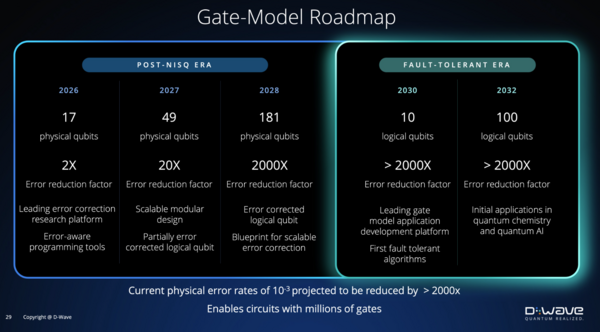
D-Wave Quantum is spreading its bets on quantum computing systems. The company is best known for its annealing systems, but now is launching a roadmap for gate-model systems.
Quantum computing has multiple flavors and it's unclear which technology will win out. Most experts are betting on superconducting systems. What's interesting is that D-Wave is among the first pure play quantum plays to target two platforms.
D-Wave said it will target 100 logical qubits able to perform more than 1 million operations by 2032.
Here's D-Wave's roadmap: