


AMD makes case for integrated Helios AI stack with new GPUs, CPUs
AMD CEO Lisa Su made the case that its Helios stack of Instinct AI accelerators, EPYC server chips, networking and software can drive AI everywhere.
"You have to design the rack as an integrated system and making them easy to deploy and service and be very reliable," said Su.
AMD officially launched its Helios rack-scale systems. That move wasn't terribly surprising given Helios deals were announced with Anthropic and Microsoft. The big takeaway is that AMD is looking to be a counterweight to Nvidia's integrated systems.
Here's a look at the moving parts from AMD's Advancing AI 2026 event.
The backdrop
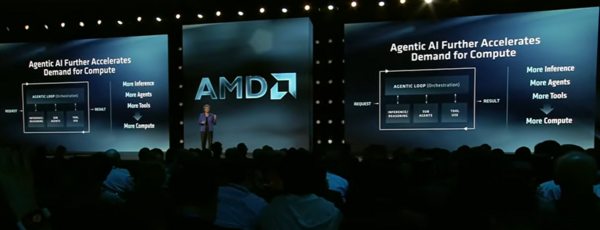
"We're in the very early innings of what's possible," said Su. She gave a nod to training, but emphasized smaller custom models and inference. "The world is using more AI compute to run models than train them. Roughly 60% of compute capacity will be used for inference. We see agents as the next big step for AI."
Su said the shift to agentic AI is accelerating the AI accelerator market. "By 2030, the AI accelerator market will hit $1.4 trillion," said Su, who said there will be multiple types of AI accelerators but GPUs will lead, but CPUs will see strong growth too.
AMD is clearly betting that its EPYC server CPUs will see strong growth. "We expect the server CPU market to grow more than 50% to $220 billion in 2030," said Su.
She emphasized that AI agents are going to go well beyond the data center to the edge. "AI will be infused everywhere," said Su.
The AMD CEO also emphasized an open ecosystem that includes AI on the PC, enterprise and physical world. RocM will also play a big role.
Helios and MI400 series GPUs
AMD Helios integrates the AMD stack in two-inch slices that are 160 pounds. Su said Helios is in full production.
"Demand is extremely strong," said Su. AMD featured both OpenAI and Anthropic on stage during her keynote.
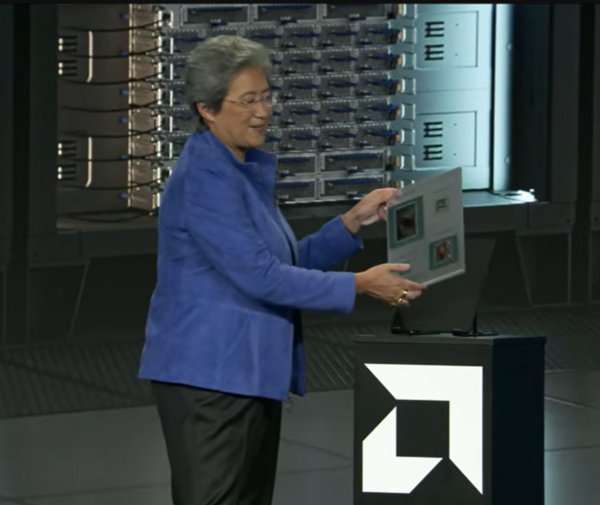
AMD’s Helios architecture with Instinct MI455X has 432GB HBM4 capacity, 23.3 TB/s and 320 billion transistors.
Although the performance in a single rack--up to 2.9 exaflops peak FP4, 1.4 exaflops peak FP8, 31 terabytes of HBM4 memory and 1.7 petabytes/second of memory bandwidth--Su said AMD is looking to drive returns, lower the cost per token and serve more users with the same investment.
Helios is powered with the just launched AMD Instinct MI400 GPUs. The latest Instinct series includes:
- MI455X GPUs for frontier AI and AI factory deployments.
- AMD Instinct MI430X GPUs for sovereign AI and HPC.
- An open software foundation via AMD ROCm software, which received a unified CLI, skills for agents, various improvements and AI-powered software optimization.
6th Gen AMD EPYC CPUs
AMD launched EPYC 9006 server CPUs designed for agentic AI, cloud and HPC deployments.
The latest EPYC series includes:
- AMD EPYC 9006 SP7, which is designed for AI agent sandbox with up to 256 cores and 512 threads. The chip is designed to improve CPU to GPU handoffs and deliver the most agents per watt, dollar and rack.
- AMD EPYC 9006 SP8, an efficient processor designed to be flexible and rightsized based on the workload.
- AMD EPYC 9006X SP7, a processor designed for high-performance computing and data intensive workloads.
- AMD EPYC 9006 LP, which is made for rack-scale AI systems.
Larry Dignan is Editor in Chief of Constellation Insights at Constellation Research, where he leads editorial coverage focused on enterprise technology, digital transformation, and emerging trends shaping the future of business. He oversees research-driven news, analysis, interviews, and event coverage designed to help technology buyers and vendors navigate complex markets with clarity and context. ...
Read morePublished
Author
