Results

Event Report - SAP TechEd Barcelona - Analytics, ML, PaaS and Hana 2

Event Report - SAP TechEd Barcelona - Analytics, ML, PaaS and Hana 2

We had the opportunity to attend the European edition of SAP’s developer conference, TechEd, held in Barcelona from November 8th till 10th 2016. The event was well attended, with an estimate 4k attendees coming from clients, prospects, partners, SAP and exhibitors. 


So take a look at my musings on the event here: (if the video doesn’t show up, check here)


No time to watch – here is the 1-2 slide condensation (if the slide doesn’t show up, check here):


Want to read on? Here you go: 
 
Always tough to pick the takeaways – but here are my Top 3:

HANA comes in two flavors and a trial version – The major news of the conference was the announcement of HANA 2, effectively the creation of two flavors of HANA. For customers that are live with HANA based applications and don’t need any further advancements of HANA, SAP will keep HANA SPS 12 around for 3 years, freeing them from onerous re-testing of their live applications, caused by HANA innovation they don’t want to uptake. And HANA2 becomes the flavor that will exhibit new capabilities, starting with the announcement and have twice a year a new service release. Effectively SAP has declared what was formerly SPS 13 to be HANA 2 now, labelling it courageously as the platform for Digital Transformation. New capabilities coming with HANA 2 are attractive – starting with a container infrastructure, BYOL capabilities, Machine Learning and predictive Analytics capabilities are the ones that stuck out for me as being most game changing for enterprises building next generation applications. And to do that enterprises need developers who know the technology, and here SAP has done (finally) something what is a must have for any technology provider to the enterprise – offered a free development and limited runtime license for HANA – with HANA Express. Anyone can download HANA, the full version, to their machine, build application and deploy them – with memory being the gate (I believe 32 GB was the limit).

HANA Cloud Platform grows – For the first HCP has become the key product message in a SAP keynote by Bernd Leukert, where HCP was the key platform for the last third of the keynote, quite adequate for a developer conference. And there are numerous new capabilities that make a difference for HCP going forward, the one that stood out for me are a new container service (I could not figure out if is the same like HANA 2’s), BYOL capabilities, improved integration into SAP’s products, improvements of the API Business Hub, a connector to Ariba named Ariba Cloud Integration Gateway, machine learning capabilities, predictive analytics functionality. SAP has done a good job of adding more services to HCP, adding a workflow service, business rules engine with services, data quality services. Probably the most impactful services for enterprises trying to build these nature of applications, the smart data streaming capabilities will be most welcome, as streaming is always tricky, but especially when solved by an individual enterprise.

We had the chance to use HCP ourselves, building a Fiori based application, connecting it via OData / SAP Gateway to a production system, adding visualization of an address in Google Maps and using the Translation Services to have the app available in 20 or so languages, all build by a rusty developer analyst in about one hour. Available with UI5 as a mobile application. I tested 7 languages, including Hebrew, where the app changed from left to right menu as well as orientation. All without any real coding, but mostly XML script extensions and changes, a powerful proof point of where SAP HCP has come to.

SAP discovers Machine Learning – For a long time I have been giving SAP a hard time about the lack of machine learning vision, talk and product uptake. This has changed now with native machine learning capabilities coming to both HANA and HCP, a very important step forward for developers building next generation applications. On top of that SAP announced a machine learning powered Brand Intelligence solution that will use the currently ubiquitous picture and video machine learning capabilities to help marketers establish brand value. Invoice matching and bias elimination in recruiting with SuccessFactors are the other two use cases that SAP currently supports. Not surprisingly there needs to be a training effort for new technologies, and SAP is doing the right thing by starting a MooC effort. Too early to judge the uptake as the capabilities come in 2017, but SAP is doing the right things to get there. And similar SAP is launching a data science curriculum for 2017 – in true SAP style with a certification.

Analyst Tidbits

 
  • DaaS with ESA – DaaS is a key revenue source and capability going forward and SAP partnered with ESA to bring ESA satellite pictures to enterprise, of course via HANA and the SAP Digital arm. Kudos for having a consuming customer on stage with Munich Re, the insurer wants to add geographical data to its risk assessment. The service is free till the end of the year, we will have to understand monetization then, but a good start on a differentiating data source for SAP, making the consumption of the ESA data easy for developers.
     
  • Make it easier to build IoT apps – SAP introduced the an IoT enablement solution, that effectively connect S/4HANA (as the Digital Core) with tiered storage, in which SAP has enabled its Digital Twin capabilities (acquired assets with Fedem). It is an important step to make it easier for enterprises to build IoT applications with HCP, with storage tiering and connecting them with S/4HANA, a good move by SAP.
     
  • KXEN DNA is alive – When SAP acquired KXEN, I was bullish on the capabilities this could bring to SAP, in terms of shrink wrapped ‘true’ analytics applications. It was longer quiet than I would have liked, but now the know how is back with a focus on helping data scientists and analytic model worker with the SAP Business Objects predictive factory. Good to see.
     
  • YaaS now available in Germany – SAP’s hybris team, the division that early on focused on a microservice architecture on top of CloudFoundry is adding the German market (US already available). YaaS is a key strategy in the API Economy market, and key for developers to be more efficient at building their next generation applications. Available by the hybris marketplace, the ESA partnership is available through this architecture.
     
  • Analytics – Maybe missed by me, but the SAP Digital Boardroom has been completely re-factored on SAP Business Objects Cloud, leveraging the assets of the original Cloud for Planning product and more. Good to see Analytics applications now available in 34 countries from the SAP Store. All the EPM applications are part of the portfolio and BPC is now helping to move to Continuous Accounting. And a Roambi powered mobile app is available, after SAP has done some ‘hardening’ of the solution to bring it to SAP standards.
     
  • SAP has an assistant now - SAP recently announced its assistant - SAP CoPilot, it was demoed in the keynote, and comes from he Fiori team. It seems the team is a pursuing an open architecture, e.g. keeping their options open when it comes to speech recognition platforms. But it is early days, good to see SAP looking at this important space.
     
  • S/4HANA makes progress – SAP keeps pushing forward with S/4HANA both on premises and in the cloud, with the major functional piece that was still missing with Manufacturing coming soon in 2017.
     
  • SAP and Apple – The first deliverables of the partnership both vendors announced at Sapphire in May of this year are now available, there is a HCP SDK for iOS, both vendors did their first academy training partners on the SDK and shared that precision tool manufacturer MAPAL is part of the early adopter program. 
 

MyPOV

From an announcement perspective, a very good TechEd for SAP, the product related announcements eclipsed what was announced at Sapphire this year. The keynote felt at times more like a Sapphire than a TechEd demo. But sometimes development cycles and marketing calendar are not on the same takt. Nothing a vendor can do and holding back is not an option, given the demands from enterprises. SAP could have stressed developer aspects / experience / side more, given the audience. But literally every major product line had substantial, architectural announcements, from the ‘sundeck’ of S/4HANA to the engine room with HANA. The new container and BYOL developer options for HANA and HCP stand out in my view. Good progress from SAP on the IoT side, too – where the purpose-built solutions got an important new facet with the digital twin. Good to see the push for machine learning – across multiple products, an area that SAP needs to move fast in, and has started now.

On the concern side SAP still needs to extend its reach to Hadoop natured storage options. In memory – no matter if with HANA or Vora / Spark remains intuitively cost prohibitive for customers to build next generation applications with SAP, as they all have a not sizeable at design time, not predictable data storage aspect. To be fair SAP acquired Altiscale recently, which could be a key enabler. But the lack of a Hadoop service from SAP hurts SAP on all levels – as a platform for both HANA and HCP, when building solutions as for IoT, when being a strategic partner, when building higher level constructs in BI / Analytics and OLTP applications and so on. Not to mention customer who have to figure this out themselves. The other source of likely confusion is between HANA Platform and HANA Cloud Platform. Agreed it is important to know that enterprises can build on HANA only if desired, but even Oracle ‘lumps’ the database into the PaaS layer. Similar challenges exist with the Hybris YaaS service vs. HANA see both on the ESA announcement. To the market, customers and prospects it doesn’t matter who build this at SAP, messaging, pricing need to be simple for enterprises not to lose time when looking at SAP development tools. Time for some message cleanup.

But overall good to see the progress on all fronts. Almost ironical that in the year where SAP started to partner for cloud IaaS (e.g. with Microsoft Azure and AWS Cloud) its up the stack products have found cloud stride in all regards, vision, speed of delivery and messaging. Exciting times ahead, stay tuned.


More on SAP:
  • News Analysis - SAP to unveil HANA 2 - New platform vs a fork's tine - read here
  • News Analysis - Microsoft announces SAP's choice of Azure to help enterprises transform HR - The SaaS land grab is on - read here
  • Event Report - SAP / Trenitalia Digital Summit - SAP is serious about IoT - read here
  • First Take - SAP BW/4HANA - Data Gravity and Cloud win - read here
  • Event Report - SAP SuccessFactors SConnect - Push on all fronts - read here
  • Event Report - SAP Insider Vienna - HCP, BI and SuccessFactors are the takeaways - read here
  • Event Report - SAP Sapphire 2016 - Top 3 Positives & Concerns: SAP changes - probably for the better - read here
  • First Take - SAP Sapphire Day #2 Keynote - read here
  • News Analysis - SAP and Microsoft usher in new era of partnership to accelerate digital transformation in the cloud - read here
  • First Take -  SAP Sapphire Bill McDermott Day #1 Keynote - read here
  • Event Preview - SAP Sapphire 2016 - What to expect and look for - read here
  • News Analysis - Apple & SAP Partner to Revolutionize Work on iPhone & iPad - read here
  • Progress Report - SAP SuccessFactors makes good progress - now needs appeal beyond SAP - read here
  • News Analysis - SAP HANA Vora now available... - A key milestone for SAP - read here
  • Event Report - SAP Ariba Live - Make Procurement Cool Again - read here
  • News Analysis - SAP SuccessFactors innovates in Performance Management with continuous feedback powered by 1 to 1s  - read here
  • Event Report - SAP SuccessFactors SuccessConnect - Good Progress sprinkled with innovative ideas and challenging the status quo - read here
  • News Analysis - WorkForce Software Announces Global Reseller Agreement with SAP - read here
  • First Take - SAP SuccessFactors SuccessConnect - Day #1 Keynote Top 3 Takeaways - read here
  • News Analysis - SAP SuccessFactors introduces Next Generation of HCM software - read here
  • News Analysis - SAP delivers next release of SAP HANA - SPS 10 - Ready for BigData and IoT - read here
  • Event Report - SAP Sapphire - Top 3 Positives and Concerns - read here
  • First Take - Bernd Leukert and Steve Singh Day #2 Keynote - read here
  • News Analysis - SAP and IBM join forces ... read here
  • First Take - SAP Sapphire Bill McDermott Day #1 Keynote - read here
  • In Depth - S/4HANA qualities as presented by Plattner - play for play - read here
  • First Take - SAP Cloud for Planning - the next spreadsheet killer is off to a good start - read here
  • Progress Report - SAP HCM makes progress and consolidates - a lot of moving parts - read here
  • First Take - SAP launches S/4HANA - The good, the challenge and the concern - read here
  • First Take - SAP's IoT strategy becomes clearer - read here
  • SAP appoints a CTO - some musings - read here
  • Event Report - SAP's SAPtd - (Finally) more talk on PaaS, good progress and aligning with IBM and Oracle - read here
  • News Analysis - SAP and IBM partner for cloud success - good news - read here
  • Market Move - SAP strikes again - this time it is Concur and the spend into spend management - read here
  • Event Report - SAP SuccessFactors picks up speed - but there remains work to be done - read here
  • First Take - SAP SuccessFactors SuccessConnect - Top 3 Takeaways Day 1 Keynote - read here.
  • Event Report - Sapphire - SAP finds its (unique) path to cloud - read here
  • What I would like SAP to address this Sapphire - read here
  • News Analysis - SAP becomes more about applications - again - read here
  • Market Move - SAP acquires Fieldglass - off to the contingent workforce - early move or reaction? Read here.
  • SAP's startup program keep rolling – read here.
  • Why SAP acquired KXEN? Getting serious about Analytics – read here.
  • SAP steamlines organization further – the Danes are leaving – read here.
  • Reading between the lines… SAP Q2 Earnings – cloudy with potential structural changes – read here.
  • SAP wants to be a technology company, really – read here
  • Why SAP acquired hybris software – read here.
  • SAP gets serious about the cloud – organizationally – read here.
  • Taking stock – what SAP answered and it didn’t answer this Sapphire [2013] – read here.
  • Act III & Final Day – A tale of two conference – Sapphire & SuiteWorld13 – read here.
  • The middle day – 2 keynotes and press releases – Sapphire & SuiteWorld – read here.
  • A tale of 2 keynotes and press releases – Sapphire & SuiteWorld – read here.
  • What I would like SAP to address this Sapphire – read here.
  • Why 3rd party maintenance is key to SAP’s and Oracle’s success – read here.
  • Why SAP acquired Camillion – read here.
  • Why SAP acquired SmartOps – read here.
  • Next in your mall – SAP and Oracle? Read here
 
And more about SAP technology:
  • Event Prieview - SAP TechEd 2015 - read here
  • News Analysis - SAP Unveils New Cloud Platform Services and In-Memory Innovation on Hadoop to Accelerate Digital Transformation – A key milestone for SAP read here
  • HANA Cloud Platform - Revisited - Improvements ahead and turning into a real PaaS - read here
  • News Analysis - SAP commits to CloudFoundry and OpenSource - key steps - but what is the direction? - Read here.
  • News Analysis - SAP moves Ariba Spend Visibility to HANA - Interesting first step in a long journey - read here
  • Launch Report - When BW 7.4 meets HANA it is like 2 + 2 = 5 - but is 5 enough - read here
  • Event Report - BI 2014 and HANA 2014 takeaways - it is all about HANA and Lumira - but is that enough? Read here.
  • News Analysis – SAP slices and dices into more Cloud, and of course more HANA – read here.
  • SAP gets serious about open source and courts developers – about time – read here.
  • My top 3 takeaways from the SAP TechEd keynote – read here.
  • SAP discovers elasticity for HANA – kind of – read here.
  • Can HANA Cloud be elastic? Tough – read here.
  • SAP’s Cloud plans get more cloudy – read here.
  • HANA Enterprise Cloud helps SAP discover the cloud (benefits) – read here

Find more coverage on the Constellation Research website here and checkout my magazine on Flipboard and my YouTube channel here.
 
Tech Optimization Data to Decisions Digital Safety, Privacy & Cybersecurity Innovation & Product-led Growth Future of Work New C-Suite SAP SaaS PaaS IaaS Cloud Digital Transformation Disruptive Technology Enterprise IT Enterprise Acceleration Enterprise Software Next Gen Apps IoT Blockchain CRM ERP CCaaS UCaaS Collaboration Enterprise Service Chief Information Officer Chief Technology Officer Chief Information Security Officer Chief Data Officer Chief Digital Officer Chief Analytics Officer Chief Executive Officer Chief Operating Officer

SAP to unveil HANA 2

SAP to unveil HANA 2

SAP kicked off its European Edition of its developer conference TechEd in Barcelona today, and the big news was the announcement of SAP HANA 2.


Definitively work our customary news analysis (check out my tweets, too as I am attending the conference) it can be found here:
BARCELONA, Spain — Nov. 8, 2016 — SAP SE (NYSE: SAP) today announced SAP® HANA 2, the next-generation of the SAP HANA platform optimized for innovation. SAP HANA 2 will include and extend the proven technology from the first release of SAP’s breakthrough in-memory platform to provide a new foundation for digital transformation. In addition, new SAP HANA microservices in the cloud are available via SAP Hybris as a Service (YaaS) to spur developer innovation by embedding richer insight into modern applications. These announcements were made at SAP TechEd, being held November 8-10 in Barcelona.

MyPOV – Interesting that SAP Hybris is part of the first paragraph, but that was to be anticipated from Sapphire, where SAP discovered its new love affair with micro services. The ‘include and extend’ reads like a ‘fork’ in the product line – but let’s read on.
 
“SAP pioneered in-memory computing with the launch of SAP HANA in 2010 and throughout our journey we have driven breakthrough innovation on a highly stable core data platform for our customers,” said Bernd Leukert, member of the Executive Board, Products & Innovation, SAP SE. “The release of SAP HANA 2 will mark a milestone in the industry, as it represents the next-generation of SAP HANA that will propel customers toward a successful and prosperous digital future.”
SAP HANA 2 will be released to customers on November 30, 2016. The express edition of SAP HANA 2 will be delivered upon validation shortly after general availability to help organizations jumpstart new development projects. As an innovation platform, SAP HANA 2 will deliver technology enhancements twice a year to support agile IT.

MyPOV – Kudos for SAP to provide a hard date for RTC, and for shipping the express edition that is key for customer and prospect sandbox activities. Embedded also that HANA 2 will have new capabilities twice a year – a usual pace these days – but a pace that is possibly too fast for customers who do not need new features and want to run in production and now can stay on SPS12 for about 3 years.
 
Planned new key features and enhancements to help IT transform include:
• Database Management – IT organizations will be able to ensure business continuity with enhanced high-availability, security, workload management, and administration enhancements. For example, the new active / active read-enabled option will enable IT organizations to leverage secondary systems – previously used only for system replication – to offload read-intensive workloads for improved operations.

MyPOV – Always good to see SAP adding capabilities in Data Management, an era where the relatively you HANA product – now a first grader – was behind the university student or seasoned professionals (pardon the age comparison between database product and humans, but it illustrates the difference well) and need to catch up. Interesting that read performance gets mentioned here.
 
• Data Management – Businesses are expected to leverage all data regardless of where it resides with enhancements to enterprise modeling, data integration, data quality and tiered storage. For example, the new SAP Enterprise Architecture Designer, Edition for SAP HANA is a Web-based solution that will allow IT organizations to manage complex information architectures and visualize the potential impact of new technologies before they are implemented.

MyPOV – Same as Database Management – good to see SAP adding capabilities in the Data Management area. Looking forward to see the Enterprise Architecture Designer.
 
• Analytical Intelligence – Developers are projected to embed rich insight into applications with enhanced analytical processing engines for text, spatial, graph and streaming data. For example, new algorithms for classification, association, time series and regression have been added to the predictive analytics library, which will empower data scientists to discover new patterns and incorporate machine learning in custom applications.

MyPOV – Very important additions for HANA overall, an area where it needed to get stronger, with this release HANA gets to par with other database options for next generation applications.
 
• Application Development – Developers are expected to build and deploy next-generation applications with enhanced capabilities for the application server, development tools and languages. For example, Bring your own Language support provides a choice of additional third party build packs and runtimes that can be used within the SAP HANA extended application services, advanced model. Also, a new file processor API will enable developers to extract text or metadata from documents for delivering deeper insights.

MyPOV – BYOL is big news for HANA, and a good move by SAP. Look forward to check out the file processor at TechEd this week.

New SAP HANA Microservices in the Cloud
Users of cloud-based microservices powered by SAP HANA can enhance applications with analytical insight with simple APIs using any language or development platform.
The new cloud services include:
• Entity extraction, fact extraction and linguistic analysis: Use text data processing capabilities of a managed SAP HANA instance in the cloud for application enhancement with natural language processing.

MyPOV – Good to see capabilities that the SAP Hybris teams has developed to run the product on HANA – now finding their way to public consumption with HANA 2. NLP is a key component of next generation applications as voice is quickly becoming the new UI.
 
• Earth Observation Analysis service (beta): Co-innovated with European Space Agency (ESA) and based on the Open Geospatial Consortium (OGC) EO-WCS standard, this microservice accesses satellite data from ESA and uses SAP HANA spatial processing in the cloud. The new service was announced today in conjunction with Munich RE, for delivering real-time and historic information about vegetation, water, soil and other spectral indexes. […]

MyPOV – Always good to see co-innovation project assets making it into project, in this case it is good to see not only the co-innovator (ESA) but also a first adopter (Munich Re) on the press release.
 

Overall MyPOV

Always good to see vendors innovating and today it is SAP with HANA 2. Likely, the background of the move is a positive one: HANA has now been adopted by so many customers that run HANA based applications in production, that they want SAP to slow down and keep a working release stable and running. On the flip side SAP cannot rest idle, and other customers (sometimes even the same one) want SAP to keep innovating and build new capabilities into HANA at rapid space. So SAP has gone back to the old and proven trick of all enterprise software vendors of providing two releases – a stable one for production at the current state -and a rapid evolving one with HANA 2. And it looks like SAP got the priorities for HANA 2 right with Data and Database Management, Analytics and better developer support.

On the concern side one could say that is is ‘just’ a glorified fork (physical and / or logical) tine in the HANA product, with HANA 2 capabilities just being what would have come in SP13 (more or less). A true new platform would have been for SAP to embrace, endorse and extend Hadoop – running on all media – not just in memory, but SSD, spinning rust (aka HDD) etc. But what has not happened can still come…

Overall a good move by SAP, that helps customers to try out HANA with the Express Edition, stabilize and run in production with HANA SP12 and go on innovating with HANA2. And listening and helping out customers is not a bad path for anyone in enterprise software. Let’s check how each three will be adopted, stay tuned.
 
More on SAP:
  • News Analysis - Microsoft announces SAP's choice of Azure to help enterprises transform HR - The SaaS land grab is on - read here
  • Event Report - SAP / Trenitalia Digital Summit - SAP is serious about IoT - read here
  • First Take - SAP BW/4HANA - Data Gravity and Cloud win - read here
  • Event Report - SAP SuccessFactors SConnect - Push on all fronts - read here
  • Event Report - SAP Insider Vienna - HCP, BI and SuccessFactors are the takeaways - read here
  • Event Report - SAP Sapphire 2016 - Top 3 Positives & Concerns: SAP changes - probably for the better - read here
  • First Take - SAP Sapphire Day #2 Keynote - read here
  • News Analysis - SAP and Microsoft usher in new era of partnership to accelerate digital transformation in the cloud - read here
  • First Take -  SAP Sapphire Bill McDermott Day #1 Keynote - read here
  • Event Preview - SAP Sapphire 2016 - What to expect and look for - read here
  • News Analysis - Apple & SAP Partner to Revolutionize Work on iPhone & iPad - read here
  • Progress Report - SAP SuccessFactors makes good progress - now needs appeal beyond SAP - read here
  • News Analysis - SAP HANA Vora now available... - A key milestone for SAP - read here
  • Event Report - SAP Ariba Live - Make Procurement Cool Again - read here
  • News Analysis - SAP SuccessFactors innovates in Performance Management with continuous feedback powered by 1 to 1s  - read here
  • Event Report - SAP SuccessFactors SuccessConnect - Good Progress sprinkled with innovative ideas and challenging the status quo - read here
  • News Analysis - WorkForce Software Announces Global Reseller Agreement with SAP - read here
  • First Take - SAP SuccessFactors SuccessConnect - Day #1 Keynote Top 3 Takeaways - read here
  • News Analysis - SAP SuccessFactors introduces Next Generation of HCM software - read here
  • News Analysis - SAP delivers next release of SAP HANA - SPS 10 - Ready for BigData and IoT - read here
  • Event Report - SAP Sapphire - Top 3 Positives and Concerns - read here
  • First Take - Bernd Leukert and Steve Singh Day #2 Keynote - read here
  • News Analysis - SAP and IBM join forces ... read here
  • First Take - SAP Sapphire Bill McDermott Day #1 Keynote - read here
  • In Depth - S/4HANA qualities as presented by Plattner - play for play - read here
  • First Take - SAP Cloud for Planning - the next spreadsheet killer is off to a good start - read here
  • Progress Report - SAP HCM makes progress and consolidates - a lot of moving parts - read here
  • First Take - SAP launches S/4HANA - The good, the challenge and the concern - read here
  • First Take - SAP's IoT strategy becomes clearer - read here
  • SAP appoints a CTO - some musings - read here
  • Event Report - SAP's SAPtd - (Finally) more talk on PaaS, good progress and aligning with IBM and Oracle - read here
  • News Analysis - SAP and IBM partner for cloud success - good news - read here
  • Market Move - SAP strikes again - this time it is Concur and the spend into spend management - read here
  • Event Report - SAP SuccessFactors picks up speed - but there remains work to be done - read here
  • First Take - SAP SuccessFactors SuccessConnect - Top 3 Takeaways Day 1 Keynote - read here.
  • Event Report - Sapphire - SAP finds its (unique) path to cloud - read here
  • What I would like SAP to address this Sapphire - read here
  • News Analysis - SAP becomes more about applications - again - read here
  • Market Move - SAP acquires Fieldglass - off to the contingent workforce - early move or reaction? Read here.
  • SAP's startup program keep rolling – read here.
  • Why SAP acquired KXEN? Getting serious about Analytics – read here.
  • SAP steamlines organization further – the Danes are leaving – read here.
  • Reading between the lines… SAP Q2 Earnings – cloudy with potential structural changes – read here.
  • SAP wants to be a technology company, really – read here
  • Why SAP acquired hybris software – read here.
  • SAP gets serious about the cloud – organizationally – read here.
  • Taking stock – what SAP answered and it didn’t answer this Sapphire [2013] – read here.
  • Act III & Final Day – A tale of two conference – Sapphire & SuiteWorld13 – read here.
  • The middle day – 2 keynotes and press releases – Sapphire & SuiteWorld – read here.
  • A tale of 2 keynotes and press releases – Sapphire & SuiteWorld – read here.
  • What I would like SAP to address this Sapphire – read here.
  • Why 3rd party maintenance is key to SAP’s and Oracle’s success – read here.
  • Why SAP acquired Camillion – read here.
  • Why SAP acquired SmartOps – read here.
  • Next in your mall – SAP and Oracle? Read here
 
And more about SAP technology:
  • Event Prieview - SAP TechEd 2015 - read here
  • News Analysis - SAP Unveils New Cloud Platform Services and In-Memory Innovation on Hadoop to Accelerate Digital Transformation – A key milestone for SAP read here
  • HANA Cloud Platform - Revisited - Improvements ahead and turning into a real PaaS - read here
  • News Analysis - SAP commits to CloudFoundry and OpenSource - key steps - but what is the direction? - Read here.
  • News Analysis - SAP moves Ariba Spend Visibility to HANA - Interesting first step in a long journey - read here
  • Launch Report - When BW 7.4 meets HANA it is like 2 + 2 = 5 - but is 5 enough - read here
  • Event Report - BI 2014 and HANA 2014 takeaways - it is all about HANA and Lumira - but is that enough? Read here.
  • News Analysis – SAP slices and dices into more Cloud, and of course more HANA – read here.
  • SAP gets serious about open source and courts developers – about time – read here.
  • My top 3 takeaways from the SAP TechEd keynote – read here.
  • SAP discovers elasticity for HANA – kind of – read here.
  • Can HANA Cloud be elastic? Tough – read here.
  • SAP’s Cloud plans get more cloudy – read here.
  • HANA Enterprise Cloud helps SAP discover the cloud (benefits) – read here

Find more coverage on the Constellation Research website here and checkout my magazine on Flipboard and my YouTube channel here.
Tech Optimization Innovation & Product-led Growth Chief Information Officer

Microsoft launches Teams

Microsoft launches Teams

We had the opportunity to attend the satellite location of the Microsoft Teams launch event in San Francisco on November 2nd 2016. The event was held at the Xbox Lounge on Bryant Street, always a grungy location for events like this. 


So take a look at my musings on the event here: (if the video doesn’t show up, check here)


No time to watch – here is the 1-2 slide condensation (if the slide doesn’t show up, check here):
 
 
Want to read on? Here you go: Always tough to pick the takeaways – but here are my Top 3:

Substantial V1 for Team Work - Obviously this is a version 1 for Microsoft, but it is not a quickly clobbered together effort, but a substantial new member of the Office product Family. Though I got not confirmation from Microsoft, Teams fells like a new incarnation of Skype, albeit much improved. But the native Chat as well as synchronous communication capability (ad hoc calls video conference) all point to that. Then Microsoft has created a well designed feed control – staple for any collaboration application today. It looks and felt (from a little product usage) like a well workable implementation of team collaboration and chat.

Suite level synergies – As all suite vendors do, Microsoft showed deep integration in other products, mostly the Office capabilities. Starting with the Outlook Calendar – though Microsoft decided to call it Meetings. And with OneNote, Graph and other Office members (of course Word, Excel and PowerPoint cannot be missed), Teams gives Office users what Office users know. Integration with PowerBI shows that there is more than ‘just’ Office to work with in Teams, and though not confirmed, one can expect Dynamics products to be exposed in Teams, sooner than later, too. But it is important to see that Microsoft has kept the product open and vendors like Asana and ZenDesk attended and have built integration into Teams. No surprise Microsoft stressed security – something customers do expect as a table stake, more a positive surprise was that Compliance was an emphasis, which is a welcome surprise to hear from Microsoft. And of course, it is the ‘Fall of AI’ – so bots are not missing, we e.g. saw the Polly and WhoIs bots at work in the chats. Lastly good to see – and the benefit of being a large enterprise vendor – Teams is available with a pretty global rollout in all major markets – right from the get go.

One more place to check things… - With Teams Microsoft created another gravity point for enterprise users to check for information and if anything is needed from them… Add that to Outlook and if a full Microsoft shop, Yammer. Over time Microsoft will and can bring this together, my guess will be in Outlook, as email gravity is expected to be the biggest (at least as I see the future). But for now the elephant in the room is Slack and similar vendors, who all get a lot of usage by users being tired of email – so Microsoft had to come to the independent, team collaboration product, to bring the fight to them. More importantly Teams give pro Microsoft minded enterprises decision makers a product that they will ask users to look at first. And then there are the 84M+ Office users who may just ‘bump’ into Teams. Over all these skirmishes and realizations, the downside of checking two places will be swept under the rug for a few years, I guess.

MyPOV

Good to see Microsoft tackling productivity, especially for teams that have been under supported in the past. It makes sense that Microsoft maintains the ‘toolkit’ philosophy as both Nadella and Koenigsbauer mentioned multiple times, 85M+ office users will not work in only one, pre-conceived way. And Microsoft is pulling the card of the large suite level vendors, who are loosing users and mindshare with point solution vendors – build a good version 1, bring the fight to the point solution, use the ‘higher ground’ of well know and liked products (e.g. OneNote, Word), stress security, roll the product out globally (nice utilization of the Office infrastructure on Azure), bundle it into the suite (Office) and make it – free. Microsoft has played all this right, and I predict it will reduce the speed of point solutions in the Microsoft productivity suite install base.

On the concern side, Microsoft is.. Microsoft. Users who for whatever reason want to escape the vendor’s products will always be at hand. A lot of the success of the chat collaboration solutions has been the desire to ‘do less email’ – but ultimately everything gets pulled back to email. Thorough, deep innovation in email (Outlook) is what is the long game, if not the war for productivity suites. AI, Robots, voice all play a role to get business users to new productivity levels. By taking the fight to point solutions, Microsoft may lose the eye on the real prize – collaborative productivity across all channels that the 21st century knowledge worker needs. But it is too early to call that, just an area to keep an eye on. The good news is that more competition in a market has never hurt the users, so expect more and better competition for team collaboration / productivity solutions out of the Microsoft Teams launch.

For now good news for Microsoft users and Microsoft using enterprises, an Office / Outlook integrated solutions is there with Teams now. True and hyped productivity from chat collaboration clients do not need to come from a 3rd party necessarily anymore. And Teams is broadly available for beta and soon GA – so time to give it a shot. 


Also don't miss my colleague Alan Lepofsky's take on Microsoft Teams - you can find it here.

Want to learn more? Checkout the Storify collection below (if it doesn’t show up – check here).


More on Microsoft:
 
  • News Analysis - Microsoft announces SAP's choice of Azure to help enterprises transform HR - The SaaS land grab is on  - read here
  • First Take - Microsoft Ignite - AI, Adobe and FPGA [From the Fences] - read here
  • News Analysis - GE and Microsoft partner to bring Predix to Azure - Multi-Cloud becomes tangible for IoT - read here
  • Market Move - Microsoft acquired Linked - Tons of synergies, start with Cortana, maybe too many - read here
  • News Analysis - Microsoft opens Windows Holographic to partners for a new era of mixed reality - read here
  • News Analysis - SAP and Microsoft usher in new era of partnership to accelerate digital transformation in the cloud - read here
  • Musings - Will Microsoft's Hololens transform the Future of Work? Read here
  • Event Report - Microsoft Build 2016 - A platform vision and plenty of tools for next generation applications - read here
  • First Take - Microsoft Build 2016 - Day 1 Keynote Takeaways - read here
  • Event Preview - Microsoft Build 2016 - Top 3 Things to watch for developers, managers and execs...  read here
  • News Analysis - Microsoft - New Hybrid Offerings Deliver Bottomless Capacity for Today's Data Explosion - read here
  • News Analysis - Welcoming the Xamarin team to Microsoft - read here
  • News Analysis - Microsoft announcements at Convergence Barcelona - Office365. Dynamics CRM and Power Apps 
  • News Analysis - Microsoft expands Azure Data Lake to unleash big data productivity - Good move - time to catch up - read here
  • News Analysis - Microsoft and Salesforce Strengthen Strategic Partnership at Dreamforce 2015 - Good for joint customers - read here
  • News Analyis - NetSuite announced Cloud Alliance with Microsoft - read here
  • Event Report - Microsoft Build - Microsoft really wants to make developers' lives easier - read here
  • First Hand with Microsoft Hololens - read here
  • Event Report - Microsoft TechEd - Top 3 Enterprise takeaways - read here
  • First Take - Microsoft discovers data ambience and delivers an organic approach to in memory database - read here
  • Event Report - Microsoft Build - Azure grows and blossoms - enough for enterprises (yet)? Read here.
  • Event Report - Microsoft Build Day 1 Keynote - Top Enterprise Takeaways - read here.
  • Microsoft gets even more serious about devices - acquire Nokia - read here.
  • Microsoft does not need one new CEO - but six - read here.
  • Microsoft makes the cloud a platform play - Or: Azure and her 7 friends - read here.
  • How the Cloud can make the unlikeliest bedfellows - read here.
  • How hard is multi-channel CRM in 2013? - Read here.
  • How hard is it to install Office 365? Or: The harsh reality of customer support - read here.
 
Find more coverage on the Constellation Research website here and checkout my magazine on Flipboard and my YouTube channel here.
Future of Work Chief People Officer

Microsoft Enters The Group Chat Market with Microsoft Teams

Microsoft Enters The Group Chat Market with Microsoft Teams

Today in NYC Microsoft announced the preview version of Microsoft Teams, their new Group Messaging application.


Microsoft CEO Satya Nadella and Office CVP Kirk Koenigsbauer discussed how communication is changing to be more conversational, and Teams is focused on providing a more modern chat centric approach to collaboration.

"We built Microsoft Teams because at Microsoft we see both tremendous opportunity and tremendous change in how people and teams get work done. More transparency and openness in decision making. Flatter organizational structures to keep information flowing, and team members working from everywhere. With Microsoft Teams, we aspire to create a more open, digital environment that can meet the evolving and diverse needs of today’s teams. Microsoft Teams fosters easy connection and conversation to help people build relationships. One that makes work visible, integrated, and accessible across the team, so everyone can stay in the know."

MyPOV: Microsoft already has quite a complex portfolio of communication and collaboration products including Yammer, (Office 365) Outlook Groups, Skype and even GroupMe. Microsoft’s stance on this is that different people/teams work in different ways, and each tool is designed for different needs and audiences. After speaking with several Constellation Research clients who use Office 365, as well as customers attending Microsoft’s Ignite Conference, my analysis is that customers don’t agree. There is too much overlap, which causes training issues (which tool do I use and when) and information silos (conversations in one place but not in another). But having too many options is a better problem to have than not having any.

Microsoft has done a wonderful job over the last 2-3 years at enhancing the Office 365 portfolio, but they need to narrow down the communication choices, not increase them. Microsoft Teams could be the answer. If Microsoft decides that Teams is the priority going forward, and focuses on making Teams integrated across the complete Office 365 portfolio, the result would be a more consistent and seamless experience, where information is available to the right people within the right context.

A Highly Competitive Market

It’s impossible to have a conversation about Group Messaging without mentioning the hottest vendor in the market, Slack. Slack now claims 4 million active daily users, and is the vendor that kick-started the “Group Messaging” revolution. Is Slack worried about Microsoft Teams, apparently not based on today’s "Dear Microsoft,” blog post, where they emphasize "Slack is here to stay"

But Slack is far from alone in this space. There are so many choices in Group Messaging now that Constellation Research has divided them into two categories: 
- Constellation ShortList™ Enterprise Group Messaging: Standalone, including: Flowdock, Glip, HiBox, HipChat and Zinc.
- Constellation ShortList™ Enterprise Group Messaging: Unified Communication, including: ALE Rainbow, Avaya Aura, Cisco Spark, Mitel MiTeam, Unify Circuit, Shortel Connect.

Adding to this complex market are IBM’s recently announced preview of Watson Workspace, Workplace by Facebook, and Google’s combination of messaging clients, Duo and Allo.

With so many choices, competitive differentiation rarely comes down to a simple checklist of features. Some of the key items that make a product successful are:

- the size of its partner ecosystem and the breadth/completeness of its product integrations
- the security/scalability of its infrastructure
- the domain experience it provides for specific industry/vertical use-cases
- the user interface/experience

As for partner ecosystem, Microsoft states: "We have over 70 Connectors and 85 Bots to date.”, which is similar to Cisco announcement of 70+ partners in their new Spark Depot (app 

As for security: Microsoft states: "Microsoft Teams provides built-in security and compliance that businesses require. It meets a broad set of global compliance and data protection requirements, including ISO 27001 and 27018, SOC 1 and SOC 2, HIPPA, EU Model Clauses and more.  Data is encrypted at all times, with full transparency into where data is stored.  And, multi-factor authentication provides enhanced identity protection to ensure data stays safe within the team."

With respect to user interface, Microsoft is follow’s Slack’s lead by making sure Teams has an element of fun to it. They provide several emoji and gifs, all of which are customizable.


Recommendations

1) Microsoft needs to focus on the integration of Teams with the rest of the Office 365 portfolio. They are off to a good start, already showing how each Team includes OneDrive, OneNote and Planner. They now need to focus on Microsoft Dynamics integration to show how business processes and workflows can be a seamless part of the Team experience.

2) Since Teams is built on Skype, then need to showcase the seamless transitions from text based chat to 1:1 or group voice or video calls. No vendor has really nailed the “improve meeting experience”, perhaps this is Microsoft’s onramp to working on that challenge.

3) One of Microsoft's strengths (and revenue streams) continues to be the creation of Office documents (Word, PowerPoint, Excel). Microsoft needs to make sure Teams has the most seamless and powerful team collaboration experience around content creation, sharing, coauthoring, publishing and discovery of any product out there.

4) They need to leverage the new cognitive computing/AI features of Microsoft Cortana to automate/augment as many team collaboration processes as possible.

5) Make the content in Teams actionable. One of the issues with open and transparent collaboration is that it quickly gets noisy and people get lost and overwhelmed. Microsoft needs to make sure posts in Teams can be linked to tasks in Planner (for team) and Wunderlist (for personal).   

6) Consolidation. Hopefully Microsoft will put a stake in the ground, pull off the bandaid and focus on reducing the complexity and overlap of their portfolio. If that means sunsetting some products, then they should do so.

It’s an exciting team for reinventing personal productivity and team collaboration, and Microsoft has a strong incumbent base to work with and grow, but the competition from standalone vendors like Slack, to unified communication vendors like Cisco, and the large collaboration vendors like Google and IBM are not sitting still.
 

Future of Work

Unveiling the Constellation ShortList for the Top IPaaS Offerings

Unveiling the Constellation ShortList for the Top IPaaS Offerings

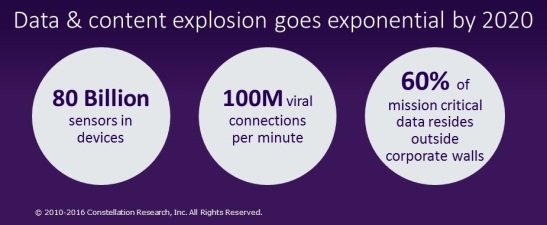
Constellation Research estimates that by 2020, at least 60 percent of the data considered to be mission-critical will live outside of the corporate firewall instead of in on-premises data centers. This trend has accelerated through the mobile, social and big data movements, with data and applications increasingly living and running outside of the four walls of the enterprise. As organizations shift from ownership to access, artificial intelligence (AI), Internet of things (IOT), and block chain will all require contextual insights to be delivered at the speed of thought.

Against this backdrop, Integration Platform as a Service (IPaaS) is emerging as a one-stop, cloud-based choice for supporting both data integration and application integration to help address the new requirements and challenges that organizations face. IPaaS provides the foundational and mission-critical capabilities required to support disruptive business models. Today, we’re releasing the top IPaaS vendors in the Constellation ShortList:

  • Dell Boomi
  • Informatica
  • Jitterbit
  • MuleSoft
  • SnapLogic

IPaaS Constellation ShortList

Over the past few weeks, we’ve launched more than 30 lists in our new Constellation ShortList program, which aims to help make the buying decisions easier for companies looking to implement disruptive technology in their organizations. Today, we also released the following lists:

If you missed the other announcements, feel free to check out our full library for this program here. When you’re ready, feel free to contact us to connect with the authoring analyst who can then help personalize the vendor selection process.


Constellation ShortList™ Social; Digital Media Engagement Platforms

Constellation ShortList™ Social; Digital Media Engagement Platforms

My Constellation ShortList™ for Social / Digital Media Listening / Monitoring/ Engagement Platforms was published today. Constellation ShortList documents offer buyers of technology a list of offerings to consider in their pursuit of digital transformation. Social, digital media listening, monitoring and engagement platforms are designed to build better brand engagement to drive customer loyalty and advocacy. Products included in this document meet the threshold criteria for this category as determined by Constellation Research.

Social Digital Engagement Constellation ShortList

This Constellation ShortList of vendors for a market category is compiled through conversations with early adopter clients, independent analysis, and briefings with vendors and partners.

Social / digital monitoring / listening and engagement solutions include listening, monitoring, analytics and intelligence, and engagement capabilities.

Social listening platforms capture online conversations based on the specific search query, offering key insights through the analysis of those conversations. These solutions are designed to evaluate a company’s activities and inform them on an overall social/digital media strategy. Often data from online can highlight every part of the business – from product launch and development to manufacturing and delivery.

Companies can develop social/digital strategies based on the insights gained through social/digital media monitoring. When a brand focuses on the highest potential markets or groups identified through market segmentation and influencer analysis, they can identify the optimal conditions for brand engagement and advocacy.

Constellation considers the following criteria for these solutions:

  •  Acquire real-time social/digital insights to inform social/digital media engagement and communication plans
  • Optimize design of advertising and marketing campaigns, as well as customer service engagement based on customer insights
  • Data management, data acquisition, export, archiving and API integration
  • Data analysis and visualization, media statistics, sentiment analysis, influencer profiling and analysis
  • Trend analysis, topic and theme analysis, word/tag cloud, competitive monitoring and analysis
  • Predictive analytics, campaign monitoring and measurement
  • Process management and user interface, data dashboard, workflow management, engagement capabilities, publishing, CRM.

Constellation evaluates over 50 solutions categorized in this market. This Constellation ShortList is determined by client inquiries, partner conversations, customer references, vendor selection projects, market share and internal research.

  • Brandwatch
  • Cision
  • Crimson Hexagon
  • Hootsuite
  • Nielsen Social
  • Oracle Social Engagement & Monitoring
  • SAS Customer Intelligence
  • Sprout Social
  • Sysomos.

For more information, please see the Constellation Research website.

@DrNatalie Petouhoff, VP and Principal Analyst, Constellation Research, Covering Customer Facing Applications

Share

Marketing Transformation Next-Generation Customer Experience Chief Customer Officer Chief Marketing Officer

IoT Visionaries and IoT Business Insights at Constellation Connected Enterprise 2016

IoT Visionaries and IoT Business Insights at Constellation Connected Enterprise 2016

Pilot and small-scale IoT deployments are becoming commonplace, but are these incremental improvements to current Business and IT systems all that IoT has to offer? The IoT Visionaries Panel at Constellation Connected Enterprise, CCE, 2016 had plenty to say about current deployments, lessons learnt and what real large scale IoT is bringing in a step change of Business Transformation. But discussion on IoT wasn’t limited to this panel alone, no matter what the Panel topic IoT soon appeared in the discussion as a key change factor.

The BIG message is that traditional IT approaches of small-scale IoT pilots linked to incremental cost reduction business cases work, but obscure the real competitive Business challenge that is underway. Attendees heard a clear message that the ubiquitous connectivity of IoT, integrated with Clouds, and AI, creates a wholly new generation Business Models based on Smart Services.

Most importantly these are no longer concepts as first movers are already transforming various industry sectors creating new revenue streams and reducing demand for existing business products.

The Constellation IoT Visionaries panel at the 2016 Constellation Connected Enterprise event featured top players in IoT solutions; Dick Ayres of GE, Stu Johnson of Plex Manufacturing, Mark Fodor of Capgemini, Charlie Isaacs of Salesforce, Tom Davis of Microsoft, and Brian Katz of VMware. Collectively these guys have worked on tens of deployments across multiple business sectors accumulating a mass of real ‘hands on’ experience.

The panel set out to answer three basic questions on IoT; what have you achieve, what have you learnt and where does this influence what happens next? Within this framework some pretty interesting ‘insights’, (to use an IoT term), emerged. Other panels on new Business Models, or on the Value of Data, Delighting Connected Customers, all echoed remarkably aligned and similar ‘insights’.

Insight number one; IoT is non-differentiating!

Companies across every industry sector are redesigning and shipping their products with inbuilt Internet connectivity, whilst others are adding sensors to instrument existing products. Public authorities are creating Smart Cities, and individuals are using apps to create Smart Homes. The result is that IoT is an environment, or infrastructure, reality that every Enterprise is part of and has access to.

Its not a case of adding IoT to your business, it’s a case of figuring out how to use the connectivity and most importantly resulting data to compete in new ways.

Insight number two; IoT doesn’t work… on its own!

IoT a key element in a technology combination of Clouds, and AI, with new ways of using Data, that integrated together enable the ‘Digital Services Economy’. The new competitive model is built around competing on ‘Services’ that may, or may not, be directly attached to a physical product. The connected ‘real time’ data flows generated by IoT transform traditional online Web Services into intelligent Smart Service interactions that match circumstances and opportunities into optimum commercial engagements.

Smart Services are the competitive capability arising from IoT that transforms industry sectors and enterprises must master for their ongoing success.

Insight number three; Understand the business destination

Pilots are a long-standing approach to new technology adoption, but almost by definition a pilot can only take place within the confines of the current business model, and that means justification solely on cost reduction. IoT is as much, or even more, about external connectivity and new market revenue creating models. CxO executives should grasp this and identify their business strategy ‘outcome’ rather than being driven by the technology products.

IoT is a defining term for a transformation of market places and industry sectors so an Enterprise adoption path should be based on competing externally, not on a handful of internal cost issues alone. 

Insight number four; IoT drives new Connected Business Models

Just as the Web removed the traditional competitive advantage of geographic location, so does IoT potentially remove the advantage of data ownership. Enterprises have to examine their current business model to find their ‘golden thread’; something of value to other ecosystem players that encourages their support to your Business Platform. Business Platforms with valuable golden threads can harness innovative service players to continually renew and extend their competitive position at minimum cost.

IoT interconnected Industry markets are a mix of primary players in competition with each other whose ability to compete is considerably enhanced by their ability to add the Services of secondary players.

Insight number five; IoT redefines the capabilities available to the COO

The COO of today attempts to maximize operational efficiency of their Enterprise on the basis of historical data, whereas in a fully transformed IoT Enterprise the role of the office of COO changes to ‘real time’ optimization of opportunities. Front Office connectivity to the external market opportunities become aligned and matched to the flow of data on the Enterprise Back Office status and capacity.

Much has been said about ‘agility’, but it’s through IoT real time data flows, AI decision making and orchestration of Services from Clouds, that it becomes reality.

Summary

This is the sixth Constellation ‘Connected Enterprise’ event and year by year the event theme of ‘connected’ has proven to be the driver of Business change. No matter what the topic, or sector, or even the speaker, the common theme is the manner in which the ubiquitous connectivity and interactivity of IoT is changing the specific activity.

However, equally clearly, the message is that IoT may be creating a new business environment, but IoT itself does not provide competitive business advantage. The capabilities of Cloud powered Data Flow ‘read’, with AI driven ‘react’ to deliver optimization of Business Operations against market opportunities will be necessary to support the ‘Digital Services’ economy 

The Digital Services economy requires Enterprises to work to recognize and develop their core strategic differentiated capabilities into a so-called ‘Golden Thread’ that integrates and adds value to other players in the market place. In new Business models an Enterprises unique differentiated ‘Golden Thread’ is their basis for becoming a dominate Enterprise Business Platform ‘tying’ other less dominate players into selling through them. Skillfully applied this business model ensures that the innovative and value adding capabilities of others are reinforcing their industry dominate position. 

Appendix;

Blog;

IoT drives Market Disruption by Market Leaders strategic focus on Business Platforms

Blog;

Corporate products are being disaggregated by IoT Smart Services and re aggregated as smart services


New C-Suite

Congratulations to the Constellation SuperNova Award Winner in Customer Experience!

Congratulations to the Constellation SuperNova Award Winner in Customer Experience!

The reason we at Constellation Research created the SuperNova Awards is because we know advancing the adoption of disruptive technology is not easy. Technology adoption faces resistance from budget constraints, hurdles to adoption, and myopia. All the finalists here today have successfully implemented technologies that will lead their organizations into the future. These people have vision. These people are leaders. These people understand the value of disruptive technology. All of the SuperNova Award applications are on the Constellation website.

Today’s customer demands a personalized experience during every stage of the buying process. Customers demand to be treated like royalty before, during, and after purchase. Customers want this same level of service across social, mobile, and analog channelsFinalists in the Next Generation Customer Experience category understand today’s demanding customers. They have implemented technologies and programs to boost brand loyalty and customer engagement. The finalists for Next Generation Customer Experience:

  • Amihai Zeltzer from Stanley Healthcare
  • Martin Marcinczyk from Comcast
  • Murray Swartzberg from the ATP World Tour
  • Roshan Koonja from Constance Hotels and Resorts
  • Scott Strickland and Jim Flatt from Denon + Marantz Electronics.

And the winner of the SuperNova Award for Next Generation Customer Experience is…. Murray Swartzberg from the ATP World Tour! Murray and his team won the SuperNova Award for enhancing the tennis experience for fans and players.  The ATP partnered with Infosys to produce Game-Stats that are based on the real-time in-memory paradigm aligned with IIP Tooling & Apache Spark. The project revolutionized how tennis analysts and fans receive statistics about professional tennis players

Make sure to apply next year!

Congratulations to all the executives and their teams who are truly making a difference in creating great customer experiences.

@DrNatalie, VP and Principal Analyst, Constellation Research, Covering customer-facing applications that deliver excellent customer service and customer experience!

Share

Next-Generation Customer Experience Chief Customer Officer

2016 SuperNova Award Winners Announced at Connected Enterprise

2016 SuperNova Award Winners Announced at Connected Enterprise

Constellation announced the winners of the 2016 SuperNova Award winners last night at the SuperNova Awards Gala Dinner. 

The Constellation SuperNova Awards celebrate the leaders and teams who successfully apply emerging and disruptive technologies for their organizations. The 2016 SuperNova Award winners demonstrated the foresight, creativity and measured audacity to successfully implement emerging technologies for their organizations. More information about the winners below. 

All applications were evaluated by the SuperNova Award Judges, and then put to a public vote. 

2016 SuperNova Award Winners

Data to Decisions - Madhav Marathe, Director and Professor, NDSS Laboratory, Biocomplexity Institute of Virginia Tech

Madhav Marathe and his team won the SuperNova Award for developing a suite of decision-support tools to help epidemiologists respond to and control pandemics. This project enables the institute to use predictive models to inform relief efforts. Analysts have deployed the technology developed by Marathe and his team during the H1N1, MERS, Ebola and the recent Zika outbreak.

Digital Marketing Transformation - Blake Cahill, Global Vice President, Digital, Royal Phillips

Blake Cahill and his team won the SuperNova Award for launching “Digital @ Scale”, a transformational strategy that brought together data from across Royal Phillips’ global marketing units. Before the project, Phillips' customer data was scattered and sporadic, making the maintenance of a central subscription status for their contacts a very manual process.The project, powered by Oracle Eloqua, has given both marketing and sales clearer visibility of new leads and existing leads and delivered a pipeline for sales worth € 9M in just nine months. Digital @ Scale initiative has since been implemented across 17 global markets in 60 countries.

Future of Work, Social Business - Michelle Ghandour, AVP Corporate Affairs, Canadian Tire Company

Michelle Ghandour and her team won the SuperNova Award for her implementation of Facebook at Work which ushered in a new way to collaborate to Canadian Tire, a ninety-four year-old company.  Canadian Tire implemented the platform quickly, enrolling 2,500 workers within the first 24 hours. Because the navigation is similar to Facebook, no training was required. Employees began collaborating immediately. Thanks to the implementation, content reaches twice as many employees. 

Future of Work, Human Capital Management - Patrick Ross III, Deputy Director of Membership, Team Rubicon

Team Rubicon is a nonprofit organization that unites the skills and experiences of military veterans with first responders to rapidly deploy emergency response teams to disasters across the globe. Patrick Ross and his team won the SuperNova Award for implementing Cornerstone OnDemand to speed the onboarding and training process so veterans can be deployed quickly when disaster strikes. The implementation enabled Team Rubicon to reduce volunteer onboarding time from four hours per volunteer to two minutes per volunteer.  

Internet of Things - Scott Strickland & Jim Flatt; CIO, Sr. Manager, Service Operations, North America; Denon + Marantz Electronics

Denon + Marantz is a provider of high-end audio and video equipment. Scott, Jim and team won the SuperNova Award for their leadership in an IoT customer service strategy. Denon + Marantz identified an opportunity to deliver proactive customer experiences via the HEOS product line which is connected to an Internet of Things (IoT) network. HEOS products use Oracle Service Cloud to monitor data in order to deliver predictive, personalized service experiences to Denon + Marantz customers. 

Matrix Commerce - Ken Finnerty, Vice President of Information Technology, UPS

Ken Finnerty and his team won the SuperNova Award his leadership in UPS My Choice and UPS Access Point. UPS My Choice gives customers control over the delivery experience while UPS Access Point enables customers to return packages at any UPS Access Point location. The UPS Access Point™ network, when combined with UPS My Choice® (UPS’s consumer-facing delivery management and notification service), offers consumers unprecedented control over the delivery experience. When consumers are not home to receive a package, UPS can re-route that package to a convenient Access Point™ location, such as a pharmacy, grocery store or dry cleaner for the consumer to pick up on their own schedule. Local small business owners who join the network experience increased foot traffic and exposure in their communities.

Next Generation Customer Experience, Murray Swartzberg, CIO, ATP World Tour

Murray Swartzberg and his team won the SuperNova Award for revolutionizing how tennis analysts and fans receive statistics about professional tennis. Under Swartzberg's leadership, the ATP partnered with Infosys to produce ATP Leaderboards, an application that provides statistical measures of the best performing players in the form of insights. The project is based on the real-time in-memory paradigm aligned with Infosys Information Platform Tooling & Apache Spark.

Technology Optimization & Innovation - Ed McMahon, CEO, Epec Engineered Technologies

Ed and his team won for their implementation of Netsuite ERP in a transformational project that improved scalability and efficiency across the business. Epec has reaped over $500,000 from its cloud investments with revenue increasing by 233%, making Epec one of the fastest growing electronic components-manufacturers.  

The Rewards

  • One ticket to Constellation's Connected Enterprise 2017

  • Three month subscription to Constellation's research library

  • Three month membership in Constellation Executive Network, including three month access to Constellation Insights


Congratulations to the winners! Continue to be brave, innovative, and disruptive!

Data to Decisions Future of Work Marketing Transformation Matrix Commerce New C-Suite Next-Generation Customer Experience Tech Optimization Innovation & Product-led Growth Event Report Executive Events Chief Customer Officer Chief Digital Officer Chief Executive Officer Chief Financial Officer Chief Information Officer Chief Marketing Officer Chief People Officer Chief Procurement Officer Chief Supply Chain Officer



IBM World of Watson - IBM's bets its future on Watson

IBM World of Watson - IBM's bets its future on Watson

We had the opportunity to attend the IBM World of Watson event, still going on in Las Vegas October23rd till 27th 2016. It is the first-time IBM brings all together under the Watson umbrella, and with keynote at a different venue (T-Mobile Arena vs MGM Garden Arena) tough to compare attendance with previous IBM events, so going with the 17k IBM shared. {Yes there was an intimate Watson ‘event’ with 1000 attendees a year ago – but not the same in my book like a large-scale conference as this one.)


So, look at my musings on the event here: (if the video doesn’t show up, check here)
 

No time to watch – here is the 1-2 slide condensation (if the slide doesn’t show up, check here):
 
 
Want to read on? 
 
Here you go: Always tough to pick the takeaways – but here are my Top 3:

Watson or bust – Not only does Watson get its own event, it also is the first-time CEO Ginni Rometty makes it to a Las Vegas event (that I am attending, ok) and the marketing spend in show floor, sponsors signage etc. seems to eclipse all the many events that started with an “I” in Las Vegas. The show floor itself takes most of the large space up in the Mandalay Bay Convention Center, and that with minimal partner presence (Box, Cisco and 2 more I think). So, Watson for everything, of course IoT, of course industries, sports, The Weather Company, personal development etc. – every possible use case for AI was on the show floor.

Bye Bye SoftLayer (in marketing) – IBM shared that it is consolidating its cloud brands with SoftLayer getting de-emphasized in favor of BlueMix going forward. Of course, all SoftLayer capabilities will remain preserved and continued. No surprise, the acquirer brand wins usually, and simplification is always a good true north. The message for developers is certainly attractive and simple – as it is all BlueMix. For enterprises with a differentiated IaaS and PaaS strategy the branding can be confusing, as enterprises may want / need the one and not the other. But with all things marketing – you never know – so we will be watching, how well this works for IBM.

Watson for Video – In many ways video is the new medium, as people read less, listen more but want visual stimulation, need to stay on top of large amounts of video, and watching video / TV is becoming an interactive experience. IBM has acquired video assets (Ustream and Clearleap), as they are also key to drive load to cloud infrastructure, the newly labelled BlueMix infrastructure now. And video is an area where Watson can make a difference, as pattern, picture, face recognition is well understood and mastered in Watson. Finding pictures, scenes in video is very powerful, as the next deluge – after the digital picture one – is from video. And the approach can be productized relatively easily, with little customization required, so a good showcase and revenue opportunity for IBM.


Analyst Tidbits:

  • The Assistants are coming – It’s good to see IBM providing more packaged offerings, always tricky in the AI area, but good to see progress being made with a series of Watson powered “Virtual Assistants”, the most notable for customer service. It was good to see frameworks for creating bot / chat applications. Check out my colleague Alan Lepofsky's coverage on this soon here.
     
  • Big partnerships – As usual IBM attracts partnerships with large corporation around its technology, of course here Watson. A partnership with GM brings Watson into OnStar for cross-selling, presence etc. A partnership with Pearson brings Watson into education. A partnership with Slack will bring Watson to IT professional with Assistants and open the popular chat platform for Watson and developers.
  • Watson Data Plaform and Watson Machine Learning – Two examples of how IBM uses Watson to enhance existing products (Data Platform) and create new product offerings (Machine Learning). Both are important for IBM's success in the new ML / AI future that is coming soon. Check out my colleague Doug Henschen coverage on this coming soon here.
    • Watson for iOS Apps – No surprise Watson also plays to augment (and likely differentiate) the applications IBM has built and is building with / for Apple on the iOS platform.
       
    • Watson for Professions – In almost a persona driven design approach, IBM wants to bring Watson capabilities to professionals in marketing, commerce, supply chain and HR. Certainly a good way to tailor AI capabilities and make the attractive to professionals. 
     

      MyPOV

      It’s always good to see vendors ‘boldly go’ and IBM is certainly betting its future on Watson. We have written and talked about the immense potential of Watson not only for IBM and its customers, but the overall market and business in general. IBM has done probably the best job in the industry at applying Watson and related abilities to any possible use case that is there for AI technology. Bringing it all together at an event like World of Watson is an important step, and it is good to see that IBM is doing all it can to propagate technology and use cases.

      On the concern side, IBM needs to make sure not lose the eye on ‘bread and butter’ business, e.g. buried in the announcements was a new, HTAP enabled version of DB2. That by itself would have carried a conference by itself not too many years ago. And pretty much all the solutions talk general capability with a grey line between Watson capabilities, product capabilities and what smart consultants are making possible. Prospects and customers want and need to know what are product vs. services capabilities, as the mix creates a very different value proposition. Hiding behind ‘it’s all about the solution’ won’t work for long, as tangible AI platform capabilities are key to evolve solutions that are powered by them.

      Overall we see IBM going Big on Watson, and it’s always good when software vendor put the marketing behind promoting and evangelizing their product innovation, IBM has certainly done a major step in this regards with World of Watson, good to see the commitment, now it is important to see the adoption and dissect on the product vs. services demarcation line. We will be watching.

      Want to learn more? Checkout the Storify collection below (if it doesn’t show up – check here).


      More on IBM:
      • Progress Report - IBM Alliances Insights - Deep Plans, now it is execution time - read here - read here
      • News Analysis - Workday, IBM Form Strategic Partnership on the IBM Cloud - The IaaS vendor race for SaaS load is on - read here
      • News Analysis - IBM Boosts Support to OpenStack's RefStack... first serious attempt to make OpenStack interoperability real - read here
      • Event Report - IBM Interconnect - IBM innovates and partners into the hybrid cloud era - read here
      • News Analysis - IBM and VMware announce partnership to accelerate enterprise hybrid cloud adoption >> Looking promising - read here
      • Event Preview - IBM Interconnect 2016 - read here
      • Site Visit - IBM Design Studio Austin - read here
      • MarketMoves - IBM strikes 3x in Fall - Cleversafe, The Weather Company and Gravitant - read here
      • News Analysis - IBM launches Industry's First Consulting Practice Dedicated to Cognitive Business - a good move it's early times - read more
      • News Analysis - IBM plans to acquire Cleversafe to propel Object Storage into the Hybrid Cloud >> a good move. Read here
        Market Move - IBM acquires StrongLoop - nodejs comes to BlueMix - read here
      • News Analysis - IBM and ARM Collaborate to Accelerate Delivery of Internet of Things - The IBM NextGenApps Stack emerges - read here
      • Progress Report - IBM Cloud makes good progress - but needs to attract more load - read here
      • Market Move - IBM gets into private cloud (services) with Blue Box acqusition - read here
      • Event Report - IBM InterConnect - IBM makes bets for the hybrid cloud - read here
      • First Take - IBM InterConnect Day #1 Keynote - BlueMix, SoftLayer and Watson - read here
      • News Analysis - IBM had a very good year in the cloud - 2015 will be key - read here
      • Event Report - IBM Insight 2014 - Is it all coming together for IBM in 2015? Or not? 
      • First Take - Top 3 Takeaways from IBM Insight Day 1 Keynote - read here
      • IBM and SAP partner for cloud - good move - read here
      • Event Report - IBM Enterprise - A lot of value for existing customers, but can IBM attract net new customers? Read here
      • Progress Report - The Mainframe is alive and kicking - but there is more in IBM STG - read here
      • News Analysis - IBM and Intel partner to make the cloud more secure - read here
      • Progress Report - IBM BigData an Analytics have a lot of potential - time to show it - read here
      • Event Report - What a difference a year makes - and off to a good start - read here
      • First Take - 3 Key Takeaways from IBM's Impact Conference - Day 1 Keynote - read here
      • Another week and another Billion - this week it's a BlueMix Paas - read here
      • First take - IBM makes Connection - introduces the TalentSuite at IBM Connect - read here
      • IBM kicks of cloud data center race in 2014 - read here
      • First Take - IBM Software Group's Analyst Insights - read here
      • Are we witnessing one of the largest cloud moves - so far? Read here
      • Why IBM acquired Softlayer - read here


      Find more coverage on the Constellation Research website here and checkout my magazine on Flipboard and my YouTube channel here.
      Tech Optimization Innovation & Product-led Growth Event Report Executive Events Chief Information Officer