


Enterprise AI projects mature: What you need to know now
Aligning AI projects to business outcomes, model routing, governance, perpetually rewriting software, process and managing humans were core topics at Constellation Research’s AI Forum in New York City, but the big theme is that best practices and projects are maturing.
The September edition of Constellation Research’s AI Forum 2026 is that AI projects have matured even from March. The growing pains are still there and enterprise AI needs better connective tissue between AI agents and business outcomes. But enterprise AI is headed in the right direction.
Here’s a look at some of the takeaways from Constellation Research’s AI Forum in New York.
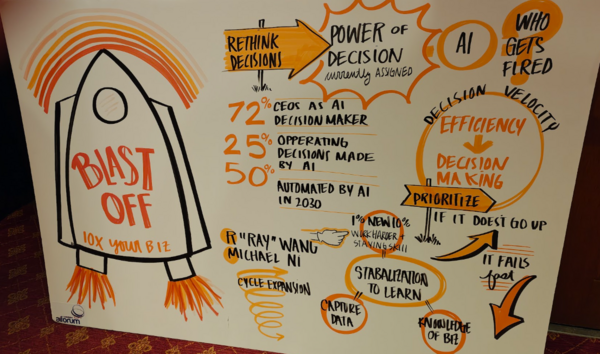
Enterprise AI will pivot to decision velocity and learning loops.
Yes, AI projects need to deliver returns with AI agents automating business, but the emerging theme revolves around changing your architecture so you can make decisions faster. The enterprise AI game will revolve around getting more at bats for decisions and iterating. You want to be the company that gets 10 at bats due to AI in the time a rival makes one decision.
Constellation Research analyst Mike Ni was quick to note that decision velocity and more at bats only work if you learn from each one. "If I'm not making the 11th decision better because of why I learned in the first 10, then I'm actually losing,” said Ni. “Dashboards die and we’re seeing learning loops as the place where enterprises actually live.”
These learning loops will require enterprises to balance deterministic and probabilistic processes. “Automate the deterministic processes. Take the probabilistic processes and improve the precision,” said Constellation Research CEO R “Ray” Wang.
AI cost is a massive problem and model routing may be an answer.
Chris Hallenbeck, SVP and GM of AI & Platform at Boomi, outlined how the company is cutting its Anthropic bill internally using the company's software. Hallenbeck said he optimizes costs with teams across Boomi using small language models and model routing.
He said:
"We were all thinking we're going to have an agent sprawl problem. We don't. We have a skills sprawl problem right now. First of all, skills are growing massively. Our own company has over 6,000 in regular use. We're only a billion-dollar company, so put that in perspective. We only have about 250 agents running processes and agentic workflows to core agents.
Skills are where the cost and the token usage is hitting us, and where the big bill from one of the big frontier models is crushing us. Through model routing, engineers are still using they're still using Claude Code, but we intercept that and then model route it based on the size of their wallet and activity. We're beginning to look at the individual request and route it automatically with our own software. And we've taken 15 times out of our Anthropic bill for our engineers."
Hallenbeck said his team is running business case analysis for work. Engineers building skills is one thing. Buildings slides is another. With model routing, Boomi has cut its costs for building skills by 87%. Employees are using the tool of their choice, but model routing in the background can save money. Don't rely on the user to pick the best model.
- Agentic AI deployments: What you should, and shouldn't do
- Subscribe to Constellation Insights newsletter
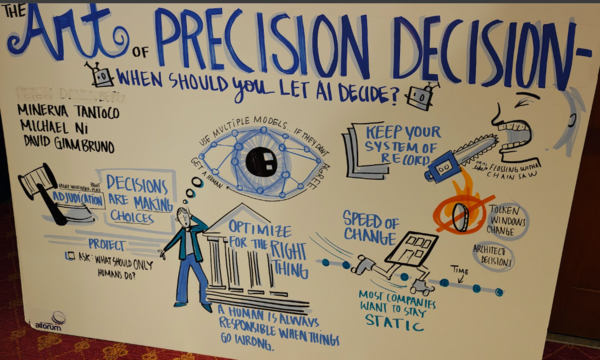
Architect for multiple models and optionality between deterministic and probabilistic outcomes.
David Giambruno, Managing Partner at Ancilla, said deterministic models and processes give you the accuracy you need on the budget you want. Deterministic code is nearly free to write now and easier to audit. "Almost everything a corporation does is deterministic. There is very little that's not," said Giambruno. "The best token you can spend is the one you don't need. Why would you ask a frontier LLM how to calculate add two plus two?"
Process and talent debt as critical as tech debt for AI success.
Vijay Vijayasankar, Global Agentic AI Officer at Genpact, said the IT debt issue is well known. What's overlooked is process debt and talent debt. "There's a lot of discussion on these topics. Many CIOs and CTOs have convinced their CEOs and CFOs to spend money on that. Now, this is a sin that has been committed for a long time, so it's not like in the next one year, you know, people will overcome all that debt. But the part of the debt that does not get talked about very much is the process debt and the talent debt," said Vijayasankar.
See: Genpact's AI chief Vijayasankar: Don't forget process, talent debt in AI projects | TCS' Bajaj: Corporate structures will need to be rewritten due to AI
Industry use cases for AI picking up
Hiral Chandrana, CEO of Veltris, said vertical AI projects are likely to have the most potential because of the combination of curated data, industry-specific workflows with guardrails and automation will drive business outcomes. Chandrana said industry-specific AI use cases "will have the most P&L impact and cycle time impact." "That's where the value creation really happens," said Chandrana.
See: Veltris CEO Chandrana on vertical AI, industrial AI use cases
AI sovereignty is broader than owning the technology.
Vincenzo Aquaro, Chief of Digital Government Branch at the United Nations, said AI sovereignty goes beyond technology. But the best outcome is probably virtual sovereignty where a nation controls the rules and data. "We believe it is not about who really physically own the systems, the data, the infrastructure, but the ownership, the rules, and all the governance framework belong to the countries," said Aquaro, who noted that the data control matters a lot more than the model used.
Rewriting software is perpetual now.
Giambruno walked through his AI agent projects and retiring tech debt. His take is that AI harnesses will go away, teams will get smaller and enterprise software will be perpetually rewritten. He has been able to cut token budgets by 90% in many cases. Focus on the AI SDLC (AI software development life cycle) and what’s a deterministic vs. probabilistic process. And embrace thinking in AI and cut the tech debt you’re building instantly.
“We're thinking about changing the product harness, and the AI comes back and says, "I am the product harness. The funniest things ever to watch with my teams scream at the agents,” he said. “We've done 101 releases in 55 days of AI improving itself, and 97% of the code to improve itself was written by itself.”
Continually building software revamps how you think about updating software. Anything you built a year ago is so outdated that you’re better off starting from scratch.
AI and human work: Questions abound.
While deploying AI has matured—even though most panelists put AI agents in the second inning and emphasized it’s early—the human issues aren’t resolved at all. Where do you put humans in the AI process? What is the future of work? Are humans merely accountability punching bags as AI runs a company? See: Personal AI assistants to proliferate and so will the governance headaches
Some quotes to ponder:
- "At each friction point, we used to say, 'Is it better off done by AI or human or both, and in what conditions?'" said Samir Kumar, Corporate Vice President of Growth and Innovation, Enterprise AI at Fortive.
- "It's really important not to anthropomorphize the agent. It's their assistant. It's their intern," said Asha Aravindakshan, COO of GlobalGiving Foundation, Inc.
- "We have built the agent with a human in the loop at the beginning and at the end and in the middle. The results have our name on it and we're liable for it," said Aravindakshan.
- "I call bullshit people write their whole documents with AI. I'm like, I know you have a brain. Let's see it on paper. I will call them out. If I can open a document and tell AI wrote it, I don't want to read it. I want to hear it from you. I will call people out very publicly because I cannot have them passing off the AI's work as their own. I worry a lot about the cognitive offloading that people are doing, especially the younger employees," said Aravindakshan.
- "Unit cost comes down. There is more work to go around, so demand increases, so jobs don't get lost. Judgment suddenly becomes pretty scarce, and that needs humans," said Vijayasankar.
- “It's a human that actually sets the goals, sets the context and owns up to the decisions. AI can accelerate things, but actually the human is in the lead,” said Ajoy Menon, Accenture's Senior Managing Director, Digital Core Lead.
- "A year ago we had a team of six to eight. Five months ago, it was teams of four to five. It's now teams of two, and that's getting to be too many. It's air traffic control for our AISDLC (AI software development life cycle), which has 68 agents running. My team's job is manage the agents, get the plane off the ground, land the plane. We can run 12 projects at once, and so more than two people, you start colliding,” said Giambruno.
And while we’re at it, here’s a look at previous AI Forums. Note the progression.
- March 2026: AI Forum 2026: There isn’t an easy button for AI | AI Forum 2026: "There are claws everywhere now"
- October 2025: AI Forum Washington, DC 2025: Everything we learned
- March 2025: Enterprise AI: Here are the trends to know right now
- September 2024: 13 artificial intelligence takeaways from Constellation Research’s AI Forum
Larry Dignan is Editor in Chief of Constellation Insights at Constellation Research, where he leads editorial coverage focused on enterprise technology, digital transformation, and emerging trends shaping the future of business. He oversees research-driven news, analysis, interviews, and event coverage designed to help technology buyers and vendors navigate complex markets with clarity and context. ...
Read morePublished
Author
