


Veltris CEO Chandrana on vertical AI, industrial AI use cases
Hiral Chandrana, CEO of Veltris, said vertical AI projects are likely to have the most potential because of the combination of curated data, industry-specific workflows with guardrails and automation will drive business outcomes.
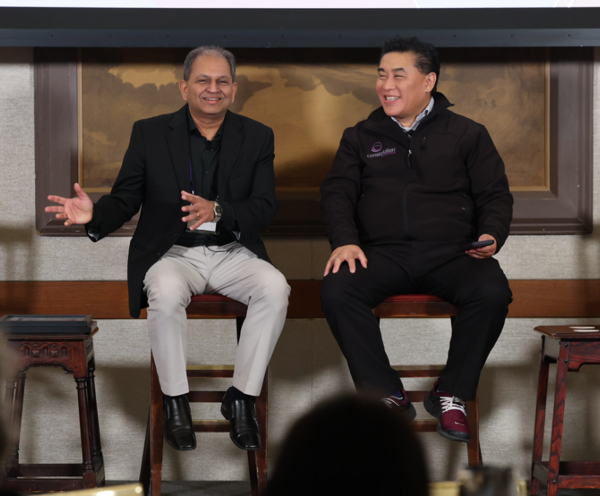
Chandrana, speaking at Constellation Research's AI Forum 2026 in New York, said industry-specific AI use cases "will have the most P&L impact and cycle time impact." "That's where the value creation really happens," said Chandrana.
Veltris made Constellation Research's list of AI-first services firms.
According to Chandrana, healthcare use cases are ripe for AI-based returns and financial services projects are also driving results.
The Veltris CEO also noted that private equity consolidation is becoming a growth channel for the firm. The big theme is that private equity firms are looking to create AI playbooks that they can deploy across portfolio companies.
Chandrana also said physical AI and digital twins are also driving demand. "People have talked about digital twins for like a decade. AI is actually starting to make them interesting now," he said.
Other themes from Chandrana:
- AI agent interoperability is a big theme and it's imperative that different platforms connect to automate end-to-end processes.
- Many AI projects are going to be scrapped. Chandrana said a third of current AI projects are going to be scrapped because "you're not ready, you don't have the right talent or you're not looking at the right micro-level use cases."
- AI-native companies will begin to pull ahead because they won't have the legacy technology and business models.
The vertical AI story
In the leadup to AI Forum, I dropped in on a conference from AI first services firm Veltris. The focus was vertical AI. Here’s a look at some of the takeaways from the sessions.
- Physical AI needs to evolve to the point where robots can make the same calls as a trained human worker would. What needs to happen is the robot needs to know when to stop and flag a problem that needs to be escalated to a human. “How do we get that intelligence to make the same decision, maybe not with the same processing, but at least the same response as a human would do. We need the robot to mark it and say, 'Hey, I couldn't figure this out,’ just like a human would," said Chris Taylor, VP of operation and engineering, Batchelor & Kimball, an EMCOR company.
- Digital models of buildings are a huge opportunity. Veltris clients have been digitizing buildings for years, the but next step is using those models to simulate renovations and additions before building ever starts.
- Business outcomes are key for AI implementations. Adam Desfosses, CIO of Owl Services, cited a use case where AI is matching point of sale activity with camera footage to flag suspicious activity.
- Panelists widely noted that AI projects need to be tied to operational KPIs. IT can pay for early innovation, but the business unit needs to own the project on its P&L.
- There is no value from AI until your data is unified, standardized and trusted. The advantage comes from what you do with the data not how much you actually have. Heather Preu, CEO Intellect, said the questions you ask are your actual business moat.
- The main problem in healthcare is disconnected data and systems that don’t talk to each other. Despite electronic health records, healthcare is a disconnected experience. A few areas where the health experience falls over include patients that can’t see insurance and benefit details and that reality delays care.
- The healthcare and AI framework revolves around efficiency vs. novelty and low risk vs. high risk. Anand Iyer, Chief AI Officer at Welldoc, said AI can change every stage of care from identifying a condition to acute care. Iyer added that healthcare will move to be “AI in the loop” as much as (and maybe instead of) human in the loop.
Larry Dignan is Editor in Chief of Constellation Insights at Constellation Research, where he leads editorial coverage focused on enterprise technology, digital transformation, and emerging trends shaping the future of business. He oversees research-driven news, analysis, interviews, and event coverage designed to help technology buyers and vendors navigate complex markets with clarity and context. ...
Read morePublished
Author
