Workday powers on - adds more to its plate
Workday powers on - adds more to its plate

Holger Mueller is VP and Principal Analyst for Constellation Research for the fundamental enablers of the cloud, IaaS, PaaS and next generation Applications, with forays up the tech stack into BigData and Analytics, HR Tech, and sometimes SaaS. Holger provides strategy and counsel to key clients, including Chief Information Officers, Chief Technology Officers, Chief Product Officers, Chief HR Officers, investment analysts, venture capitalists, sell-side firms, and technology buyers. Coverage Areas: Future of Work Tech Optimization & Innovation Background: Before joining Constellation Research, Mueller was VP of Products for NorthgateArinso, a KKR company. There, he led the transformation of products to the cloud and laid the foundation for new Business Process as a…...
Read moreThe Workday Rising conference has concluded and - fair to say - it was a very good event for Workday. There is something naturally exhilarating for customers, partners and vendor when their is significant growth - everything gets bigger and better including a user conference like Rising. And customer and partners are invigorated to see more companies being on board, doing the same as them.

Let's visit announcements, the findings from the keynote and Technology summit coupled with the takeaways.
Recruiting sees light of day
Workday showed the new recruiting application, which fills a key functional gap on the talent management side, that got more sensitive to Workday with Oracle's acquisition of Taleo - the go to partner for Workday before that acquisition. And Workday deserves credit that they not only built - but delivered mobile first - with the recruiting software using the known mobile platforms that Workday has used - with native iOS and Android apps and HTML5 for the rest of devices. Potentially we may see HTML5 only here - but later more on that.
The new mobile recruiting screens look polished and it is evident that Workday spent a lot of time to get the usability right. Desite all the lipservice to mobile first in the enterprise software industry - Workday may be the first vendor delivering mobile first for a major piece of automation. Behind the scenes recruitment, due to its circular and parallel nature, required enhancements to the Workday process management capabilities, that used to be strictly linear. An enhancement that will benefit Workday functionality beyond recruiting.

But its a first release of a major piece of business automation - so not all can be done and addressed - it will be important to understand how the roadmap of recruitment functionality will pan out beyond this first release. Major functional components like e.g. sourcing and the very start of recruiting in connection with talent pools, need to be defined and clarified further.
BigData Analyics - a new flavor
One of the key announcements was around BigData Analytics, in which Workday allows to query, import and transfer data in Hadoop clusters (the BigData component) through a business user friendly interface (with friendly support from Datameer) into the Workday object model. The analytics then are the visual representation of these imported contents in combination with the data already residing in Workday from the HCM and Financial side. And Workday builds templates that help both with the aggregation and extraction of the data and its representation in a new dashboard.
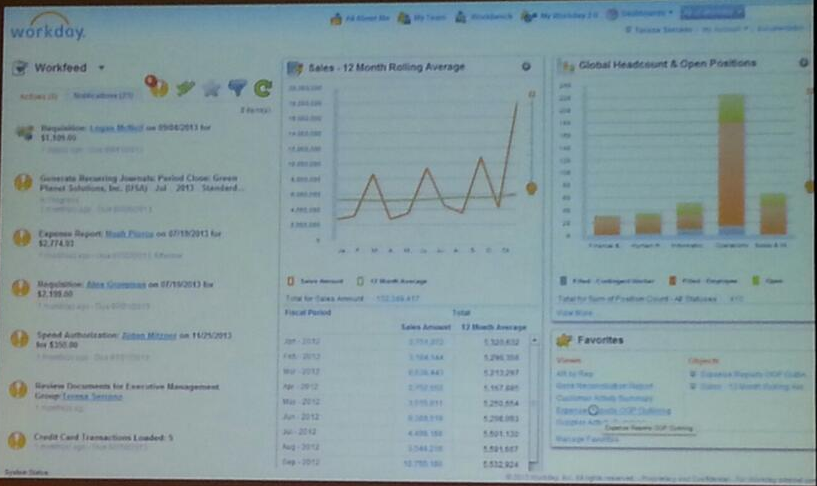
The approach makes sense for Workday in order to be able to offer the best content aggregated - or queried from an unstructured NoSQL system like a Hadoop cluster. And the examples around the compensation planning scenario, with the selection of compensation data coming from Deloitte and IBM / Kenexa is a great showcase. It will be interesting to see if customers could aggregate and mix and match across both (and more) sources - which would be a key value add.
Workday is one of the first enterprise vendors to uptake Hadoop capabilities and deserves credit for pioneering the space - but like the classic data warehouse vendors, Workday wants the Hadoop content in their own transactional - in this case object - space. But that defeats the idea of a non structured database like Hadoop - unless you could show a dynamic and on the fly morphing of that object model into anything the result set may require. And then drive to decisions or recommended actions powered by (real) analytics - the one that do or at least suggest an action.
But we didn't see anything like this - so non surprisingly one of the Workday design partners stated that internally, what Workday fancily, buzz-wordingly calls BigData Analytics - is simply called reporting. And maybe you should call it Workday's new dashboarding capability with an ETL that can merge unstructured content into its dashboards.
So Workday deserves credit for a first start - but a lot needs to be covered to make this a BigData solution (e.g. consider to put the Workday data into the Hadoop clusters for some higher insight potential) and add real analytical capabilities. Workday will also need to address the flexible representation of the result set - in a much more visually appealing way then in this release. The best dash boarding content can look tired and old when coupled with pedestrian visualization capabilities. Workday should think about using visualizations or risk being marginalized by the likes of Tableau and Qliktech for HCM dashboard needs.
Bye bye wheel - welcome new UI
The famous Workday wheel seems to have found the way to the scrapyard - and though odd - it was a strong unique identifier for the Workday UI. Gone with the wheel is also Adobe's flex technology, a good move of Workday to get rid of some technical debt ie thn its user interface layer.
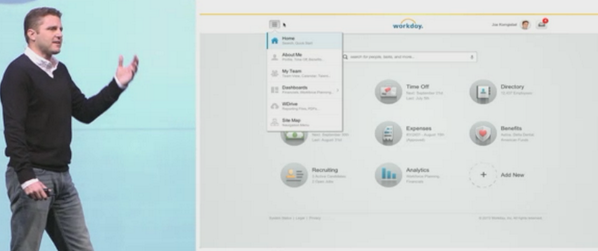
The new UI looks clean and takes advantage of all the nice HTML5 capabilities like re-sizing, zooming and moving objects. The wheel gets replaced by a more common menue and we saw the usual search options and drop down menus.
Like all other recent HTML5 UIs shown (e.g. SAP's Fiori and Infor come to mind) the density of information seems to be a victim of the new technology. The verdict is still out on what this means for usability - but it certainly makes the life of the vendors easier. We also did not see any detailed transactional screens, and that's where the rubber hits the road as far as new user interfaces and usability are concerned.
Welcome Workday Student
The other major announcement was the creation of the first vertical application of Workday with the creation of a higher education solution. If anyone doubted how long Duffield would still be active in the business re-watch the keynote video - there is no doubt that announcing new software is like a fountain of youth. And a ton of fun. And with Workday Student supposed to ship not before 2014 / 2015 we will see Duffield around for significant time to come.

And the move to HigherEd is a common path Duffield companies have taken - to the point that some of them are now leapfrogging from his 2nd last, over the last (Peoplesoft) company to the new Workday Student system.
One would be naive thinking that the release of the new recruiting system and the announcement of a HigherEd vertical are pure coincidence - there are nice synergies between the two - starting with the recruitment pipeline, the identification of skills and potential etc. On the flipside Workday will most likely face a set of not so usual competitors on campus - as we should not be surprised to see large internet properties like Facebook and LinkedIn pursuing the student market. Not the usual competition and Workday will have to show it can provide a consumer grade UI for the Millenial users that form today's student body and compete with a new set of competitors.
On the architecture side it remains to be seen how Worday will isolate and abstract for the new vertical functionality demand. This is particularly interesting since Workday business logic resides on an object model and given the poor track record of the overall enterprise software industry to create and maintain vertical functionality on top of moving horizontal function pools.
Little noticed... OpenStack
At the Tech Summit it was a nice surprise to see OpenStack / Grizzly on the slides. Workday had to build their own proprietary cloud tech stack when the company started out - as there were no standards and alternatives. But now these have emerged and it is key that Workday finds a way to tap into the larger (and cheaper) compute and other IT resources offered by the cloud infrastructure vendors... And while Workday has done this with AWS for development and test systems - it's still an open question for production systems. Equally we know that HP has announced that Workday will run in the HP OpenCloud - so OpenStack is a very good path for Workday to be able to run on HP's (and other) public clouds.
More importantly it gives Workday the technical capability to - yes horrible dictu - to deploy on premise. And while it may disappoint some cloud purists, this is a smart move given that we live in the age of the PRISM/NSA scandal fallout and vendors are wise to be able to deploy both to the public an private cloud. Customers may well ask and demand for that capability in the next quarters.
And as we speak about Workday and public clouds its worth mentioning that the BigData Analytics offering runs on top of AWS Hadoop service. It is better for Workday to use AWS than build up it's own infastructure. It will be interesting to see if customers care - but so far nothing critical in this regards has come up.
Less can be more
But apart from the new functionality seen - the major change affecting Workday customers will be that the company is switching from 3 to 2 releases per year. This is a good move as the previous pace put some onus on their customers, even though it's SaaS and supposedly these upgrades / updates are easy, they still take a toll on the users in the client organizations. It also equates into significant cost savings since instead of integration and regression testing the scope three times a year - Workday customers will now do this only twice a year. Certainly a welcome change. And in my experience a 6 months cycle is much more manageable for customers and is a good compromise between productive application usage and innovation in automation becoming available.

Moreover Workday will put a preview environment into the release cycle before production and after the sandbox - a good move to allow customers more time to familiarize themselves and test a new update.

Behind the scenes the company has moved to a single code line - which is a application development feat seldom achieved. Workday seems to have found a way to just flag the code and objects that need to go to a release or version. This gives Workday the ability to release functionality at will and also has the ability - shocking, too - to move off the one release lockstep mechanism for customers.
Putting my old product developer hat on, this is a key change for Workday and its customers and may certainly have been influenced by larger functional deliveries happening down the road e.g. with a new user interface, recruitment etc. and a huge flexibility win for customers and Workday. That said, it was also good to see the constant tuning and improvement mentality shared in detail at the Technology Summit - certainly a best practice and good to see it lived so well by Workday product executives.
Financials
The Financials side of the product seems to be doing well with Workday adding capabilities and scalability to qualify and play in the BigFin market space. The requirements of the Financial product are a good alternate stress test of the Workday platform compared to the HCM load.
My mayor takeaway is, that the Financials side is also a defensive move for Workday. Previously I blogged about Peoplesoft being challenged even on closed sales on the CxO level by SAP and Oracle - so the former Peoplesoft DNA does not want that to repeat this phenomena and being able to expand and own Financials as a footprint is one strategic move to avoid that Peoplesoft history repeats for Workday.
But on that front Workday missed to pitch to their predominant HCM centric user base present in the keynote audience as the value proposition of an integrated HCM and Finance system was not as clearly articulated. It will not make these HCM users go and see their Finance counterparts as soon as they are back in their office from Workday Rising. But what hasn't happened has the charme of being able to still happen in the future.
The road ahead
With recruiting shipping the major piece that Workday still misses on the HCM side is Learning - and the company for now is partnering in this area. But in a Q&A Bhusri was pretty clear that down the road Workday will address this functional gap - and not with an acquisition. That would be true to the Workday tradition of build and not buy.

On the payroll side the company plans to ship the UK and France payrolls in 2015 and 2016 respectively. The overall thinking off the management team is that with 7-8 native Workday payrolls the company can cover enough ground in terms of critical user base. The rest is planned to be addressed with partners and with plans to extend and expand the payroll interface for those partners. This will pose still some headache to international customers who will have to look for partners and run interfaces that could break - every and any pay cycle. And what we heard more than one time from customers on stage was, that they key value for them was .... integration.
The non product challenge
Workday will have to keep growing revenues, customers and expand its global presence at a fast and steady pace to keep investors happy. Japan was announced at the conference as a new country Workday will operate in. The good news for Workday is, that it can source from its former Peoplesoft bench - but the competitive landscape is changing and the pressure to deliver numbers has not changed - but only increased.
MyPOV
If you were - like yours truly - very concerned that Workday has already a lot on its plate - then the company has certainly added more to its plate. But executives seem to be confident that they can deliver - and to their credit - they have so far delivered. Shipping a thought leading recruiting product will be a key milestone. The technical challenges seem to be under control and some weaknesses are turning to the better - so 2014 will be a key year for Workday to continue to deliver on product and master the non technical growth challenges as well.
---------------------------------------------------------------
If you missed it - check out the Storify collection here.
Wondering on my pre Rising questions - I will come back to them in a later post.


 SaaS Adoption Gains Ground, Based on Outstanding Economic Characteristics



 Industry veteran joins Constellation Research to extend coverage of enterprise software by publishing