An Update on Enterprise Low-Code and AI: Appian World 2023
Vice President and Principal Analyst
Constellation Research
Title: About Dion Hinchcliffe
Dion Hinchcliffe is an internationally recognized business strategist, bestselling author, enterprise architect, industry analyst, and noted keynote speaker. He is widely regarded as one of the most influential figures in digital strategy, the future of work, and enterprise IT. He works with the leadership teams of large enterprises as well as software vendors to raise the bar for the art-of-the-possible in their digital capabilities.
He is currently Vice President and Principal Analyst at Constellation Research. Dion is also currently an executive fellow at the Tuck School of Business Center for Digital Strategies. He is a globally recognized industry expert on the topics of digital transformation, digital workplace, enterprise collaboration, API…...
Read more
I'm in San Diego this week for Appian World, the annual confab of the well-known enterprise low-code and citizen development platform provider. Low-code has come a long way from the early days, when drag-and-drop app builders were just getting capable enough to use by the average IT staff member or business analyst. Now data fabrics, process mining, industry templates, and artificial intelligence are standard fare in the large enterprise low-code suites.
For its part, Appian has helped the industry revolutionize the way businesses create and deploy applications, greatly lowering the cost of development and accelerating time to value. Since its inception in 1999 by co-founders Matt Calkins, Michael Beckley, Marc Wilson, and Robert Kramer, the company has sought to provide organizations with an effective and user-friendly platform that streamlines app development, allowing for quicker innovation and improved efficiency. Today, Appian is known for its transformative impact on the business applications and process execution landscape, with an extensive portfolio of clients ranging from government agencies to Fortune 500 companies.
Over the years, Appian has reached many key milestones that have solidified its position as an industry frontrunner. In 2007, the company unveiled the first version of its low-code platform, which would ultimately become the foundation for its modern product offerings. Appian's growth was further accelerated by venture funding in 2008, which enabled them to scale up and serve an even larger market. The company has continued its upward trajectory, going public in 2017 with a successful IPO on NASDAQ. The past two decades have seen Appian reguarly push the boundaries of low-code development. With its long heritage and industry staying-power, the company is poised to continue shaping the future of application development for years to come.
Live Blog of Appian World 2023: Day 2 (First Full Day)
What follows is the the unfolding events of Appian World today in San Diego:
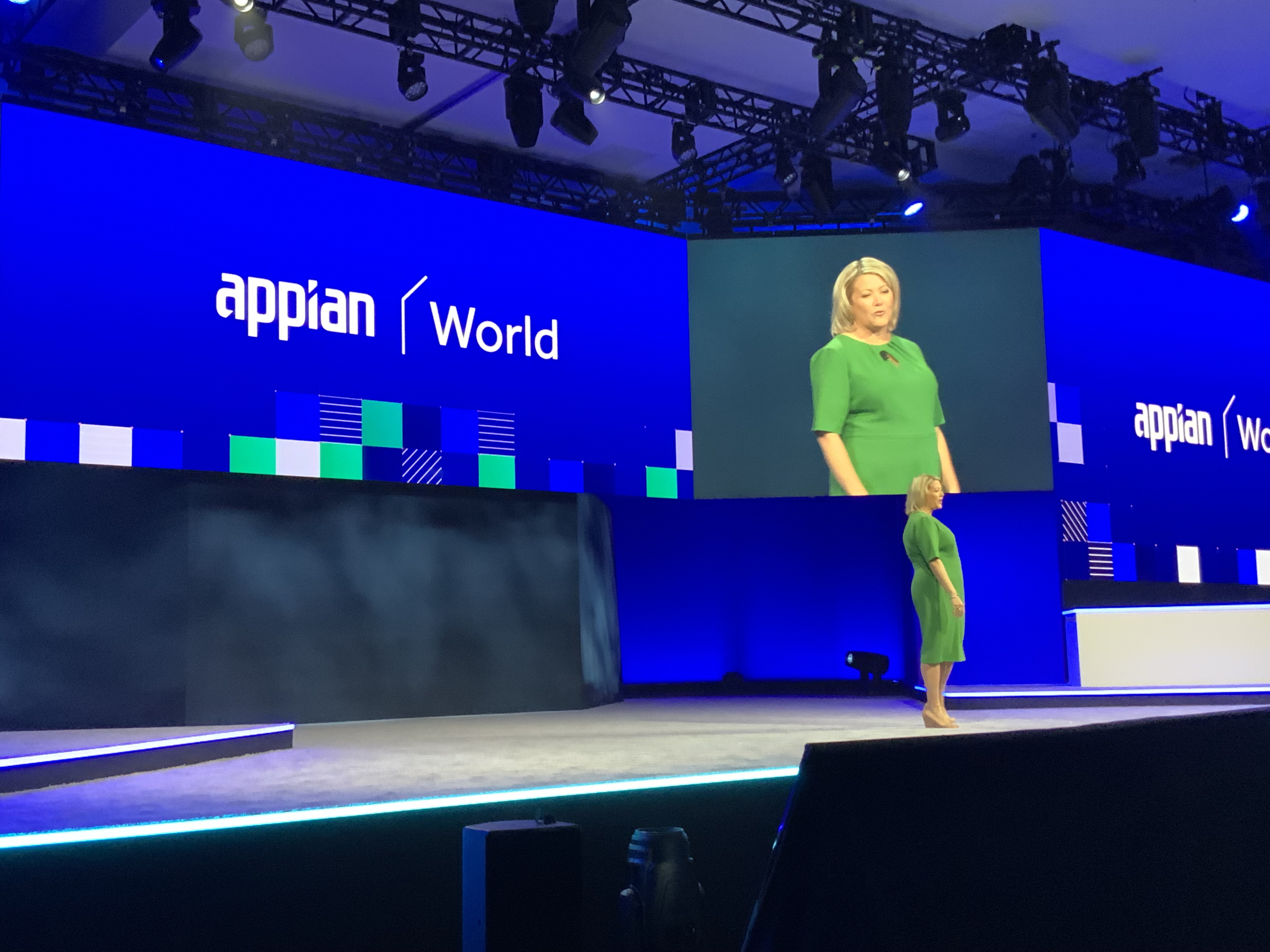
8:53am: I'm in the front row at the general session keynote. We're waiting for co-founder and CEO Matt Calkins and team to come on stage.
9:09am: A rousing video kickoff is showing that was co-generated with AI, about low code and its relation to artificial intelligence. It's a decent overview that helps set the stage for the morning.
9:12am: Now April DelFavero is starting off the main keynote session: "This event presents an incredible opportunity to bring together our global community of digital transformation leaders Appian delivers end to end process automation and is purpose built to help you solve your most complex processes."
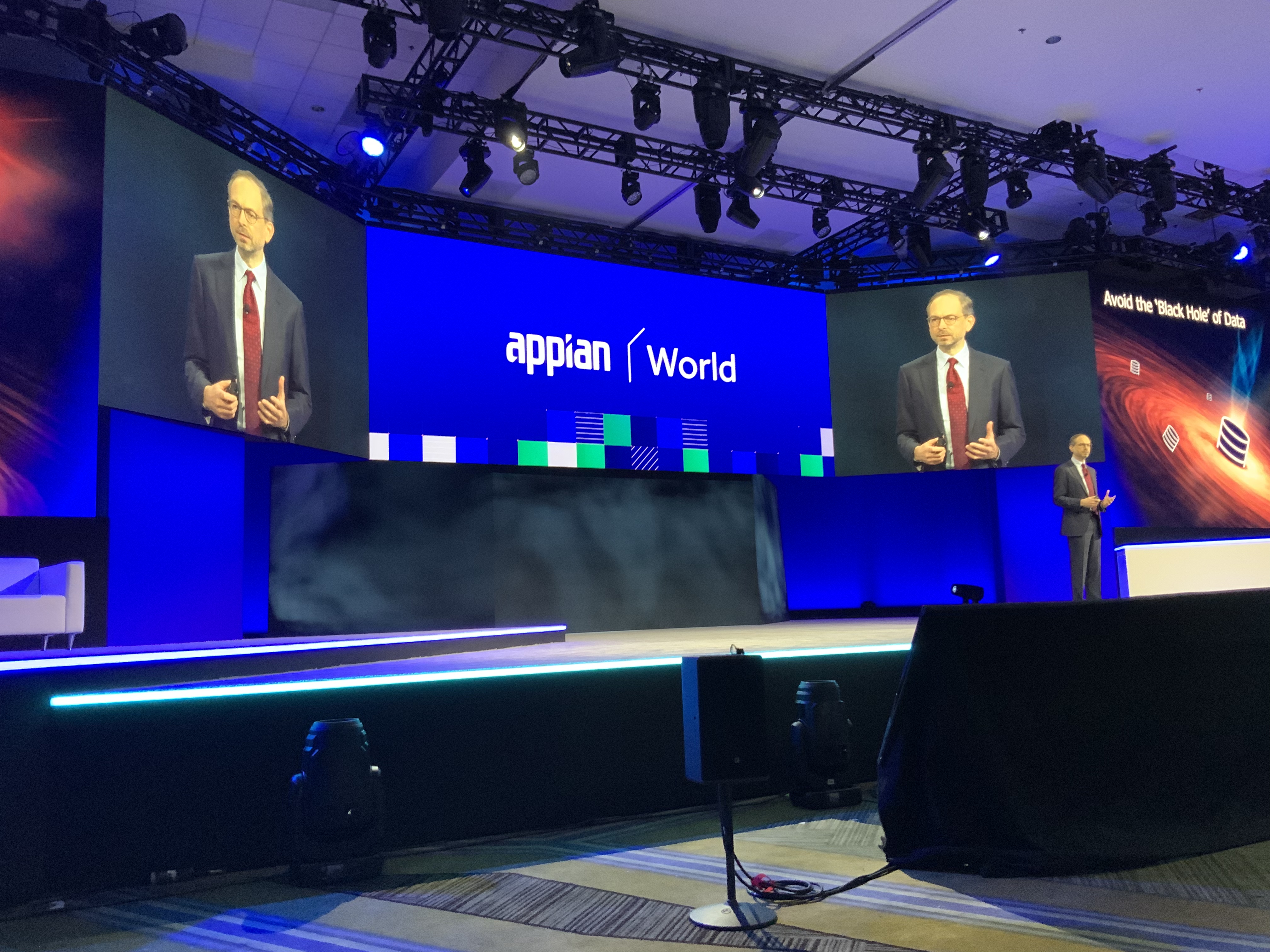
9:13am: Founder and CEO Matt Calkins is now onstage making the case that Appian's message to the market is simpler than ever before: "Anything you need to do with a process you can do on our platform. It's a complete, end-to-end software layer for your processes."
9:19am: Now talking about data fabric and how it unleashes enterprise data: "We're respecting the the architecture of your enterprise. We're leaving the data where it is. We're treating it all as a unified entity and allowing you to have access to it as if it was one with vast data source that is exceptionally valuable." Noting that traditional approaches are very burdensome.
9:21am: Cites specifically productivity gains they're seeing with Appian customers; "I can tell you that some Appian customers have seen a 50% leap in productivity and output per customer hour."
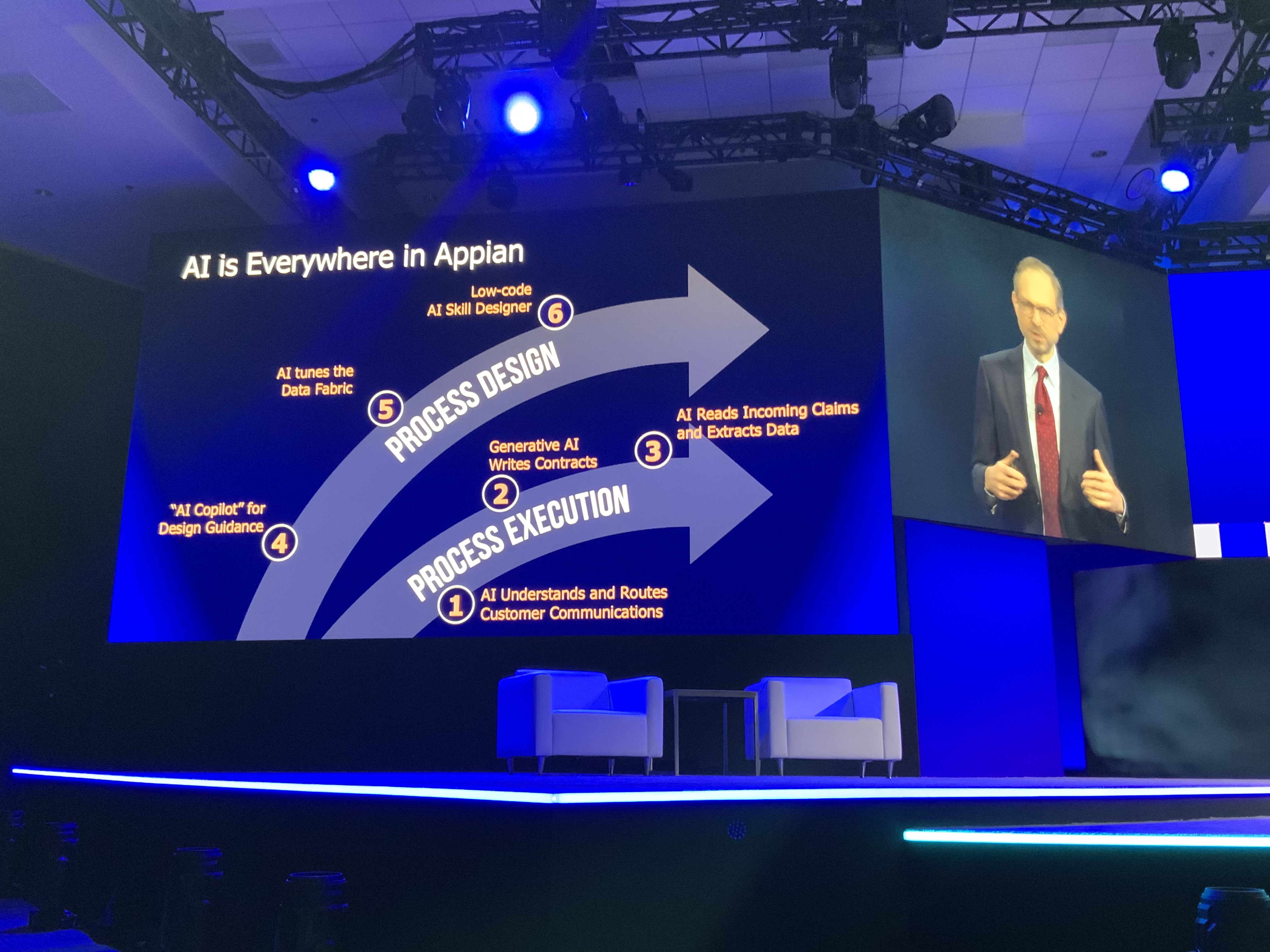
9:22am: Now talking about artificial intelligence, which is the hottest topic in the industry right now. "The other thing I primarily want to talk about in this speech is AI. Appian uses AI throughout its architecture. We use it for design of a new process and we use it for execution of that process. You really can't escape artificial intelligence. If you're using AI, it's everywhere." Teases an annnouncement.
9:25am: "It's really astonishing what AI can do. It has peaks, and it has valleys and the natural question we might ask is, how can we get the upside of AI without suffering the downside? That would be a smart question for all of us to be asking in 2023. And luckily, there's an easy answer. The answer is that people have to be involved." Although I'd argue people can't be involved in the details. You cannot scale AI if people are involved in every step. But Matt has a lot to say on AI, so let's follow the argument.
9:30am: Matt is now diving deep on AI, making a distinction between public AI and private AI. Makes a major case for private AI as key to competitive advantage. "Our intention is to be sure that we're supporting your vision, your freedom, your freedom to choose the best of breed products that you want your freedom to keep data where you put it, your freedom to keep your information and train your own AI algorithm instead of sharing it with your competitors and with your vendors." Making a strong case for not over-exposing data and AI models to public scrutiny, although there is going also be a broad industry/government push for just that at some point. But that particular but necessary privacy/regulatory/ethical discussion is for another day for now for most vendors.
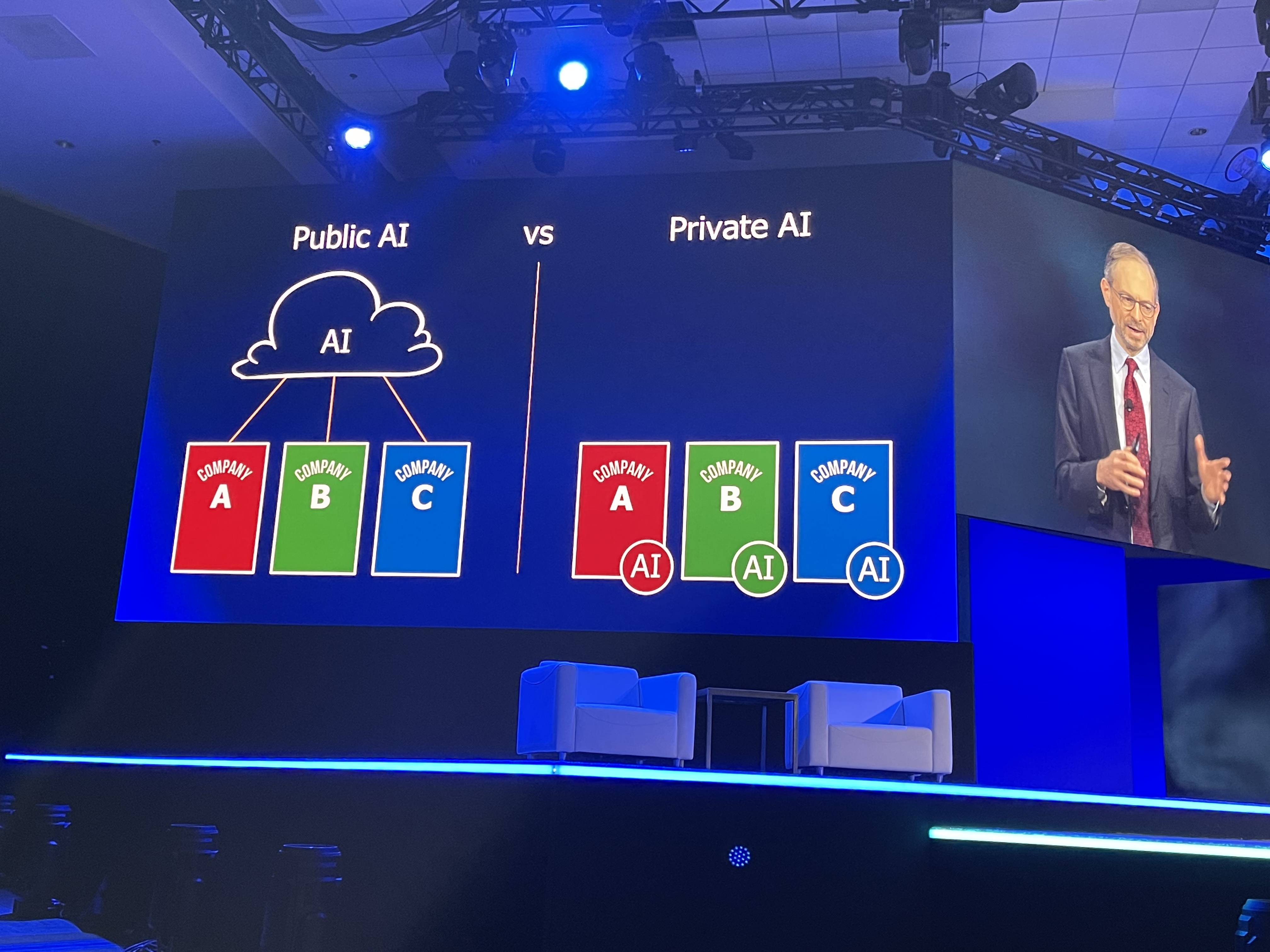
9:35am: Now here's probably the core of Matt's vision for AI for Appian and for enterprise low code in general: "Private AI means every organization every major organization in the world has its own AI algorithm. It's based on some publicly available models of open source AI, but then you train it yourself. You train it internally based on your own information. And it becomes your AI purpose built focused on the things you need, trained on the data you have the forms you have the behaviors you want.
Key point (my emphasis): The data never escapes your control. and all of the models stay unique and you preserve the totality of the benefit for your own organization as you should. I believe that custom AI is going to become like custom applications. Every organization is going to want it for themselves. and we'll end up with a situation where it's, it's second nature to expect that everybody's going to cultivate their own AI algorithms based on popularly available AI technology. This is the future that I predict."
9:37am: Now talking about the maturity of low code and the scale of solutions that can be developed for it. "Solutions have reached a high stage of maturity, such that it would make sense for everyone in this room to be thinking about using it. Low code apps are very broadly used. They do an exceptionally high volume of work.
Such as a procurement system, which is a government acquisitions management system that's doing 10s of billions of dollars of acquisitions every year at this point. It's very mature, a very high test solution. A solution has a lot of built in expertise and so you can benefit from all the expertise we have stocked our solutions with. It has the latest features, of course, like the Data Fabric, the automation solutions are up to the moment and they stay up to the moment because we keep updating them and that makes it easier for these new offerings to stay fresh with your solution. It has integrations already built-in."
9:42am: Now announcing Process HQ -- see my video of him providing a detailed explanation of the forthcoming solution -- Matt explains what it is and how it works: "What we've got here is low code process mining using our data fabric to connect to data across the enterprise. This is very different already from the typical way process mining would work. Generally it's a hard hard struggle at the beginning where you seek out data, parse it and and try to integrate many different sources. "

9:45am: "Because we've got this real time awareness of data why not make process process mining a real time phenomenon? Instead of one survey that gives you one set of results after a quarter of work? How about just every minute you can log in and see how your efficiency is going?" Basically, they are making process mining a continuous, real-time workflow that enables organizations to mine and optimize their organizations as a seamless, ongoing endeavor.
9:47am: Cites early figures from a new study on Appian's low code benefits: "90% reduction in development time. Less than 6 months to pay back the initial investment in Appian. 95% acceleration in operational processes." I've long cited the potential of low code to dramatically improve both development time and operational processes, now we are indeed seeing the hard data that shows this is the case.
9:50am: Matt wraps his opening keynote.
Customer Story: Food and Drug Administration (FDA)
Now Vid Desai, the Chief Information Officer (CIO) of the FDA, is up on stage at Appian World 2023 talking about low-code at that vital U.S. government agency.
11:03am: Vid is exploring the huge remit of the FDA and all the aspects of the food and drug supply chain. "We're part we're a regulatory agency. That's part of the Health and Human Services. Part of our mission is to ensure that the products that we regulate, are safe and effective. And we regulate a lot of products."
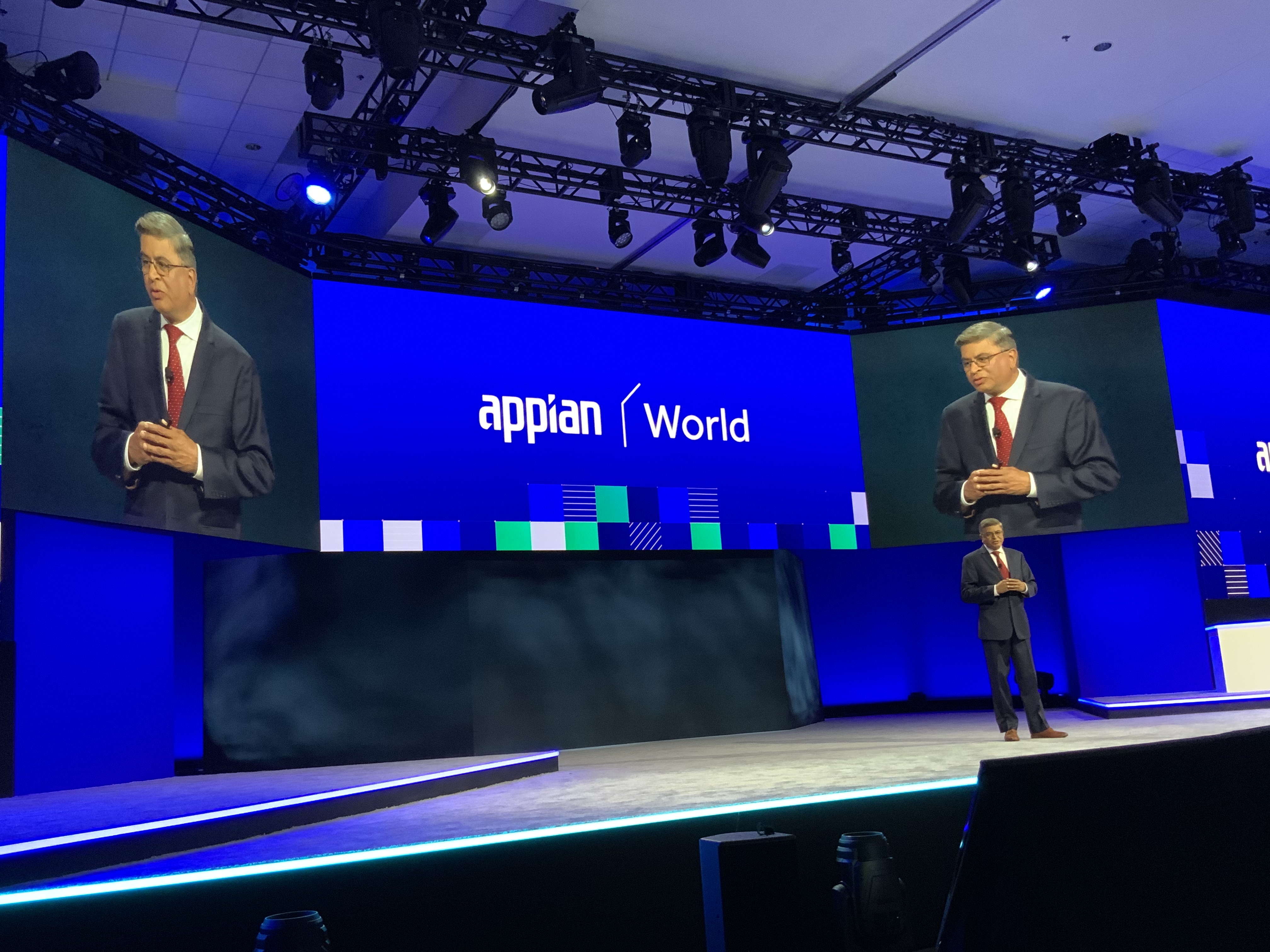
11:06am: Vid talks about the extremely rapid changes happening in how the FDA works: "The science is changing. It used to be the case that we relied a lot on chemistry. But now increasingly, we're in the world of genomics and genomics datasets. And we're rapidly moving away from looking at products and developing products based on PDF documents submitted to us. Now we are analyzing very complex large genomic datasets. The technology is changing. All of you are familiar with the IoT, AI, cloud. There seems to be a new technology almost every day that's obviously changing the world around us." Engaged in a multi-year modernization process to transition to this future that is far more data-infused and AI-powered.
11:08am: "But anyone that tells you that they have a cookbook for modernization is essentially lying to you" on the enormous challenges of changing a large organization like the FDA.
11:14am: Now Desai gets down to the real value-prop and motivation for low-code: "Frankly, IT so far has been a bit of a bottleneck."
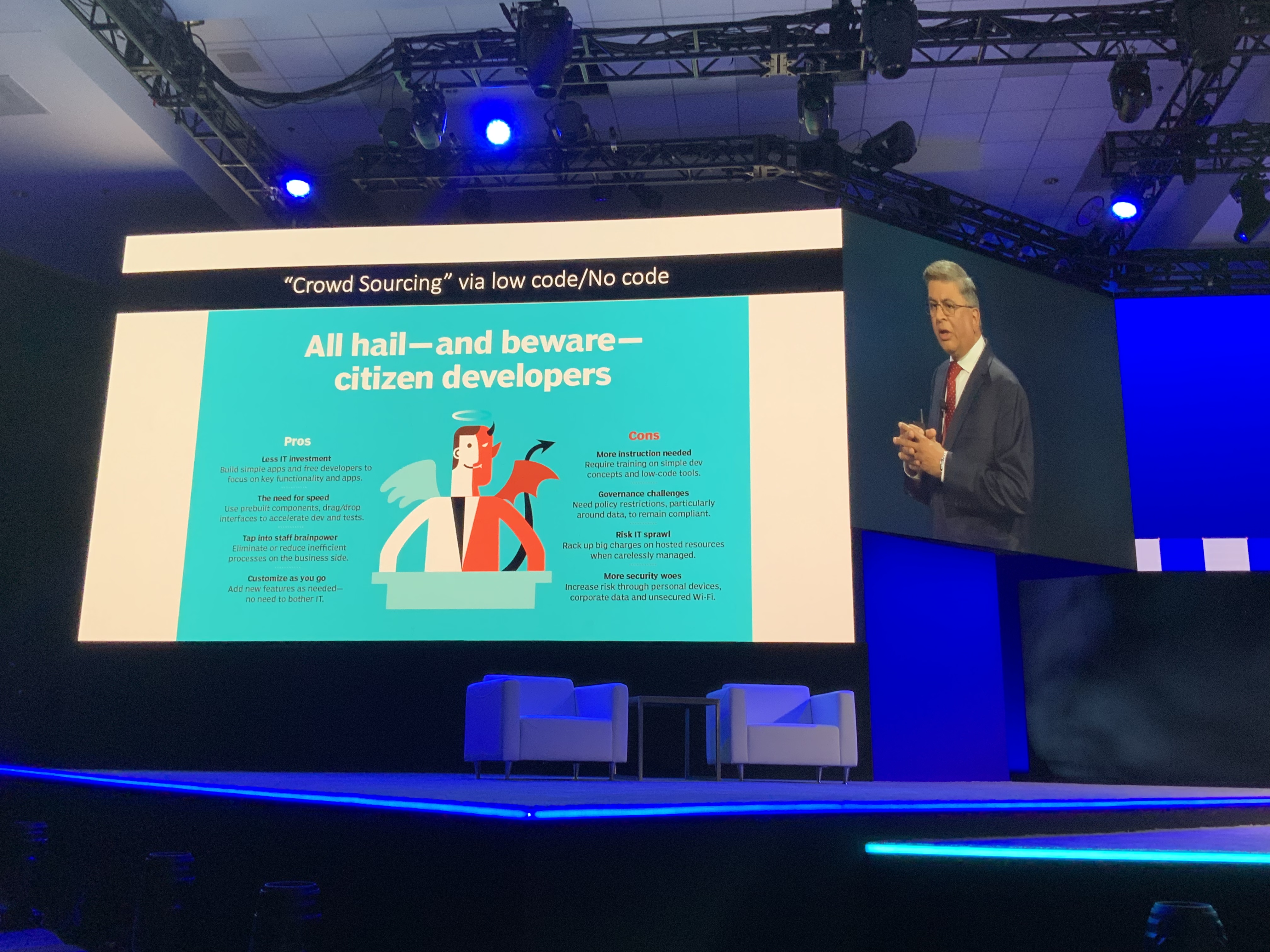
11:16am: Desai also makes of the best statements on the enormous potential of citizen development that I've heard from a major CIO: "Enabling citizen developers I believe is a very powerful thing. Now IT can become an enabler. We empower the business folks to go develop their own solutions. They understand their problems the best, they are in the best position to solve them.
So we equip them with the right tools and the right governance structures around that. And they can create solutions, which frankly from an IT solutioning perspective is exponentially greater than what we're able to do right. So I think this whole concept of citizen development.... some people are scared of it... but I think it is a very powerful movement is going to really increase the effectiveness of IT."
11:20am: Talks about the high stakes of changing and the traditional processes of procurement which can take years to see if they've even gotten anywhere. Seeks to move to more real-time use of data, process mining, and process optimization: "You can develop a whole new solution and kind of cut over our business. We can't shut down 1/5 of the economy while we cut over to a new environment. We've got to fix our processes while they're in use. And so the process mining way is a very important way that we're now creating our new solutions." Says favorable things about Appian's ability to deliver on this: "Instead [of lengthy traditional process modernization], we think the process mining approach that Appian offers is really powerful."
Backstory: Mission-Driven Innovation: Inspections and Digital Services at the FDA
Other News at Appian World 2023
Also announced today was the Appian AI Skill Designer. It integrates generative AI into the Appian platform to reduce the need for specialized data science and Python coding skills. AI Skill Designer can create custom AI machine learning models on an enterprise's private data. This enables customers to create unique AI solutions that are tailored for their business without the need for hard-to-find data science skills. Three AI skills are available at launch, including e-mail classification, document classification, and document extraction.
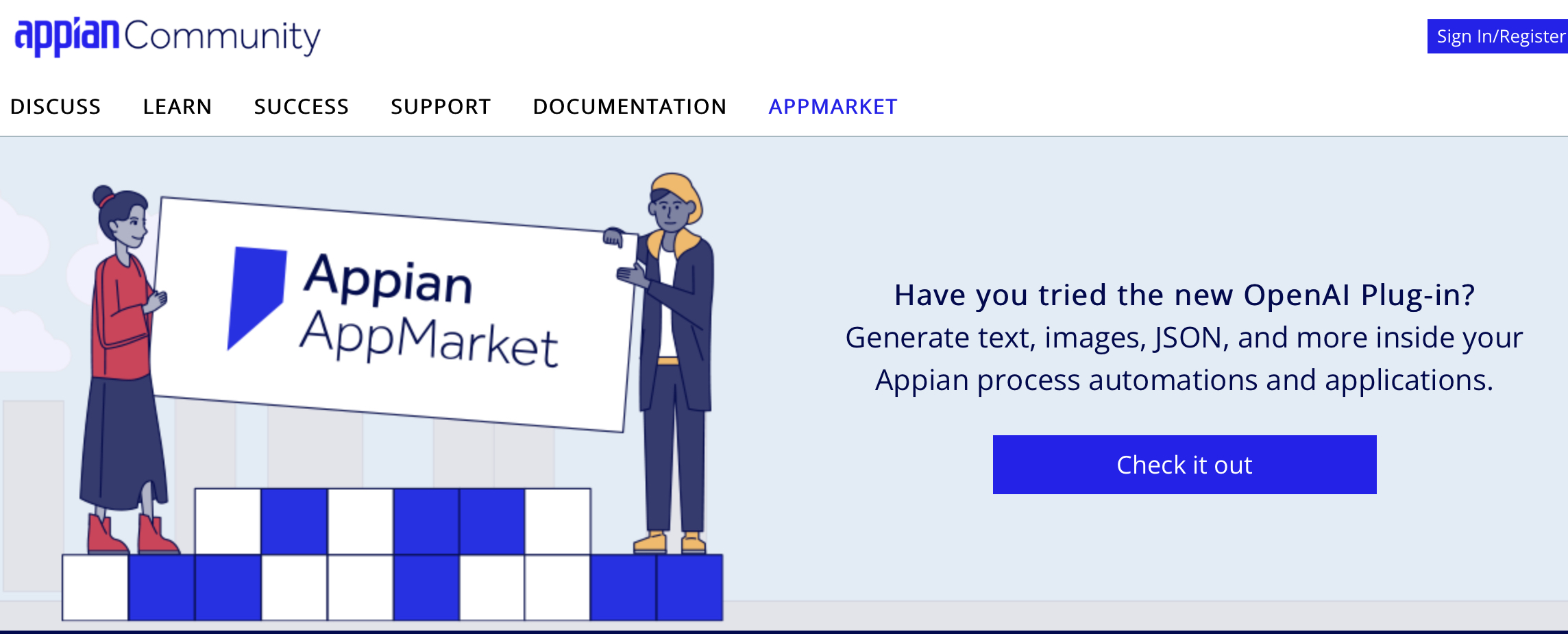
This provides the private AI capabilities that Matt talked about in this keynote. However, AI Skill Designer is also built on an extensible architecture, so others can extend it and provide new skills from the Appian App Marketplace. Appian also has created the first AI Skill extension, an OpenAI/ChatGPT Generative AI Skill available now available on the Appian AppMarket, which provides public AI capabilities in apps developed with the low-code platform. Appian is thus delivering on both sides of the public/private AI divide that Matt talked about so passionately in his keynote.
Separately, Appian also announced a new "Insight to Action” Process Mining Program. The new service provides process mining preparation, analysis, and service hours to implement process improvements, all for a one-time fixed fee. While process mining can find bottlenecks, inefficiencies, and insights into how to improve the business, the results are often famously difficult to interpret. This service is intended to reduce the disconnect between process mining and the downstream automation technologies needed to implement the needed improvements.
Fixed free is a brave and in-demand model, though IT buyers have been wary of them in the past, since they often require more actual budget to reach completion. Appian is apparently aware of this and reading between the lines, it appears that not all process mining scenarios are candidates for the program. However, in an economically constrained environment in 2023, I predict there is appetite for access to fixed price services like this.
The official Appian Insight to Action service offering can be found here.
Live Blog at Appian World 2023: Day 3
9:07am: April DelFavero introduces Appian CTO Michael Beckley to talk about product vision.
9:11am: Michael Beckey starts off the product vision keynote, doing the usual disclaimers. Talks about a post on a "from Reddit from the Appian forum from just a few days ago, where Appian developers were expressing some angst and anxiety about whether or not AI was going to come into their jobs."
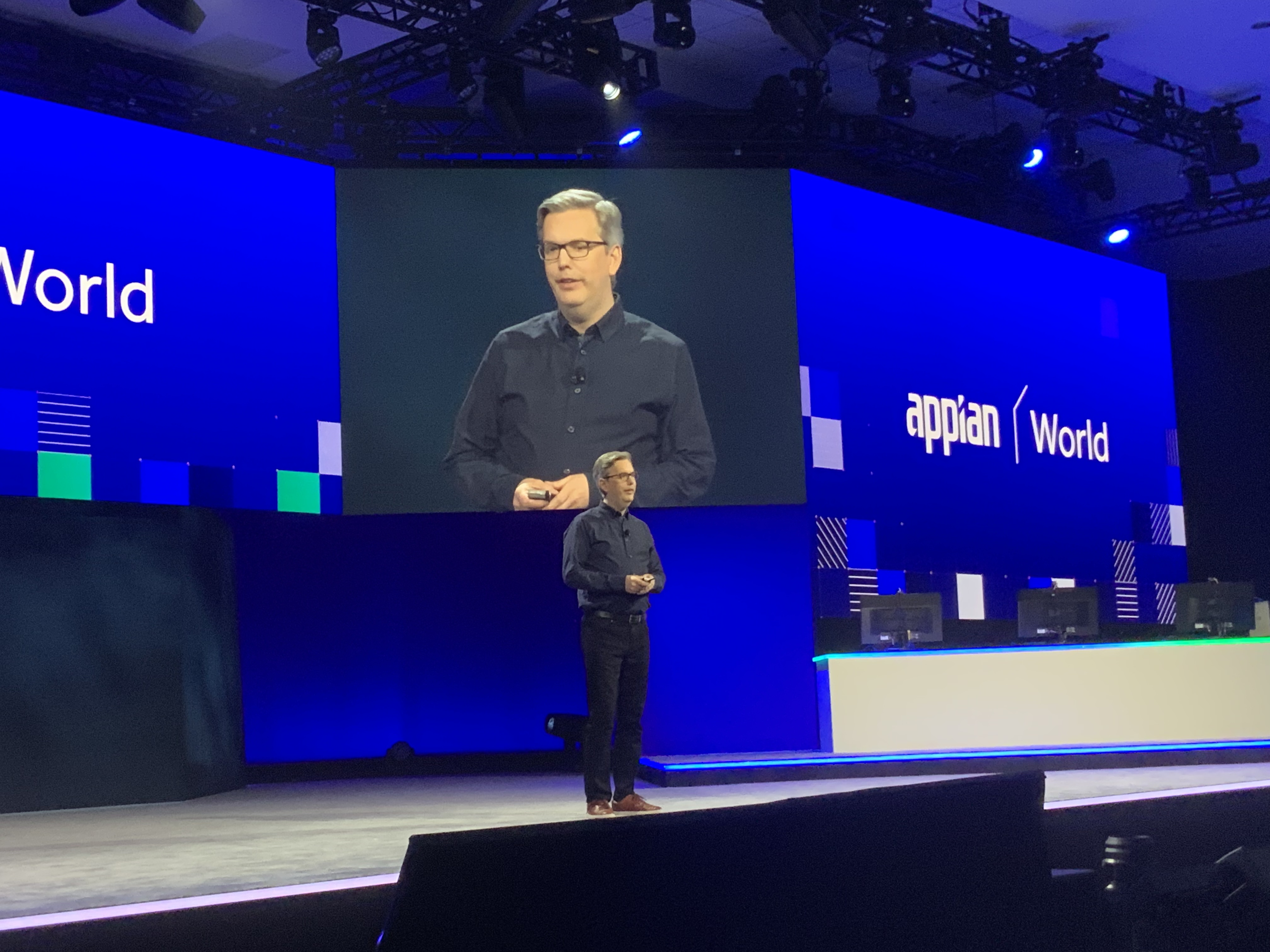
9:14am: Dismisses the concern however, noting that "this was true with Model Driven Development with drag and drop design. And yet the reality is when we make it possible for you to do so much more with less than the reality is you're more valuable, and you need more developers. So that's been true throughout Appian's history. There are now 10 times more developers than there were before we introduced visual design." I talked to Appian folks today, about the fact their platform unleashes the 24x more non-developers out there. Despite this, professional devs are still in high demand.
9:18am: Talks about the declarative language, SAIL (self-assembling interface language), that makes the Appian platform work so simply. Talks about that it must be possible to make it easy to teach AI. And that it works well with a consistent data fabric: "Similarly with the data fabric, it's a messy world out there you have hundreds or 1000s of API's. So they all have different syntax. They all have different functions. And it can be confusing to navigate, which is why we built the Data Fabric product common vocabulary to make it simple for you to interact with. And again, it's simple for users and developers. It should be simple to teach it to an AI."
9:22am: Now Mike explores how they are using large language models (LLMs) to make querying the data fabric far more contextual and effective. How Appian has "already been taking a large stride towards making it self service. Making it simple for people to build instant analytic solutions" using AI. Then presents a full demo of how they have gone from predictive suggestion of analytics to full free-form natural language queries, that then result in working analytics dashboards.
9:24am: "So we can interact with what the AI generated and get to the exact result you as a developer want or as a business user. Doesn't doesn't matter at this point. Now you're creating a really sophisticated report in seconds, not minutes, not hours and not even necessarily waiting for whatever that backlog is. What we see here is the potential for collaboration between AI and the developer community and the business users."
Video of Mike's powerful demo of using language language models to support querying data can be viewed here.
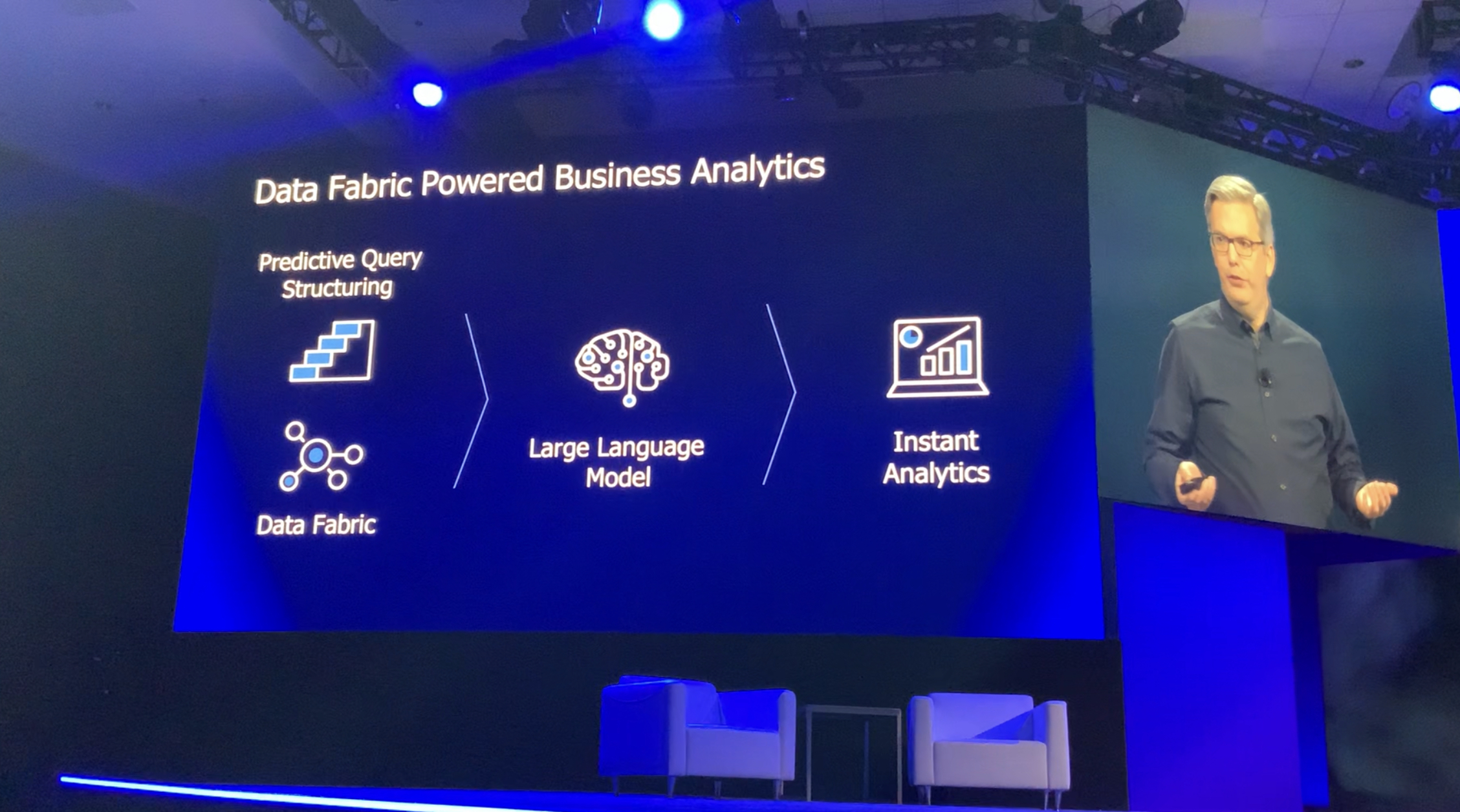
9:26am: "So to sum up what we've seen here so far, that's the question is AI really a threat to your jobs? Is it really a threat to human innovation, productivity, and every time AI makes that next leap?" Makes the analogy to chess, that computers can now play well, but notes the real world is messier and "is a lot more confusing and complicated than a test or a game."
9:28am: Mike sums up his thoughts on the impact of AI and its use in platforms like Appian to eliminate drudgery and unleash human potential: "The collaboration between AI and and that ability for you as creators to delegate the mundane and repetitive work documentation of your applications to an AI worker, is going to make it much more possible for you to be more human, and to be more creative." My analysis is that this is largely correct, and AI will likely have some task impact, but not large employment impact for now. Even longer term, it will only create more jobs as it creates new possibilities that create broader demand.
My Related Research
Our Enterprise Low-Code Platforms ShortList
Taming Complexity in Digital Business and IT: Next Generation Approaches
How Low-Code Scales Digital Transformation
To Strategically Scale Digital, Enterprises Must Have a Multicloud Experience Integration Stack
Pervasive Integration of Systems and Data Arrives | ZDNet