


HubSpot sees turbulence ahead due to outcome-based pricing shift, AI budget scrutiny
HubSpot cut its third quarter outlook as a pivot to outcome-based pricing and budget concerns have crimped expected demand. CEO Yamini Rangan, however, said outcome-based pricing is the best move in the long run despite the short-term hit.
Watch HubSpot's transition to outcome-based pricing models closely since other SaaS companies are likely to see similar turbulence ahead. Enterprises software companies are pivoting to hybrid models that include consumption and outcomes delivered by AI agents. Typically, software companies sold more predictable subscriptions and seats.
The company, which caters to small and mid-sized businesses but is moving upstream, projected third quarter revenue between $924 million to $925 million, which was below the $942 million Wall Street estimate. HubSpot also said non-GAAP earnings will be $3.25 a share to $3.27 a share. Wall Street was expecting $3.45 a share.
For 2026, HubSpot said revenue will be between $3.67 billion and $3.68 billion. Wall Street was looking for $3.71 billion.
HubSpot's disappointing outlook landed even as the company reported a better-than-expected second quarter results. The company delivered second quarter net income of $43.3 million, or 86 cents a share, on revenue of $911.7 million, up 20% from a year ago. Non-GAAP earnings of $3.26 a share were well ahead of estimates.
Outcome-based pricing is hard
In April, HubSpot said it started outcome based pricing for its Breeze Customer Agent and Breeze Prospecting Agents. Customers paid only when the AI agents completed an assignment.
That's partly where the trouble began.
- HubSpot to price Breeze Customer Agent, Breeze Prospecting Agent on outcomes
- HubSpot adds Answer Engine Optimization, contextual updates to platform
- HubSpot’s strategy: Use AI to deliver work, not software
Rangan said:
"April got off to a slow start and the quarter we expected did not fully materialize. Two factors drove the headwinds. The first was deliberate. As we discussed last quarter, customers adopting AI want proof of value before they commit and predictability in what it costs. So in April, we leaned into those trends and made changes across product, pricing and go-to-market. On the product side, we introduced trials so customers can turn on agents and AEO in their own environment with their data for their workflows. The goal is simple, let customers experience real outcomes before they buy. We knew this would create some near-term headwinds by extending the buying process, but we believe it's the right long-term trade-off, lowering the barrier to adoption and building customer confidence and outcomes will ultimately accelerate AI adoption."
Not surprisingly, outcome-based pricing was the big topic on HubSpot's earnings call with the word "outcome" mentioned 39 times.
Rangan said the outcome-based pricing worked well with upmarket customers because there are teams and partners to support trials. Other customers were skeptical and torched by higher AI costs. "On pricing, predictability has become a defining theme in AI adoption. Businesses have been hit with unpredictable token costs. And they want pricing that is transparent and tied to value," explained Rangan. "In response, we introduced outcome-based pricing for several of our HubSpot agents, lowered entry price points and are providing customers clear visibility and control over usage and spend, including the ability to set thresholds that fit their budget."
HubSpot added that it is engaging the C-suite earlier in the buying process, investing in its partner ecosystem and stepping up its pace of innovation. Despite the headwinds, HubSpot said its data agent had more than 16,000 customers activated in the second quarter, up 80% from the first quarter, and the prospecting agent has nearly 17,000 activated. HubSpot AEO, a tool focused on AI engine visibility, has also resonated as a feature in HubSpot Marketing Hub and as a standalone product.
Once HubSpot's agents are running and delivering outcomes, Rangan said customers are buying more credits and expanding use cases. He cited AI agents resolving issues at Sesame HR and RevenueWell.
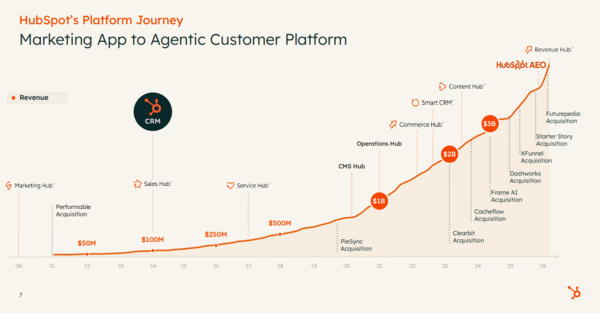
"The last 20 years were about helping teams do more work with software. The next 20 will be about helping them achieve better outcomes with AI. That's the opportunity we're building for. And that's why we are evolving every part of HubSpot from our products to our go-to-market to how we operate as a company," said Rangan. "Our AI strategy is simple: drive growth for scaling companies. And that means delivering real outcomes across the full customer journey, and that is exactly what our HubSpot agents do. Customers don't want a chaotic agent sprawl. They want a controlled cohesive way to build demand, win deals and delight their customers."
Rangan's moves highlight how HubSpot is playing the long game. In July, HubSpot launched Agent Builder and Agent Hub. However, it's going to take a bit of time to activate partners, retool sales and deliver proof points for customers.
The bet is that once customers have confidence in HubSpot's AI agents and outcomes, they will expand use cases. HubSpot is landing larger deals and the plan is to make it easy for smaller companies to leverage AI agents.
"We'd rather remove friction and build customer confidence at the beginning of the AI journey and then help them drive much more adoption as they continue. We believe those are the right trade-offs to becoming the long-term winner," said Rangan.
Economic concerns, token burnout
HubSpot has a massive customer base that includes thousands of smaller enterprises. Rangan said the outcome-based pricing change was one issue in the quarter. The other issue was elongated buying cycles.
Rangan said HubSpot saw a shift in demand with "increased budget sensitivity."
"Businesses want greater confidence that their investments will position them for the AI platform shift. As a result, purchase decisions are facing greater scrutiny, buying committees are larger and more deals require C-suite and Board approval, leading to longer sales cycles. For existing customers, unpredictable AI costs across the broader landscape are impacting budgets, leading to budget optimization and downgrade pressure."
The takeaway here is that tokenomics have put AI budgets under more scrutiny. CFOs are now looking for returns. Even tales of token-budget woes have curbed free-spending AI dreams. The grown-ups are now in charge and vendors will have to adapt.
- Uber controls token spend, outlines AI use cases
- Enterprise AI grows up, vendors are noticing
- Get ready for US open LLMs and just in time
- Rightsizing open models may cut your AI inference spend
- Here’s what we learned about AI projects from enterprise buyers so far
In addition, enterprises are sorting through AI platforms that will set them up for the future. Rangan noted that the tokenmaxxing trend wasn’t sustainable and now there’s a spending hangover.
Rangan said HubSpot is focusing on accelerating time to value and transparent pricing to win more wallet share. The strategy can work. In the second quarter, credit consumption grew despite the pricing changes and customers are adopting more than one AI use case.
To manage through the pricing shifts ahead, HubSpot is using AI to gain operating leverage. It has reorganized into smaller teams, using its own agents and expanding operating margins even as it invests.
Now HubSpot's situation is far from dire. The company sees revenue growth of 14% in the third quarter and 18% for 2026. HubSpot also has 306,446 customers as of June 30 with an average subscription revenue per customer of $11,800. In addition, HubSpot is seeing more C-level conversations.
Nevertheless, transitions are hard and lumpy quarters are likely for HubSpot.
"We are in the middle of a real transition to AI, and we are making deliberate choices to lead in it. While some of these choices create near-term headwinds and they will help us drive long-term compounding growth," said Rangan.
Larry Dignan is Editor in Chief of Constellation Insights at Constellation Research, where he leads editorial coverage focused on enterprise technology, digital transformation, and emerging trends shaping the future of business. He oversees research-driven news, analysis, interviews, and event coverage designed to help technology buyers and vendors navigate complex markets with clarity and context. ...
Read morePublished
Author
