


Nvidia’s Nemotron hit enterprise AI inflection point
Nvidia's open Nemotron models are at an inflection point where they're likely to be the most dominant AI tools for enterprises. Simply put, you'll either tailor Nemotron models on your own or consume them via your enterprise software vendor.
Yes, we all know about Anthropic and OpenAI with closed models. How can you not? The frontier AI labs are too busy talking about AI regulation and the end of humanity to be useful. For the enterprise, you have more pressing concerns like returns, budgets and efficiency.
This backdrop is why Nemotron is accelerating. Nvidia's open models aren't the best, but they're good enough for most use cases and tasks. And, with tuning, Nemotron models are cheaper, give you control and more accurate. Nvidia's greatest skill is seeing around corners and sticking with open models when few in the US did is just another example.
Here are some recent vignettes that highlight how the enterprise gravitated toward Nvidia Nemotron.
Salesforce launched Kao, a model built on Nvidia Nemotron 3 Super and leverages decades of synthetic data on workflows, processes and the moving parts inside of the Salesforce platform.
The company said Koa was measured in Salesforce's CRM Bench, which benchmarks CRM use cases and tasks, and found Koa matched or exceeded performance compared to leading models with 3x fewer errors. Salesforce controls the model weights and performed post-training inference within its trust boundary.
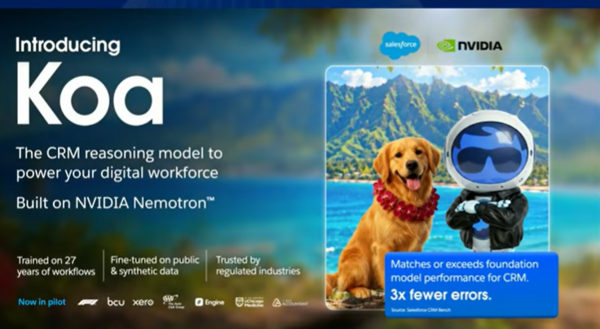
Nvidia CEO Jensen Huang, riffing with Salesforce CEO Marc Benioff at Dreamforce 2026, said:
"We see a future where the world uses closed models, but every company would also be able to build their own private models, your own customized models, which is the work that we're doing with you guys."
Huang could have just as easily say that Nemotron will be embedded in every enterprise software provider because their margins depend on open models working in conjunction with pricier frontier models.
- Why you should arbitrage your AI models like your vendors do
- Nvidia’s $12.93 billion Hugging Face acquisition validates open weight models
Salesforce's Koa model will be replicated by every SaaS vendor. Why? These vendors have data on every implementation and process used by enterprises. The data may not be perfect, but synthetic data can close the gaps. Rest assured that ServiceNow, which has small language models and a Nvidia partnership that includes Nemotron, Workday and others will start touting their own models. The data over decades from ServiceNow and Workday tell you how enterprises run in practice.
And this Nemotron love affair will move across the enterprise software stack. DocuSign understands contracts and its Intelligent Agreement Management (IAM) platform could integrate open models. Box, an expert on document management, will do something similar. Until there are more US open models that are enterprise friendly, the game is Nvidia Nemotron's to lose.

Palantir is driving Nemotron in the enterprise. At AIPCon 11, Palantir's customer showcase, there was a heavy dose of Nemotron and what CEO Alex Karp calls sovereign AI. The general idea is that the enterprise should control their differentiating data or your alpha. Karp has ranted about frontier AI labs repeatedly and in many respects is talking up Palantir's ontology and data game.
Nevertheless, it's hard to argue with Palantir's results. Meanwhile, SaaS vendors are cribbing whatever they can from Palantir whether it's ontology talk, forward deployed engineers and the importance of open models.
At AIPCon, Palantir and Nvidia stepped up their Nemotron efforts. The partnership, which was recently announced, is starting to scale and so is Nemotron usage.
- Open-Weight Models Are Gaining Ground in Enterprise AI
- Get ready for US open LLMs and just in time
- Rightsizing open models may cut your AI inference spend
- The most important LLM benchmark today: Price
Heidi Wood, Chief Digital and Transformation Officer of L3 Harris, said at AIPCon 11 that the company is starting to leverage open models. L3 Harris has been a Palantir customer for years and runs on its data ontology. Nemotron is starting to ride shotgun.
Wood said:
"We believe American defense companies should not be a vassal for frontier AI labs, handing over our data and institutional knowledge, hoping to rent back the intelligence it creates. So we recently ran an experiment. We have an AI workflow that helps us monitor a country of origin for all the parts that we receive. Previously, we've relied on frontier models, and they've worked fine. But when we fine-tune open models trained on our own data, we were able to outperform the frontier models in less than 48 hours. The cost of our fine-tuned open-source model was 95% lower than the frontier models we were using."
She added:
"AI is a commodity; it's all about the data. We view our data as a corporate asset. We have decades of data. Our data is a massive competitive differentiator. Using our data in our own ontology, in our own sovereign AI, that's next-level discriminator. We own the model. We own the compute, we own the advantage."
Nvidia's supply chain usage of Nemotron and Palantir. I'm not a huge fan of customer zero case studies, but Nvidia's use of Nemotron open models with Palantir Foundry and Artificial Intelligence Platform (AIP) as well as Palantir Ontology is worth noting.
Alex Neefus, Nvidia’s Senior Director of Solution Architecture, said at AIPCon 11 that the company is optimizing its supply chain, the most important one in the AI economy, using its open models.
"We want to optimize not just production volume, but we want to minimize the amount of time that those critical components are sitting waiting for other material to show up before we can build those boards," said Neefus.
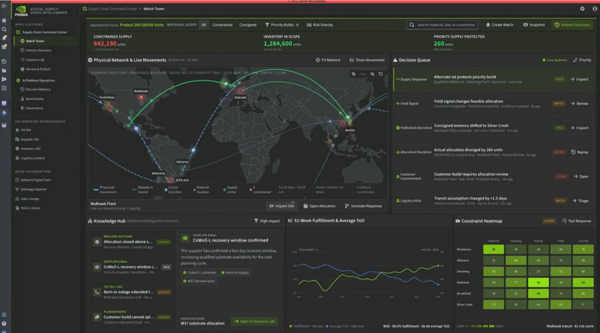
Nvidia post trained its small Nemotron 3.5 Lightning model for lower cost and faster retraining. "A small-purpose-trained model will outperform the predictive correctness of the biggest model, one that's 10, 20 times bigger," said Neefus. "We can retrain this model on just a single GPU in a couple of hours. This lowers the bar, meaning that we can be retraining more and more often, really as often as we like, weekly, nightly."
Nvidia is running its supply chain optimization efforts on premises for security and safety.
These use cases for Nemotron models are likely to proliferate. Stay tuned.
Synthetic data is also at an inflection point
The Nvidia supply chain use case as well as Salesforce's Koa launch featured mentions of synthetic data. Toss in Qualtrics' recent launch, which featured synthetic customer modeling and you have an emerging trend.
Synthetic data refers to information that's artificially generated by algorithms instead of collected from real-world events. Synthetic data mimics statistical properties of real data but doesn't have personal identifiable data about real people.
There are handy synthetic data primers from SAS, ServiceNowand IBM.
Given real supply chain data was sparse and sensitive, Nvidia used NeMo Data Designer to generate synthetic and anonymized data to bootstrap model training while preserving signal. "What it lets us do is take one week’s worth of sample information and make that look like months’ worth of samples," said Neefus.
As for the Salesforce Koa launch, the CRM vendor said it used synthetic data to train its latest model. For starters, Koa wasn't trained using customer data.
And it's likely that Salesforce's data over last 27 years had gaps. Leveraging synthetic data enabled it to fill in those data gaps. With Koa, Salesforce is looking to harness enterprise processes, workflows and policies and encapsulate them in a model.
Koa is built on scenarios for multiple CRM use cases including generating leads to resolving service issues across multiple industries. Each scenario is paired with a persona and tasks that need to be completed.
The idea is that Koa can improve further with an enterprise's data and context.
Synthetic data has been largely an academic topic until recently. Most enterprises will start using synthetic data to smooth over dirty data and make sense of their most valuable asset.
Larry Dignan is Editor in Chief of Constellation Insights at Constellation Research, where he leads editorial coverage focused on enterprise technology, digital transformation, and emerging trends shaping the future of business. He oversees research-driven news, analysis, interviews, and event coverage designed to help technology buyers and vendors navigate complex markets with clarity and context. ...
Read morePublished
Author
