


CoreWeave launches CoreWeave Forge: Here's a look at the strategy
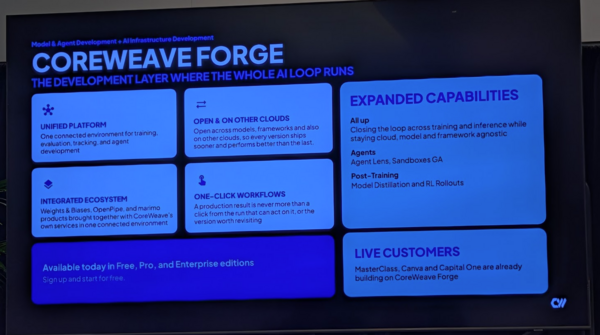
CoreWeave launched CoreWeave Forge, which brings together the neocloud provider's core assets into one connected environment. The bet is that CoreWeave's specialization in AI workloads will be a differentiator.
As CoreWeave has scaled it has acquired a formidable set of applications as well as compute and storage for AI workloads. CoreWeave Forge brings together the following:
- Weights & Biases Models, Agent Lens, Registry and Notebook and can run on any cloud.
- AI development and deployment tools including reinforcement learning, distillation and inference.
Those tools run on top of CoreWeave's compute, networking storage and model sandboxes.
Forge is CoreWeave's attempt to turn fragmented AI development and operations into a connected and iterative workflow. In addition, CoreWeave's platform includes its Aria agent, CoreWeave Mission Control and services to partner with customers.
Michael Intrator, CEO of CoreWeave, caught up with Constellation Research CEO R "Ray" Wang and laid out the strategy. "You’ve got to build your software. You’ve got to build cloud from the ground up in order to be able to deliver scale," said Intrator. "The generalized cloud is a wonderful minivan, but you had to build an F1 for AI. You had to build something that was super focused to serve a specific purpose."
CoreWeave Forge, announced at the company's Fully Connected AI conference in San Francisco, is the company's biggest move to become a platform as well as an AI infrastructure provider. According to CoreWeave, Forge connects various AI workflows and enables its 4,500 customers to build on any framework, model or cloud.
"Forge really allow us to address AI infrastructure holistically and meet our clients where they are," said Intrator, who said CoreWeave is making is AI infrastructure usable across a wide range of customers.
Enabling the AI Loop
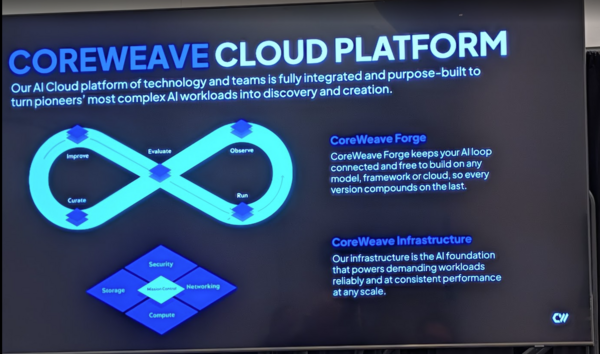
The company's efforts to broaden its platform are designed to focus on the "AI Loop," which consists of the connected AI systems that include evaluation, observability, curation, improvement and running workloads.
CoreWeave argued that the AI Loop is what creates versions of models that improve and compound advances.
Chen Goldberg, executive vice president of product and engineering at CoreWeave, said customers are putting models to work with their own data and workflows. "That's where the gaps between model capability and system performance becomes clear," she said. "Engineering teams need to understand those gaps, identify the signals that matter, improve the next version and measure whether the change worked in real operating conditions."
The key components of CoreWeave Forge including the CoreWeave AIRA coding agent, CoreWeave Notebooks, CoreWeave Agent Lens, an intelligent observability system for production agents, CoreWeave Sandboxes and CoreWeave Inference are mostly generally available.
"We always start with run. We move to observe with the signals, curate, decide what matters and improve, run again, and evaluate," said Goldberg.
CoreWeave Forge comes in Free, Pro and Enterprise editions so customers can get started.
- AI Gets Cheaper. Demand Gets Bigger: Inside CoreWeave’s AI Infrastructure Strategy
- CoreWeave Q2 stronger than expected, touts backlog
- CoreWeave floats debt, equity offering and touts compute pricing
- CoreWeave launches ARIA agent
CoreWeave's Nvidia compute
The company announced the availability of the Nvidia Vera Rubin NVL72 on CoreWeave with Cognition as the first customer running production workloads.
CoreWeave said customers can run the latest Nvidia system on the same operating model and tooling as their existing Nvidia GB200 and GB300 fleets.
Goldberg said CoreWeave was focused on bringing Vera Rubin NVL72 quickly and delivering performance gains.
Cognition, the AI lab behind Devin, is using CoreWeave Vera Rubin NVL72 systems to scale thousands of GPUs for training and inference.
CoreWeave stood up Vera Rubin NVL72 with Dell Technologies.
In addition, CoreWeave said it will offer Nvidia Vera CPUs, which is designed for AI agents. Goldberg said Vera CPUs are integrated with CoreWeave Sandboxes out of the box.
Other news from Fully Connected:
- The company announced the CoreWeave Partner Network, which features a curated set of integrations in production environments. CrowdStrike, VAST Data, Reflection and ClickHouse are headline partners. These integrations include infrastructure, data services, software vendors and model and inference players.
- Ennoble Care LLC said it will run its clinical AI inference workloads on CoreWeave Cloud. Ennoble Care was just one of the many customers sharing their AI best practices and workloads. Caterpillar, Capital One and Cognition were other headline customers.
CoreWeave’s recent moves
CoreWeave recent moves highlight how the company is maturing and focusing on builders as well as enterprises. Ahead of Fully Connected 2026, the company announced new capabilities in CoreWeave AI Object Storage with cross-region write acceleration and a new archive tier to keep data close to GPUs.
Other moves include:
The launch of a physical AI field engineering team. The launch of CoreWeave Physical AI Field Engineering pairs CoreWeave engineers with domain specialists. CoreWeave said its physical AI field team has been used across more than 100 engineering projects in automotive, aerospace and robotics.
The company has also moved to fortify its balance sheet. The bet is simple. CoreWeave is funding an expansion as it appears to have pricing power for its infrastructure. CoreWeave said it has established an at-the-market (ATM) offering program that'll enable it to sell up to 35 million shares to raise money. The ATM program "is being established to provide ongoing financing flexibility and to support CoreWeave’s objective of migrating its enterprise credit profile toward investment grade."
In addition, CoreWeave said it will seek to raise $3 billion in convertible bonds due 2033.
Along with the fundraising, CoreWeave said compute capacity prices are moving higher. The company said it has signed short-term customer contracts ranging from three to six months at a price of $40 million per megawatt.
What you need to know
During CoreWeave's analyst sessions, Goldberg, Chief Revenue Officer Jon Jones and others expanded on the company's strategy. Here's a list of the takeaways.
- AI adoption is broadening beyond the AI labs. Goldberg said CoreWeave is serving companies across multiple industries. "We are focusing on the customers that build with AI across all industries," she said.
- AI agents make systems harder to operate reliably. Agents are expected to complete tasks and not just answer prompts. That means AI agent performance depends on an integrated stack including compute, storage, networking, latency, context, accuracy and throughput.
- Returns are driving customer conversations. Jones said AI adoption in enterprises is shifting to production and ROI is the test. Customers are looking for growth, cost savings, efficiency and risk mitigation as reasons to fund AI.
- Physical AI is becoming more of a focus in manufacturing. Richard Ahlfield, SVP of physical AI at CoreWeave, said physical AI is moving faster to prototypes. Looking forward, Ahlfield said a big signal for physical AI in the year ahead will be real "manufacturing production use cases not just a bartender robot or dancing robot videos."
- Simulation and cloud compute are central to physical AI even when systems run at the edge. Ahlfield said physical AI require simulation "because you can't train on the internet" in the same way as language models.
- Open models vs closed models. Intrator said open models and closed ones will both do fine. Customers are looking to lower AI costs and using open models.
Constellation Research analyst Holger Mueller said:
"The AI cloud market is quickly maturing and it is entering the software platformization phase. It's not surprising CoreWeave leads the charge, but now it is all about publishing the roadmap and delivering it. CxOs are assessing neocloud vendors to decide where to put their infinite compute workloads in the AI era."
Larry Dignan is Editor in Chief of Constellation Insights at Constellation Research, where he leads editorial coverage focused on enterprise technology, digital transformation, and emerging trends shaping the future of business. He oversees research-driven news, analysis, interviews, and event coverage designed to help technology buyers and vendors navigate complex markets with clarity and context. ...
Read morePublished
Author
