


2027: VCs see a time of potentially brutal sorting
There won't be an AI-driven crash in 2027, but a time of volatility, debt concerns and a "brutal sorting," according to a panel of venture capitalists.
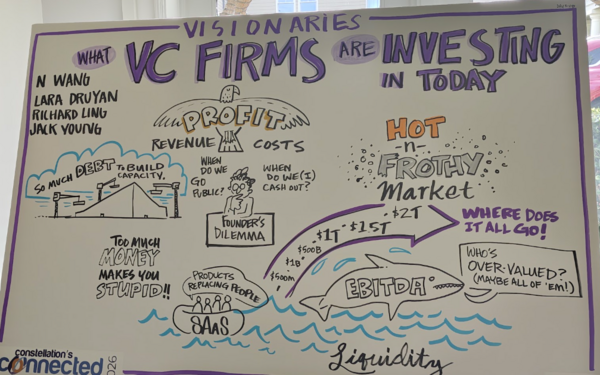
At Constellation Research's Connected Enterprise 2026, the list of concerns about venture capital, IPOs and mergers and acquisitions was long. Valuations are high, the market is frothy, it's unclear how IPOs will fare on the public markets. In addition, growing debt loads make the entire market fragile.
Here's a look at a few of the takeaways from Richard Ling, Board Member of Riptide, Jack Young, DTCP and Cherng Family Trust, and Lara Druyan, General Partner Private Liquidity Partners.
Exits are stuck, M&A is hard and IPOs suck up capital. "How many companies can afford to buy you with you not contributing to the EBITDA? The dilution is going to be humongous," said Young. "If there is no IPO market for these top-end companies. "We have lots of promising company, but there's no liquidity."
Who needs an exit? Ling said AI-efficient companies that grow on little capital may simply sell for hundreds of millions rather than raise money that requires a billion-dollar outcome. "Do I take the money now and go and sell for hundreds of millions and be very happy?" asked Ling.
More CCE 2026:
- AI strategy is business strategy and boards don't get it
- Outcome based pricing: Pros, cons and nuances
- Teamwork in the AI age: Pods, clusters, flocks
- An early read on your 2027 AI budget
- Management amid AI chaos: Takeaways from the field
- 2027 themes to watch and what you should do now
- Boomi CEO Lucas: Beware your zombie AI agents
Venture capital isn't set up to offer liquidity for limited partners. "I've talked to LPs who are in funds where Stripe is," said Druyan. "Stripe has zero plans to go public. How can you not demand liquidity?"
SaaS metrics hide what AI costs. Young said one issue is that AI companies are still using SaaS metrics that assume the cost of compute is negligible. The metrics in the AI age need to account for revenue vs. compute and token costs as a ratio, said Young.
A correction is likely over a crash and expect "brutal sorting." Capital has become concentrated in just a handful of companies and too much capital is a risk. There are also risks to the debt in SaaS and AI infrastructure. "The build-out has relied on really cheap debt. It's fragile because things are priced to perfection," said Druyan. "Not every company needs a $200 million A round. Too much money makes you stupid. I expect a brutal sorting."
Larry Dignan is Editor in Chief of Constellation Insights at Constellation Research, where he leads editorial coverage focused on enterprise technology, digital transformation, and emerging trends shaping the future of business. He oversees research-driven news, analysis, interviews, and event coverage designed to help technology buyers and vendors navigate complex markets with clarity and context. ...
Read morePublished
Author
