


OpenAI doubles down on health, targets providers and patients
OpenAI is planning on being a healthcare industry AI player with the launch of OpenAI for Healthcare, a HIPAA-compliant version of ChatGPT for clinicians, just days after debuting ChatGPT Health for consumers.
The rollout of OpenAI for Healthcare makes it clear the company is betting that health is going to be a big vertical. OpenAI is looking to make ChatGPT a key tool on both sides of the healthcare equation. Anthropic has also launched Claude for Life Sciences and has embedded its models into healthcare workflows. Both model providers will compete and partner with healthcare efforts from multiple software and cloud vendors.
ChatGPT for Healthcare is rolling out with some major customers. In a blog post, OpenAI said AdventHealth, Baylor Scott & White Health, Boston Children’s Hospital, Cedars-Sinai Medical Center, HCA Healthcare, Memorial Sloan Kettering Cancer Center, Stanford Medicine Children’s Health and University of California, San Francisco (UCSF) will use ChatGPT for Healthcare.
- OpenAI touts enterprise mojo with 1 million business customers
- OpenAI, Anthropic increasingly diverge as strategies evolve
- Anthropic follows enterprise software industry playbook, hires Smith as commercial chief
- Anthropic's multi-agent system overview a must read for CIOs
OpenAI said healthcare providers have been tailoring OpenAI API to be HIPAA compliant. ChatGPT for Healthcare can help with serving up medical knowledge, admin work and personalize care. OpenAI provided sample prompts and use cases for ChatGPT for Healthcare.
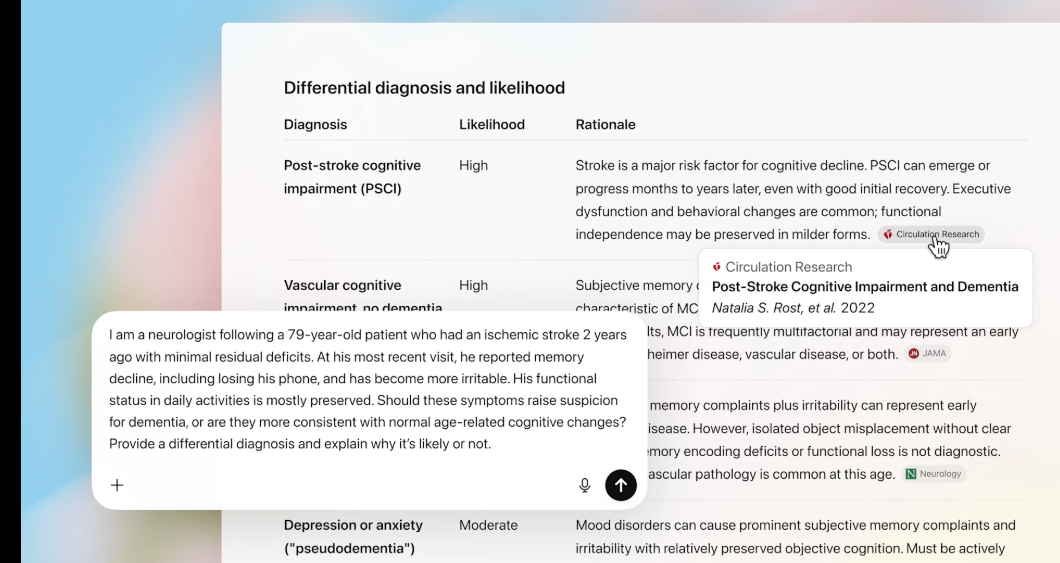
ChatGPT for Healthcare includes:
- GPT-5 models specifically built for healthcare and tested by physicians and benchmarked.
- Citations for evidence retrieval to check sources.
- Integrations with enterprise tools so healthcare providers align ChatGPT for Healthcare with policies, document repositories and best practices.
- Templates for workflow automation for patient instructions, discharge summaries, clinical letters and authorizations.
- Governance and access management based on roles.
- HIPAA compliance. Content shared with ChatGPT for Healthcare isn't used to train models.
ChatGPT for Healthcare appears to have a better footing in the enterprise with big name customers already in the fold. It remains to be seen how ChatGPT Health fares with consumers.
Launched earlier this week to a small number of customers, ChatGPT Health is a dedicated experience where consumers can share medical records, data and wellness information. ChatGPT Health promises to keep conversations encrypted and isolated.
- CVS Health outlines AI-driven ‘engagement as a service’ plan
- AWS preps healthcare, life sciences AI agent with Wiley content
- Healthcare leaders eye agentic AI as next frontier for clinicians, patients
- AI agents aimed at healthcare, but data interoperability still a big issue
- Samsung lays out digital health plans with Xealth acquisition
ChatGPT Health also integrates with Apple Health, Function and MyFitnessPal and will likely expand its roster of health apps in the future. OpenAI said that ChatGPT Health conversations won't flow over to regular chats. Ultimately, OpenAI sees ChatGPT Health as an advisor to prep consumers for doctor visits, improve nutrition and craft exercise programs. The service will even digest your lab results and point out what's important.
What could go wrong? Given that health is a primary use case for ChatGPT already, I didn't expect much wariness from health savvy consumers in my circle. Instead, the answers were unanimous with some form of "hell no." Biggest concern was sharing your data with OpenAI. Now this informal poll isn't scientific, but there will be some set of consumers that won't trust OpenAI's dedicated health service without some HIPAA-like promise.
Either way, ChatGPT for Healthcare may take care of patient usage. It'll just be a question of whether patients use OpenAI directly or indirectly.
Larry Dignan is Editor in Chief of Constellation Insights at Constellation Research, where he leads editorial coverage focused on enterprise technology, digital transformation, and emerging trends shaping the future of business. He oversees research-driven news, analysis, interviews, and event coverage designed to help technology buyers and vendors navigate complex markets with clarity and context. ...
Read morePublished
Author
