


Miro aims to smooth out AI, human collaboration
Miro, which provides a visual workspace so teams can collaborate on projects, is looking to ease collaboration between AI and humans. The problem? AI has created "single player AI experiences" that can disrupt collaborative teamwork because people are in silos.
The company at its Canvas 2025 event outlined a series of updates to its platform to integrate AI into collaborative workspaces to create shared context. In a demo, Jeff Chow, Chief Product and Technology Officer, walked through how AI can be integrated into workflows on a visual canvas and run scenarios and create. Miro plays in a growing category of applications called digital canvases and competes with companies like Figjam, Mural, Stormboard and Lucid Software. In the broader collaborative product development space, Miro faces a larger mix of competitors ranging from Asana, Atlassian, Figma, GitHub, Pendo, Zoho and others.
- Constellation ShortList™ Digital Canvas Workboards
- Constellation ShortList™ AI-augmented Collaborative Product Development Solutions
What Miro is trying to solve is a collaboration flow where individuals work with AI agents in isolation and then return to teams with different context and conclusion. That state of affairs hampers team alignment, noted Chow.
"Our innovation workspace is really built to help support the full innovation process, from insight, discovery, definition of solutions and helping teams collaborate all the way through to delivery," said Chow, who added teams are moving beyond brainstorming to more use cases via blueprints, or templated boards for workflows.
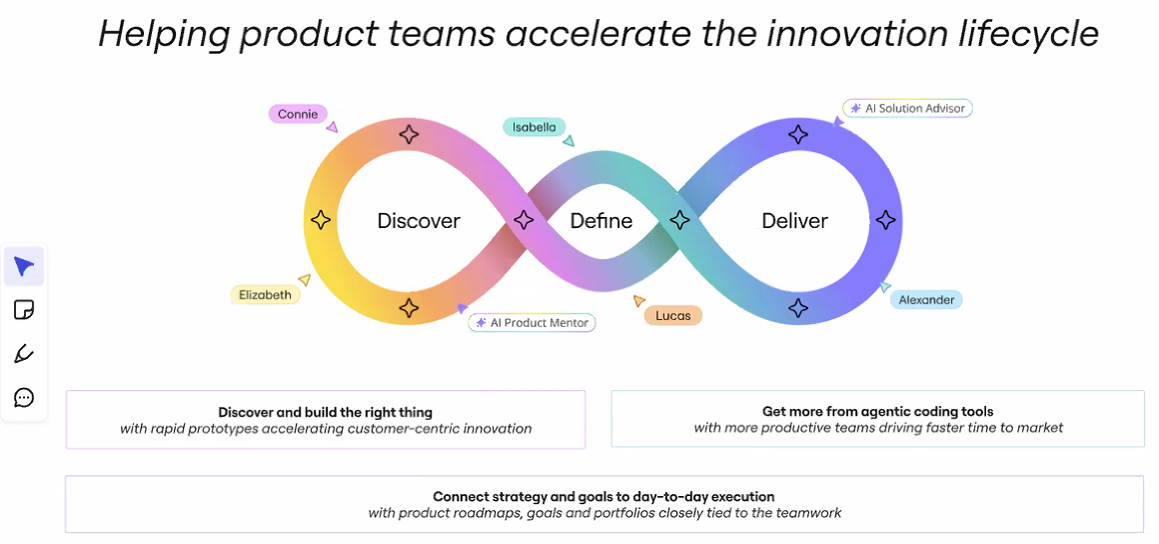
Chow added that Miro initially focused on human to human collaboration, but AI needs to be included in the mix. He said:
"What if you put AI where teamwork was actually happening, so that AI could be supporting people when and where they collaborate? We really believe the best place for that is the canvas, because the canvas is a great surface to bring together teams and AI. It's visual. It helps mirror how teams communicate and think, and it also creates a shared context layer for AI, because it has all of those artifacts from the cross functional group. It's a place where everyone feels at home."
Miro's software has a visual theme that revolves around clustered sticky notes, voting patterns and mind map notes. Miro has more than 100 million users and customers include Red Hat, GitHub, NFL, PayPal and Warner Bros. Discovery.
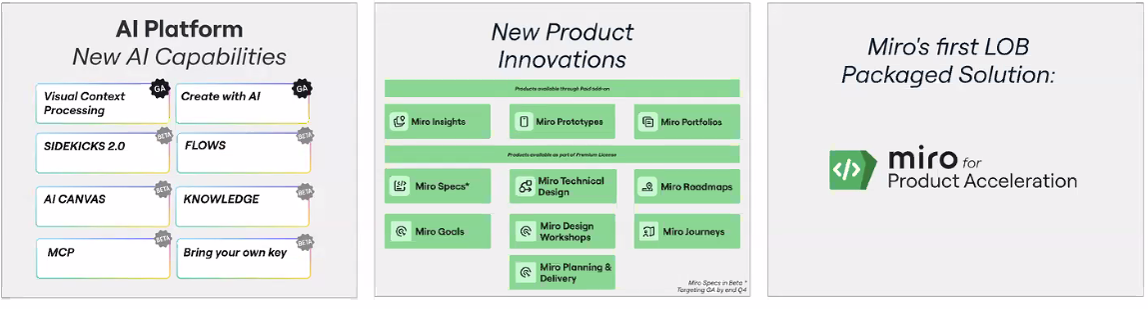
Miro's platform updates include:
- Enhanced Sidekicks, which are Miro's chat-based AI agents. Sidekicks will get contextual understanding and are more integrated into creative flows.
- Flows, which are automation designed to eliminate "record scratch moments" that break a team's flow.
- Visual Context Processing, which allows AI to understand spatial relationships on a canvas. Typically, AI processes text and misses visual collaboration cues.
- Support for all major large language models, integration with corporate knowledge systems and a Model Context Protocol server to work with platforms like Cursor and GitHub Copilot.
The upshot from Miro's updates is that the company is looking to keep collaboration, AI and context in the same place without switching between apps.
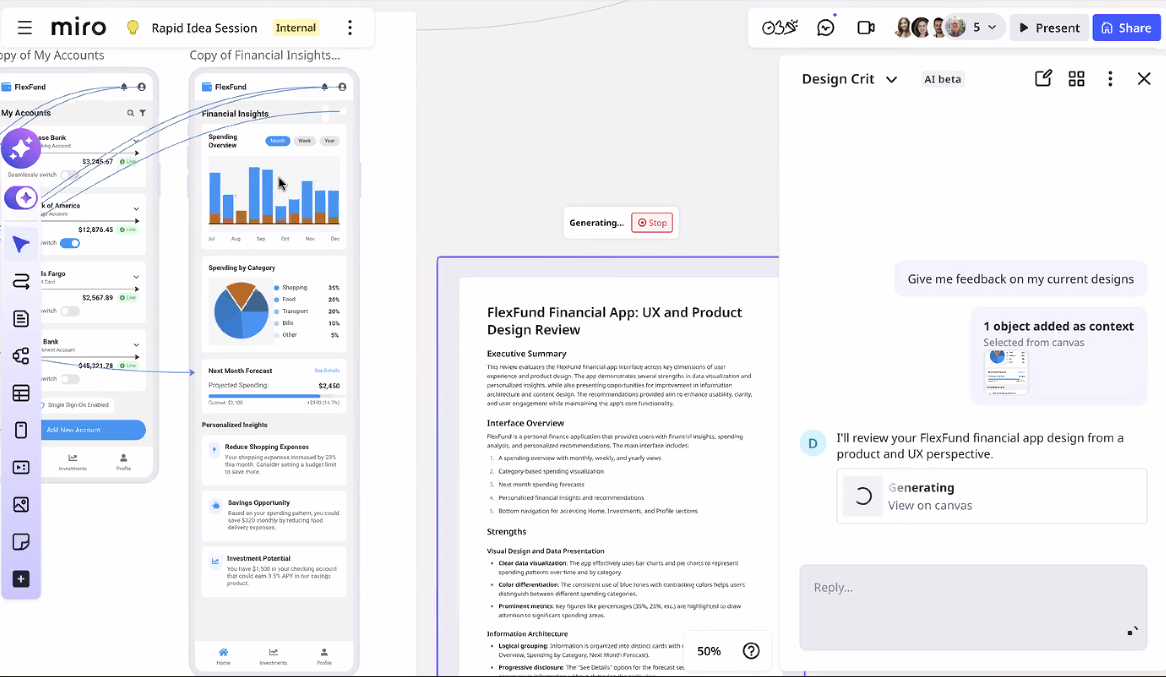
Here's an example of how AI and humans come together within Miro.
As for use cases, Miro's updates cover multiple fronts.
- Product team lifecycle including synthesizing customer insights, design critiques and technical specification generation.
- Workflow automation use cases including product brief creation from brainstorming sessions and process automation across multiple boards.
- Enterprise use cases where teams are prototyping loyalty program apps.
Miro is also branching out into line of business teams with Miro for Product Acceleration. The offering targets product design, engineering, and operations. Today, 60% of Miro's customer base is in product engineering or design, but the company is focused on product teams across a lifecycle.
"We are looking to help product teams with this whole idea of connecting strategy and goals to day to day execution. If you think about the accelerated work that product teams are doing today, and how AI is changing a lot of that, we see that it's challenging for leaders to make sure that the strategy work," said Chow.
Larry Dignan is Editor in Chief of Constellation Insights at Constellation Research, where he leads editorial coverage focused on enterprise technology, digital transformation, and emerging trends shaping the future of business. He oversees research-driven news, analysis, interviews, and event coverage designed to help technology buyers and vendors navigate complex markets with clarity and context. ...
Read morePublished
Author
