Larry Dignan

Editor in Chief of Constellation Insights
Constellation Research
Larry Dignan photograph

Results

Neptune Insurance, which we covered when it went public, delivered a strong first quarter and highlighted what an AI-native company looks like. Some fun facts.

  • Revenue per employee was $2.8 million, up 17% from a year ago. Neptune Insurance has 60 employees.
  • Adjusted EBITDA per employee was $1.7 billion, up 15%.
  • The company is 91 on the Rule of 40.
  • Neptune Insurance deployed 24 new versions of its Triton platform in the first quarter bringing the total to 570 versions.
  • The company is seeing good traction with customers from its integration with OpenAI’s ChatGPT.
  • “Machine learning models continue to be applied across underwriting, sales, and retention, and improve as more data flows through the system. We continue to develop a platform that improves in real time, with each release and each interaction contributing to the flywheel effects.”
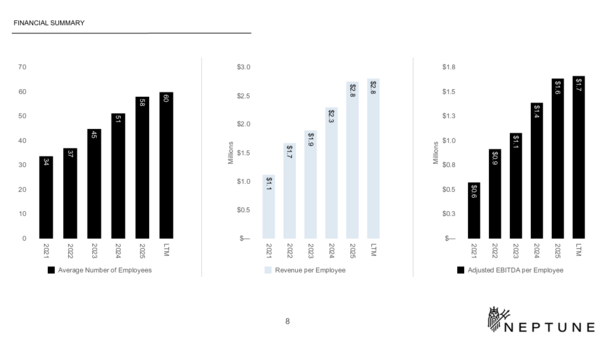
Neptune Insurance metrics

3M CEO William Brown said the company is using “AI-enabled tools that enhance planning, prioritize opportunities and accelerate productivity.” Specifically, Brown said on the company’s second quarter earnings call:

“Many of the activities and support functions like finance, HR and customer service operate independently across regions and business units, creating unnecessary complexity, inefficiency and duplication. We're bringing these activities together into a single global service delivery model and partnering with an external provider to run them at scale using automation and AI.”

Circle Internet Group said it has acquired IBM's blockchain portfolio, which has nearly 1,000 patents worldwide. The patents are focused on foundational blockchain technology, banking, financial services, enterprise infrastructure and cloud operations.

According to Circle, the blockchain patents will help it expand. Circle is best known for its USDC stablecoin, but has a much broader digital payment platform.

The Wall Street Journal is reporting that Nvidia is providing a $250 billion backstop for OpenAI so it can lease a 10-gigawatt data center being developed by Softbank's energy subsidiary. The project could cost more than $500 billion including the chips, which will obviously be Nvidia's. The power is controlled by the US government and funded by Japan.

Now if we're keeping score at home, I count three backstops in a circular deal that winds up with more GPUs. Nothing to see here and I'm sure it'll be great, but circular financing critics are going to have a field day with this deal.

You don’t think of General Motors as a company that takes a hit on memory costs, but reality bites. GM CEO Mary Barra, who noted that GM partnerships with Micron Technology and Samsung, said on the company’s second quarter earnings call: “We continue to expect commodity inflation, logistics and higher DRAM costs to be a headwind of $1.5 billion to $2 billion for the full year. We realized approximately $600 million in commodity costs in the first half and expect that headwind to increase in the second half, largely because it reflects 2 quarters of higher costs rather than just 1. In addition, spot rates continued to rise after our first quarter earnings call. And while they have eased somewhat recently, several commodities remain above those levels.”

Nvidia CEO Jensen Huang released an open letter on how America needs to focus on open weight models. Huang isn't wrong that the world needs both frontier closed models and frontier open models. Also note who signed on and who didn't.

I'm not a huge believer in open letters and think the problem in the US will largely take care of itself due to competition. Here's what I noted in my newsletter this week.

The breakneck pace of open LLM releases from Chinese AI players has US executives and a few policymakers freaked out. You can regulate China models all you want but all the signs are that US companies will also apply pressure on frontier AI companies. If you’re an enterprise trying to wrangle your AI budget you might as well cheer all of the open source LLM crowd on.

Intel's second quarter was strong and illustrates how the company is recovering well. But I can't get too wound up. For starters, the foundry business is a big unknown. Yes, Intel can ride CPUs, which are the AI inference darling of the moment, but AMD has only become stronger. On GPUs, Intel is all roadmap.

The most notable thing on Intel's earnings call was an AMD question from an analyst asking about market share and losing server share. There's work to do. AMD's AI event upstaged Intel, which was also asked about Arm.

ServiceNow CEO Bill McDermott has a knack for buzzwords. Here's one that you'll hear every AI agent orchestrator say soon: Kill switch.

Given OpenAI's Hugging Face fiasco, CIOs everywhere are going to worry about rogue AI agents (or just ones programmed to cheat benchmarks). Spotting an opportunity to put ServiceNow in the security conversation, McDermott said on the company's second quarter earnings call:

"For any company that's running ServiceNow and you get a rogue AI, there's a kill switch, it doesn't get through. And then you think about how you use the right model and you hire it for the right job. And we do that, too. And people are realizing you don't need to take a Ferrari to mail a letter. So using the right technology for the right job and then managing the budgets, including all the tokens and the security of this has become pretty important."

The upshot here is ServiceNow wants to be seen as the AI grownup in the room.