



Executive Summary
A specialized type of customer service, field service involves the operations, logistics, and orchestration of mobile field technicians who repair or service products in service centers or on customer sites. Field service management (FSM) software helps to coordinate the complex logistics—including parts, warranties, and customer and staff schedules—integral to field service delivery. Increasingly, FSM solutions also manage customer communications and experiences, offering deeper insights into scheduling, costs, and opportunities to self-serve or self-triage issues.
In line with increased customer expectations for timely, convenient service, these solutions optimize work-order routing and technician scheduling, providing increased transparency and real-time visibility into scheduling, timelines, orders, and workflows. They incorporate communication features that automate status updates and arrival times to customers, empower real-time communication between technicians and worksites, and follow up post-visit with detailed, contextual, and personalized content for ongoing maintenance and optimized ownership. Technicians gain improved stock visibility, easy escalation procedures, automated notes, case closure, and next job assignments. Dispatchers and operations have also seen enhancements, including AI-powered agents and assistants to optimize schedules, recommend updates, enable smart routing, and generate AI-generated summaries and notes to accelerate case closures. Automated workflows are often configured out of the box based on common FSM use cases to accelerate autonomous follow up and notifications to customers, technicians, dispatchers and operations to ensure smooth service supply chains.
Leading vendors are incorporating Internet of Things (IoT) capabilities into their FSM solutions. Information directly from the products themselves can significantly improve technicians' time to resolution in the field. IoT data combined with customer feedback from technicians provides useful insights for marketing and product development teams. This enables feedback loops from dealers and subcontractors back to original equipment manufacturers.
Advancements in virtual and augmented reality (VR/AR) capabilities further push the envelope and make it possible to deliver field service support and training remotely. Constellation anticipates this to be a growing area of demand as the capacity to deliver data-powered, AI-generated digital twins in complex, asset-intensive environments expands.
Threshold Criteria
Constellation considers the following criteria for these solutions:
- Diagnostics and knowledge base summary delivered prior to truck roll
- Resource management and material allocation
- Case management tools, including access to CRM and ERP data specific to customers, assets, and services
- Multi-channel asynchronous communication channels between the customer, dispatch and technician
- Self-service scheduling, including workforce management capabilities for shift management, and customer appointment scheduling
- Resource allocation
- Inventory optimization with real-time visibility
- Mobile enablement for technicians, including voice-first interfaces for easy customer and dispatch connections
- Advanced communications capabilities, including collaboration connections for enhanced expert service access
- Route optimization with AI-powered route recommendations, real-time modifications, and technician-initiated updates
- IoT integration, including data aggregation for continuous monitoring and remote update
- VR/AR capabilities to remotely support technicians and customers in the field
- Generative AI capabilities are introducing digital twin experimentation
- Remote access and collaboration capabilities, including voice, video, and text communications, to connect customers with technicians without a truck roll
- Integrations with critical operations and customer experience systems, including CRM, ERP, Operations, and Communications infrastructures
- Easily scalable workforce management tools to manage shifting workforce capacity, temporary positions, and independent contracts as part of the field workforce
- Proactive and predictive service and automated service offerings
- Robust security and governance
The Constellation ShortList
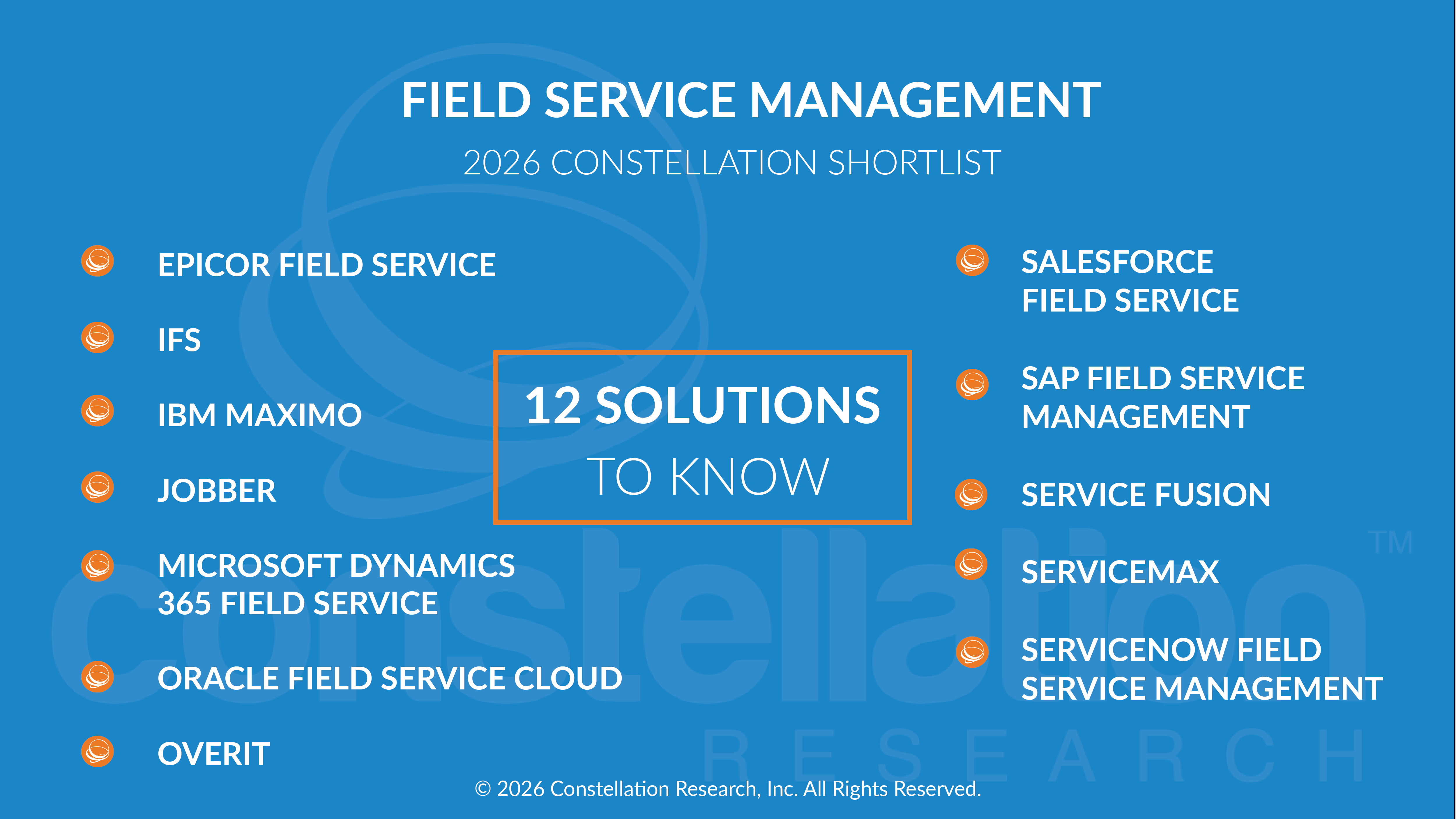
Constellation evaluates more than 30 solutions categorized in this market. This Constellation ShortList is determined by client inquiries, partner conversations, customer references, vendor selection projects, market share and internal research.
- Epicor Field Service
- IFS
- IBM Maximo
- Jobber
- Microsoft Dynamics 365 Field Service
- Oracle Field Service Cloud
- OverIT
- Salesforce Field Service
- SAP Field Service Management
- Service Fusion
- ServiceMax
- ServiceNow Field Service Management
Frequency Evaluation
Each Constellation ShortList is updated at least once per year. Updates may occur after six months if deemed necessary.
Evaluation Services
Constellation clients can work with the analyst and research team to conduct a more thorough discussion of this Constellation ShortList. Constellation can also provide guidance in vendor selection and contract negotiation.