Is Zoho the SaaS company best positioned to weather the “SaaSpocalypse?”

Following one of the most information packed Zoho analyst days in recent memory, you are no doubt going to hear a lot of different takes coming from this event. But I think one of the most important takeaways from ZohoDay 2026 is this: Zoho has had the foresight to plan for almost all of the disruptions we are facing in the software industry and maybe one of the most well positioned providers to not only weather the storm but to capitalize on these disruptions in innovative ways.
I want to break out how Zoho is well prepared to withstand the kind of “SaaSpocalypse” disruption we are across three main matrices: Geographic, Economic, and finally (because it runs the deepest) Technical. Let’s dig in.
Geographic Advantages
Zoho is not just a country that sells around the globe. The company has a large global presence INSIDE these markets – establishing a real presence across the gamut of go-to-market. And while most SaaS providers’ revenue splits tend to heavily favor North America, Zoho enjoys a split with nearly 605 of revenue coming from OUTSIDE The US, Canada and Mexico. This is important. As AI and other tools allow businesses in developing regions to “leapfrog” stages of IT development – Zoho is there to offer solid business solutions in local currency to offer predictable IT development costs and well supported solutions.
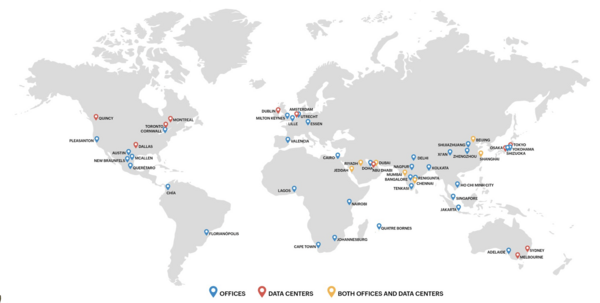
And beyond local currency, Zoho has spent more than the past decade building out its own SaaS/Cloud infrastructure. (more on this in the technical section). This means not only predictable costs, but also reliable, scalable SaaS offerings upon which global SMBs and midsize orgs can build their go-to-market tech stacks.
Economic Advantages
Apart from pricing in local currency, Zoho continues to offer what call exponential efficiency when it comes to businesses looking to create a modern business operating system. Zoho One has long been one of the most comprehensive suites of business applications available from a single provider – accessible at a single, predictable low monthly cost per user. As AI and other disruptive factors continue to make SaaS margin compression a reality – Zoho is one of the few vendors that offers a system of record that includes so much potential functionality that as pricing/margins compress – Zoho stands to gain. Savvy midsize businesses can consolidate and lower their SaaS bill by moving to Zoho One, and even if Zoho lowers prices to further differentiate on value – it will still see growth while other singularly focuses SaaS vendors feel the crunch.
Zoho’s datacenter buildout also has economic benefits, both lowering operations costs while also making Zoho more attractive to a global audience (as noted above). However, above and beyond its datacenter play, Zoho has hinted during its ZohoDay analyst event that it will start building out and leveraging its own hardware. Specifics are still vague, but if true – Zoho stands to gain in a big way. If Zoho can build out a global infrastructure that can own and leverage its own large, small and medium sized language models which are optimized for verticals, use cases, etc. – it could provide AI tools that are wholly home grown and priced well under what other CRM and SaaS vendors will be able to price as AI subsidies from companies like OpenAI and Anthropic eventually wane.
In short, Zoho is incredibly well positioned to withstand any number of economic disruptions as the age of AI takes hold. In fact, it could be argued that Zoho is building up to not only weather any storms, but to ride a new wave in terms of capitalizing on go-to-market and monetization shifts in the world of software.
Technical Advantages
Zoho’s technical innovation revolves around one major theme: Unification. The company has been working on unifying its disparate 55+ applications that can be utilized by Zoho One users into a more seamless and integrated experience. They are aggressively taking this vision to the next level by evolving its platform architecture toward a concept it calls AppOS, a shift from a disparate collection of SaaS tools to a unified "operating system for business." This transformation centers on breaking down the traditional silos between applications by abstracting the underlying data, intelligence, and administrative layers. By standardizing the UI through context-aware "Spaces" (as well as building overarching Unified Business Context and CX layers to better power AI and more effective user experiences respectively) and implementing a unified "Action Panel" that aggregates tasks and approvals from across the entire suite, Zoho is moving toward a singular, persistent environment where the application name is secondary to the business outcome.
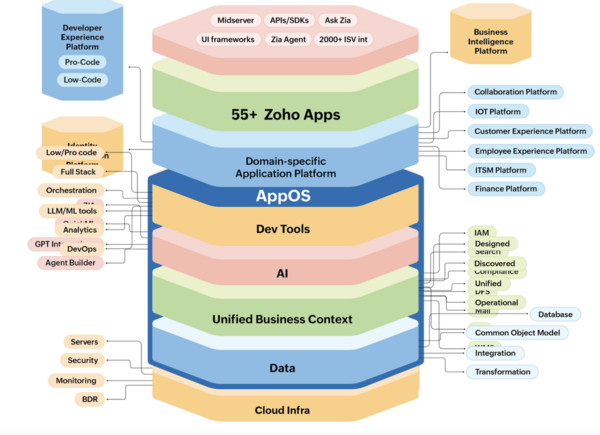
For users, this architectural shift translates into a massive reduction in "context switching," which has long been a drain on enterprise productivity. With AppOS, a user can manage a deal in CRM, approve an expense in Books, and reply to a support ticket in Desk without ever leaving a unified interface or losing the thread of their workflow. This is underpinned by Zia, Zoho’s AI assistant, which now operates as a cross-platform intelligence layer. Because Zia has access to a unified data model, it can provide insights that were previously hidden in separate databases—such as correlating marketing spend with real-time accounting data—enabling more precise, data-driven decision-making at every level of the organization.
For partners and ISVs (Independent Software Vendors), the unification provides a far more stable and scalable development foundation through tools like Catalyst and the Unified Data Service. Partners no longer need to build complex, brittle "point-to-point" integrations for every individual Zoho app; instead, they can build onto the platform once and have their solutions surface across the entire ecosystem. This "build once, deploy everywhere" efficiency, combined with unified domain verification and identity management, lowers the total cost of ownership for custom solutions. ISVs, in particular, benefit from a massive, pre-integrated audience who can discover and adopt extensions via the Zoho Marketplace that feel like native components of their existing AppOS environment.
Comparison: Traditional SaaS vs. Zoho AppOS
| Feature | Traditional SaaS Model | Zoho AppOS Model |
|---|---|---|
| Data Structure | Isolated application databases (Silos) | Unified Data Service (Single Source of Truth) |
| Workflow | App-centric (switching tabs/apps) | Task-centric (Unified Action Panels) |
| Integrations | Complex API "handshakes" between apps | Native cross-functional data flow |
| AI Intelligence | App-specific bots (CRM bot, Support bot) | Unified Cross-Platform AI (Zia) |
| Development | Build for specific app APIs | Build for the platform (Catalyst/AppOS) |
What Stands in the Way?
While Zoho certainly has formulated the right vision and method of execution for withstanding disruption, there are a few factors that will decide how successful it will be in executing on this vision. The simple fact is that Zoho now has more than ONE MILLION individual customers. As the company unifies its platform, it has to make careful considerations on how (and if) it migrates the entirety of that install base. (For example, do smaller users of custom Creator-based apps even need this migration now, if ever?)
But almost more important than migration is messaging and positioning. Zoho is one of the humblest and least “loud” vendors when it comes to broadcasting its advancements. The world needs to know what Zoho is building, and why. Zoho needs to amplify its vision to its global customer base, as well as more upmarket targets as it offers a compelling alternative to overprices and increasingly commodified SaaS offerings.
The Takeaway
All told, Zoho is setting the stage to not only survive but thrive in a world where software is being commoditized if not even cannibalized by rapid AI innovation and further democratization of development by traditionally non-technical roles. By building out it's own delivery and AI infrastructure as well as unifying its platform and simplifying the ability for end users, partners and ISVs alike to extend the value of the Zoho platform prompt, it is becoming a provider even the largest enterprises cannot ignore when it comes to the next phase of business transformation initiatives.
Martin Schneider has had a unique career that has spanned both analyst and marketing practitioner roles, focused on high technology and related industries. The unifying factor has always been both a keen analysis of go-to-market trends, while also having achieved success as a marketing leader. Schneider started his career as a journalist covering B2B technologies, and quickly transitioned into a leading analyst covering application software for the 451 Group in NYC, where he specialized in CRM, marketing automation, and business intelligence/analytics technologies. After analyzing various go-to-market strategies of dozens of technology vendors, Schneider made the move to the vendor side, where he led successful go-to-market teams for several startups and established tech providers,…...
Read morePublished
Author