Rethinking CRM as a New System of Action
“Reports of CRM’s demise have been greatly exaggerated.” OK, that’s not the exact quote, but the meaning is clear: Even as AI takes hold in the world of B2B software, leveraging a packaged CRM platform is still a core necessity for maintaining a modern, functioning, and optimized go-to-market (GTM) tech stack today and in the foreseeable future. And while the defining elements of a CRM system may be in flux, one thing is certain: A strong foundation of quality data and seamless workflow is still required to effectively optimize key GTM motions. The age of agentic AI has done more to prove this point than to refute it.
Essentially, what we are seeing is a shift in how CRM systems can generate value and improve business outcomes. As humans and AI agents start to work together across CRM use cases, CRM systems must evolve from their legacy as static repositories of data (and mostly only data inputted by users) into systems where jobs actually get done. Rather than CRM being an ex post facto tool to capture what has happened, it needs to be the place where work is happening.
In short, we are seeing CRM act as the focus point for a new system of action.
Toward CRM as a New System of Action
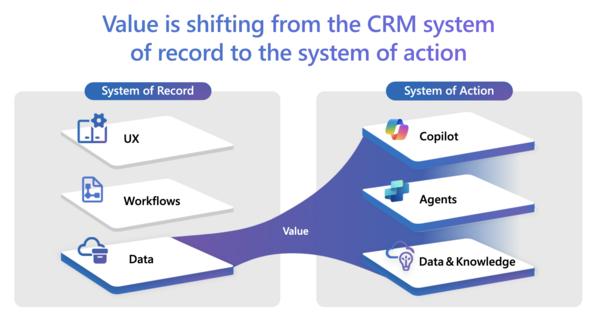
What is meant by the phrase “a new system of action?” In the age of AI, it means bringing AI agents, humans, and data together on a platform that can automate processes in such a sophisticated manner as to know when to fully automate with agents, while also knowing when and where to insert humans in the loop, for example. It needs to be a system where value creation iterates in a benevolent cycle; where quality data is an afterthought and not about the seemingly endless drudgery of data input and quality control efforts. This means a truly headless system, where sellers and other CRM stakeholders access and enter CRM data in the flow of work (whether that is in an email client or simply talking to their mobile device) and the CRM user experience is fluid, context-rich, and dynamic (see Figure 1).
By prepopulating CRM systems with quality data from the right internal and external sources, GTM teams can immediately see value from the CRM. This, in turn, solves the age-old adoption hurdle issue, and when users and agents use the system, this benevolent cycle arises in which good data gets even better and more useful with 100% adoption and the cycle repeats and repeats, driving more value to the GTM organization.
Microsoft is a company with a unique vision that fully aligns with this concept. This blog goes into more detail on some of these elements below, but it’s easy to illustrate with just a few of Microsoft’s recent innovations how a GTM team can build up this system. By leveraging agentic tools in Microsoft Dynamics 365 Sales such as the Data Enrichment Agent and the Sales Research Agent, GTM teams can have far deeper insights into every customer. And with a more context-aware CRM system, customer-facing users can be prompted to next-best actions across the customer lifecycle in ways that were close to impossible just a few years ago.
Figure 1. A Microsoft Image of the Shift From System of Record to System of Action
Source: Microsoft
Build vs. Buy Is Evolving Toward Blended IT Ownership
Implementing an evolved CRM system that understands the difference between human and machine input and offers native AI capabilities does not necessarily mean starting from scratch. Instead, it is about building on top of existing platforms that are proven and trusted in the enterprise. It is about forming a new style of partnership with technology providers—one where shared ownership and innovation leads to outsized results. In the area of CRM, this means expanding and evolving existing platforms, but only if you have the right foundational CRM partner in place.
Not all CRM platforms have entered the age of AI properly prepared. However, providers such as Microsoft have been investing in AI as an embedded part of the architecture—not simply as a “bolt on”—since the beginning. From its investments in OpenAI, through its deeply integrated Copilot concept, and now with native AI agents, Microsoft has reimagined its CRM portfolio as the kind of platform where work gets done. Taking the years of CRM experience and adding deep AI expertise is yielding an intelligent, agentic CRM platform that can offer a secure, reliable foundation yet enable the kind of fast innovation and iteration that AI-native startup tools offer. It’s a “best of both worlds” scenario.
After all, a CRM system is meant to be the system supporting the entire revenue cycle. Not even the smallest business, let alone multinational enterprises, should be wholeheartedly committing to rebuilding their CRM systems with a “vibe coded” approach. The decades of experience that providers such as Microsoft can offer is not easily replaced with a few hours in front of a prompt.
In addition, building a CRM system from scratch via vibe coding implies other cautions. Apart from the issues of governance, security, compliance, and so forth that can arise, cost concerns can creep in as well. By simply throwing together a bunch of code, agentic processes, and databases in a few hours or days, that vibe-coded implementation could be running up tokens and credits and in turn be more expensive than if the system were built on top of a trusted platform. Microsoft, for example, has already done the hard work to maximize not only the effectiveness of the outcomes of AI usage but also the efficiency of the agentic and generative AI actions to minimize costs for the end users.
A New System of Action Means a New CRM Architecture
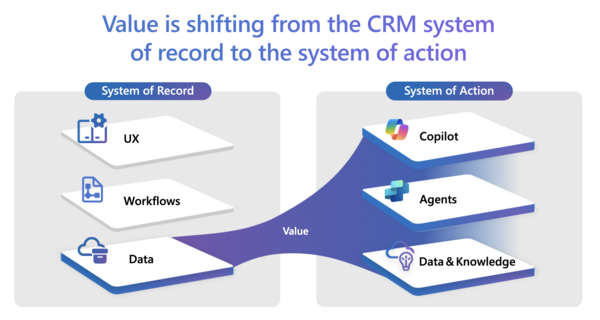
So, if we are reimagining our systems of work, a large part of that includes rethinking the core elements of a CRM architecture in the age of agentic AI. Here’s a look at how Microsoft’s evolved vision for CRM—one that layers AI agents, voice-activated CRM to drive productivity, data enrichment that moves beyond simple field-level into true insight enrichment, and robust workflow to meet CRM users in the flow of work. By layering agentic AI across Dynamics 365 and the Microsoft 365 ecosystem, the company is transforming CRM from a place where data is stored into a place where work gets done—what Microsoft is calling a new system of action (see Figure 2).
Figure 2. Microsoft’s New System of Action for CRM

Source: Microsoft
The Sales Agent at the Center
The heart of this shift is the Sales agent in Microsoft 365, an AI assistant designed to orchestrate multiple agents and maximize seller productivity by bringing deep AI and CRM insights directly into the Microsoft 365 tools sellers already use daily—Outlook, Teams, and beyond. Rather than forcing reps to toggle between their inbox and their CRM system, the Sales agent meets them where they work. Sellers can connect CRM data for tailored insights from Dynamics 365 Sales, use it in Teams meetings to capture action items from calls, and use it in Outlook for email drafting, follow-ups, and next-step recommendations. The CRM doesn’t go away: It becomes smarter, more accessible, and increasingly proactive.
Data That Stays Fresh—Automatically
One of the most persistent frustrations in sales is stale pipeline data. Reps are busy; CRM updates lag behind reality. Microsoft addresses this head-on with an agentic feature called Data Enrichment, now available for Dynamics 365 Sales. Data Enrichment automatically analyzes recent email interactions and suggests—or directly makes—updates to opportunity records. It scans conversations for deal-critical signals such as budget, authority, need, and timeline and then identifies missing or outdated fields and surfaces suggestions that sellers can apply with a single click. For sales managers, this means forecasts they can actually trust, and deal reviews grounded in current reality rather than last week’s memory.
From Insight to Action—Without Leaving the Flow of Work
Knowing what to do next is only half the battle. The other half is actually doing it without losing momentum. Microsoft’s Recommended Actions feature, part of the Dynamics 365 2026 wave 1 release, tackles this directly. Recommended Actions not only prioritizes the key actions for sellers to focus on, but also provides the necessary context—relevant contacts, discussion history, key points to address—so execution is seamless and fast. Critically, sellers can act on recommendations in place within Dynamics 365, Outlook, Teams, or Microsoft 365 Copilot, without navigating across tools or losing the flow of work.
The Conversational, “Headless” CRM
Perhaps the most striking evolution is how the Sales agent enables a truly headless CRM experience—one where the interface dissolves and natural language becomes the primary mode of interaction. With Microsoft 365 Copilot and Copilot Cowork, sellers can use natural language to search, synthesize, and take action on sales data across applications. Rather than navigating through multiple CRM pages to build an account status report, a seller can simply ask, and the agent handles the complex task of identifying and compiling the relevant data.
This extends fully to mobile. Sales agent chat is available on mobile via Outlook mobile and the stand-alone Microsoft 365 Copilot app, enabling reps to search and update CRM records, summarize emails, draft responses, and capture voice notes—all from their device, on the go. A rep leaving a customer meeting can dictate notes by voice, and the agent routes them directly to the right CRM record—no typing, no navigating, no forgetting.
Imagine a midmarket sales team running on Dynamics 365. Their pipeline data stays current because the AI Data Enrichment Agent is scanning email threads overnight. When a rep opens Outlook Monday morning, Recommended Actions has already prioritized which deals need attention and drafted content for the follow-up email. On the road, the rep updates opportunities by voice from Outlook or Microsoft 365 mobile. Back at the office, a natural-language query surfaces the full account picture in seconds. This is the promise Microsoft is delivering: proven systems of record, now animated by agentic AI into genuine systems of work. The CRM hasn’t been replaced—it’s finally been put to work.
So ultimately, it is safe to say that CRM is not dead, and will not be any time soon. But it is evolving, and fast. The good news is that CRM can now provide more benefits to users and give back more in terms of value and outcomes than it takes in terms of administration and data input time. As we shift into a new reality where enterprises are managing work done by both humans and machines, the CRM system must evolve in kind. By building upon proven core CRM frameworks and layering agentic tools and workflows in a safe, well-governed manner, organizations can modernize and see exponential increases in businesses’ outcomes from their CRM initiatives. The key is not trying to reinvent wheels but rather to leverage proven tools and AI frameworks aimed at solving GTM motions into the age of AI.
Martin Schneider has had a unique career that has spanned both analyst and marketing practitioner roles, focused on high technology and related industries. The unifying factor has always been both a keen analysis of go-to-market trends, while also having achieved success as a marketing leader. Schneider started his career as a journalist covering B2B technologies, and quickly transitioned into a leading analyst covering application software for the 451 Group in NYC, where he specialized in CRM, marketing automation, and business intelligence/analytics technologies. After analyzing various go-to-market strategies of dozens of technology vendors, Schneider made the move to the vendor side, where he led successful go-to-market teams for several startups and established tech providers,…...
Read morePublished
Author