


Quantum computing: Where we stand in 2026
Quantum computing has quietly matured in 2026 and is moving from laboratory research to engineered systems that are increasingly being deployed. However, quantum computing remains technologically immature.
Among the key themes in quantum computing based on earnings call transcripts and recent news:
- Full stack platforms are replacing processor-driven themes. Companies are looking to build quantum ecosystems.
- Commercialization is progressing but it is uneven. Quantum computing revenue depends on government customers and experimentation in key industries with defined use cases.
- Sovereign quantum computing is seen as critical and vendors are looking at supply chain control and manufacturing as strategic assets.
- Applications are focused on optimization and scientific workloads.
- Hybrid deployments combining quantum computing, AI and supercomputing are emerging.
Here’s a look at the individual companies in the quantum computing sector.
- Constellation ShortList™ Quantum Computing Software Platforms
- Constellation ShortList™ Quantum Computing Platforms
- Constellation ShortList™ Quantum Full Stack Vendors
D-Wave: Dual bets on quantum
D-Wave CEO Alan Baratz has argued that the company is at an inflection point and has a path to growth with differentiated technology. Notably, Baratz has pivoted D-Wave to focus on dual platforms. A recent investor day also laid out D-Wave's strategy.
"We have a differentiated technical foundation, deep expertise building and operating commercial quantum systems, a growing portfolio of production applications and clear road maps across our dual platform strategy," said Baratz.
D-Wave started with its annealing quantum systems but is also bettering on superconducting for scientific use cases. D-Wave is also betting that its cryogenics and control systems are differentiators.
Baratz said platform maturity matters more than raw qubit counts.
"Quantum computing leadership requires far more than a promising processor. It requires hardware, cryogenics, control systems, software, cloud infrastructure, developer tools, professional services and the operating discipline to make the entire stack perform reliably. We have spent more than 15 years doing that hard work."
D-Wave is looking to deliver a Gate-Model system that's fault tolerant to address commercial problems.
The roadmap for D-Wave's superconducting quantum systems breaks down like this:
- Deliver a 17 physical qubit system.
- 2027: Complete a 49 physical qubit system to deliver a 20x error reduction factor.
- 2028: 181 physical qubit system with about a 2,000-fold error reduction factor.
- By 2030, D-Wave expects to complete a system with 10 logical qubits capable of supporting the first fault tolerant algorithms.
- 2032: Scale to 100 logical qubits and more than 1 million reliable operations.
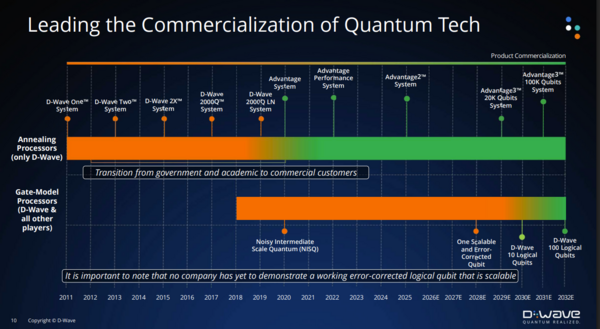
D-Wave also plans to scale its Advantage quantum systems focused on annealing.
The company announced an agreement with AT&T during the second quarter and outlined a partnership with UnitedHealth Group's Optum unit. D-Wave also has on-premises deployments.
While these advances are notable, D-Wave's revenue in the second quarter was flat with a year ago at $3.1 million. D-Wave had 100 customers in the quarter. D-Wave's second quarter net loss was $48 million, or 13 cents a share.
D-Wave's revenue for the six months ended June 30 was $5.9 million, down 67% from a year ago. Quantum quarters are lumpy.
IBM: Quantum momentum nested in a giant
IBM isn't a standalone quantum computing company so visibility into sales is nil. However, IBM is seen as the quantum computing leader.
In IBM's second quarter, CEO Arvind Krishna gave quantum computing some headline space as he has in recent keynotes. Quantum was a nice distraction in a quarter that missed estimates.
IBM's big wins in the second quarter were US government funding to create Anderon, a pure-play quantum foundry. IBM said it will invest more than $10 billion in quantum over the next five years. According to Krishna, the funding will support the company's roadmap to Sarling in 2029, the world's first large-scale fault tolerant quantum computer.
"Finally, quantum computing is no longer decades away. It is upon us, and we are investing aggressively," he said.
For good measure, IBM said it acquired HRL Laboratories to build out its quantum research.
- IBM to invest $10 billion in quantum over 5 years
- IBM CEO following Q2 wipeout: We're confident in our strategy
- IBM acquires HRL Laboratories for quantum computing efforts
- A peek at IBM's practical approach to quantum computing
- IBM Embarks on a Fault-Tolerant Quantum Voyage
IBM also said it joined and cooled down two cryogenic modules into a single environment. The architecture is designed to create a modular ultra-cold systems that can string together quantum chips. The effort is a milestone in IBM's march to delivering IBM Quantum Starling, a fault-tolerant quantum computer, in 2029.
Infleqtion: Delivering results
Infleqtion hasn't been a public company for long, but is delivering solid results. The neutral-atom quantum computing company went public in February in a Special Purpose Acquisition Corp (SPAC) deal.
Here are some key developments in 2026:
- March: The company delivered a 100-qubit Sqale system to the National Quantum Computing Centre in the UK. The installation of the Sqale platform is part of its broader Quantum Computing Testbed Initiative. Infleqtion recently went public via a SPAC deal and held an analyst day.
- April: Infleqtion laid out its 2026 sales outlook and revenue guidance of $40 million. That sum tops what many of the publicly traded quantum companies produce. The company reported its first quarter results and announced deals with NASA, the US Navy and DARPA.
- August: Infleqtion reported second quarter revenue of $13.5 million, up 157% from a year ago. The quantum computing company projected 2026 revenue of about $45 million. CEO Matt Kinsella said, "the pace of quantum commercialization is accelerating" and "governments are putting dates and dollars behind quantum." The company said its second quarter net loss was $24.7 million. The company also announced a deal with Eaton.
"Last quarter, I summarized Q1 in one word: momentum. This quarter, the word is acceleration, and by that I mean the market is moving faster, and the opportunities in front of us are becoming more concrete," said Kinsella, on the company's earnings call. "Our visibility is also improving as customers commit to larger systems, and the market increasingly validates the roadmap that we laid out and have been executing to. We secured a contracted fault-tolerant system sale and strengthened our position in quantum space and energy."
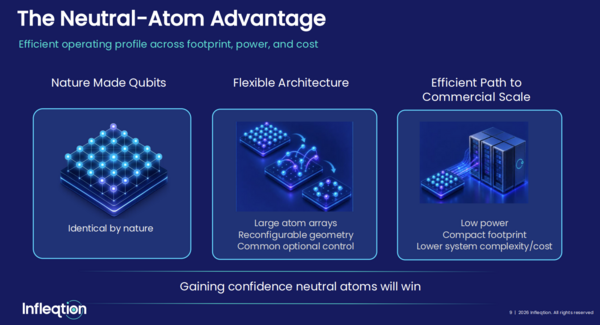
Key points from the Infleqtion earnings call include:
- The company is aiming to be a neutral atom quantum platform across computing, sensing and software built on one stack.
- Infleqtion is leveraging AI tooling from OpenAI to accelerate projects.
- The company said it is on track to demonstrate a 30 logical qubit quantum computer this year.
- Three end customers in finance, energy and precision medicine are working with Infleqtion on the 30-logical-qubit demonstration.
IonQ: Bulked up, focused on what you need now and later
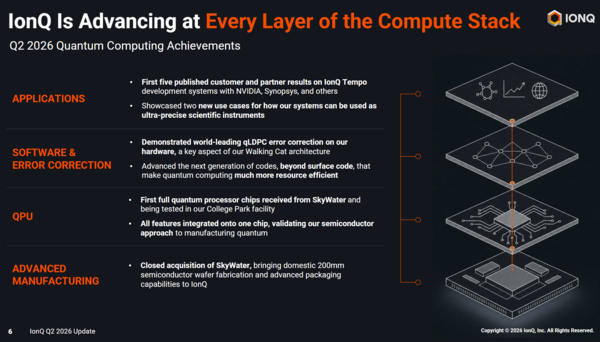
IonQ's second quarter results highlighted a company that has bulked up via acquisition with the goal of being an integrated quantum computing supplier. And with the $1.8 billion acquisition of Skywater complete, IonQ aims to be a quantum chip supplier. The catch is that a lot of Skywater's incoming revenue includes other chips.
What remains to be seen is whether IonQ can keep Skywater a merchant supplier even for the company's competition.
Niccolo de Masi, IonQ's President and CEO, said on the company's earnings call: "We are supporting the industry, and we're doing so with the highest degrees of physical and digital IP protections and physical and digital security. And so we are selling our atomic clocks, our integrated photonics, our quantum networking solutions, and now also our quantum foundry solutions, all under the umbrella of SkyWater as a merchant supplier. This will not change. We are a reliable partner."
IonQ is on a breakneck pace since its September analyst meeting.
- The company closed its acquisition of Oxford Ionics.
- IonQ had progressed through the tape-outs for its first semiconductor based quantum chip.
- In May, IonQ received its first chip prototypes back.
- In the second quarter, IonQ received its first fully integrated QPU back from Skywater.
"Our goal is to accelerate all quantum companies working with us, ions, atoms, superconductors, photonics, sensors and networks," said de Masi, who added that IonQ is a player in the post-quantum cryptography space.
Inder Singh, CFO and COO at IonQ, said the company is scaling to deliver multiple quantum systems at the same time and at scale. The company reported second quarter revenue of $80.1 million, up 287% from a year ago. Organic revenue in the second quarter was up 132% from a year ago. IonQ's Tempo quantum computer is driving revenue growth.
The company is projecting 2026 revenue between $280 million and $290 million. The guidance only applies to IonQ and will be raised when Skywater is integrated and intercompany transactions are accounted for. For instance, IonQ was spending about $120 million a year on Skywater.
IonQ is going for a total quantum platform strategy and provides its own integrated systems as well as components to the ecosystem. About 25% of IonQ's customers are utilizing multiple products.
Quantinuum: Headliner IPO, Oracle deal
Quantinuum was the headliner quantum computing IPO for 2026 and the company is building on its Helios system momentum.
Quantinuum said it will deploy its Helios quantum computer in US Oracle Cloud Infrastructure data centers for hybrid quantum and AI workloads.
Under the multi-year agreement, Oracle Cloud customers will be able to directly access Quantinuum's Helios alongside Oracle's high-performance computing and GPU infrastructure. The move highlights how hybrid infrastructure for classical compute and quantum is emerging.
In a statement, the companies said "Quantinuum and Oracle plan to explore how hybrid quantum-AI infrastructure could address some of the most computationally intensive challenges facing enterprises and broaden access for universities and research institutions advancing scientific discovery and education."
- Quantinuum, Rolls-Royce, Riverlane, EPCC eye industrial quantum use cases
- Quantinuum’s IPO prices at $60: What you need to know
- Quantinuum launches Helios quantum computer, touts fidelity, enterprise customers
The company reported a second quarter net loss of $597 million, or $1.93 a share, on revenue of $8 million, up 279% from a year ago. The company's non-GAAP loss in the quarter was 28 cents a share. Wall Street was looking for a loss of 28 cents a share in the second quarter on revenue of $7.6 million.
Quantinuum CEO Rajeeb Hazra said the company "delivered critical R&D breakthroughs to advance our platform roadmap and enhance our competitive position, strengthened our supply chain and manufacturing capabilities, and increased our developer ecosystem engagement."
As for the outlook, Quantinuum said its 2026 revenue will be between $28 million to $32 million.
Quantinuum followed up its earnings with a partnership with Quanta to manufacture quantum systems at scale. The two companies said they plan to co-develop the infrastructure, the systems engineering and manufacturing.
Here's what Hazra said on the earnings call: "Our hardware road map continues to advance to plan, hardened by the derisking approach we have undertaken to prove out the critical technologies for building very large-scale fault-tolerant quantum computers like Apollo in 2029 via intermediate generation of commercial systems such as Helios and Sol. We are on track for the release of Sol in 2027, a system designed to provide 192 physical qubits and 100 logical qubits with a logical error rate of 10 to the power minus 5 or 99.999% logical fidelity. Sol is the first commercial system on our road map to use the 2-dimensional QCCD trap chip."
Rigetti: Hybrid quantum
Rigetti's second quarter sales surged to $5.1 million, up from $1.8 million a year ago. Net loss for the second quarter was $52.6 million.
Dr. Subodh Kulkarni, Rigetti CEO, said the company is focused on broadening its reach and deploying its on-premises systems. "We are seeing broadening engagement across government, academic, and commercial customers, and we believe our open modular approach, superconducting gate-based architecture, and chiplet-based scaling strategy continue to differentiate Rigetti in the market. End users who leverage our systems over the cloud benefit from ease of use and consistent uptime, which we will continue to prioritize as quantum computing R&D progresses," said Kulkarni.
Kulkarni argued on the company's earnings call that its focus on modular architecture and superconducting systems will win in the long run. "Our objective remains to reach approximately 1,000 qubits, 2 qubit gate fidelities of 99.9% and gate speed below 40 nanoseconds in roughly 3 years," he said.
Here's a look at the key developments for Rigetti:
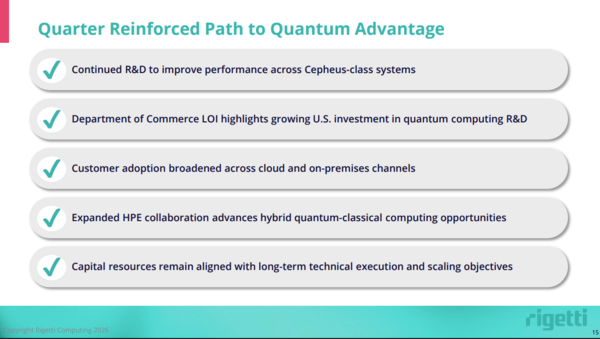
- The company will deliver its 9-qubit Novera quantum system to the new Pittsburgh Supercomputing Center to create a hybrid system with HPE.
- Rigetti announced the general availability of its Cepheus-1-108Q 108 qubit system with its chiplet scaling architecture.
- Kulkarni said the strategy is to "meet customers where they are across public cloud, hybrid infrastructure and dedicated quantum systems." Rigetti systems are available on its cloud services, Amazon Braket, Microsoft Azure Quantum and qBraid.
"At this stage of the market, we are prioritizing customers committed to active experimentation and collaboration, and we are deliberate in how we build those relationships," Kulkarni.
What's refreshing about Rigetti is that Kulkarni isn't a hype man. He's understated and playing the long game.
Quantum Computing Inc: Gone shopping
Quantum Computing Inc. (QCI) set up its balance sheet in 2025 and has gone shopping in 2026 with three acquisition to round out its offerings. The company recently completed three strategic acquisitions: NHanced Semiconductors, Luminar Semiconductor and NuCrypt.
QCI in the second quarter leveraged its smaller systems that operate at room temperature to deliver sales of $5.6 million, up from $61,000 in the same quarter a year ago. QCI reported a second quarter net loss of $11.8 million.
CEO Dr. Yuping Huang said the strategy is to make its quantum systems "smaller, more practical and more accessible."
QCI's Huang said the company is focusing on optimization problems today with its machines, but has gate-based machines on its roadmap. Huang argued that customers will ultimately determine the ultimate architecture of quantum machines based on returns.
Larry Dignan is Editor in Chief of Constellation Insights at Constellation Research, where he leads editorial coverage focused on enterprise technology, digital transformation, and emerging trends shaping the future of business. He oversees research-driven news, analysis, interviews, and event coverage designed to help technology buyers and vendors navigate complex markets with clarity and context. ...
Read morePublished
Author
