


Hitachi Energy expands Celonis partnership amid process, AI push
Hitachi Energy has expanded a partnership with Celonis to use its Process Intelligence across its operations and accelerate its AI efforts.
The aim is to combine Hitachi Energy's industrial knowhow with Celonis Process Intelligence. The collaboration supports AI Nexus, Hitachi Energy's AI transformation program.
For Hitachi Energy, the expansion with Celonis is a no brainer. Hitachi mentioned how Celonis Process Intelligence drove returns for its energy unit in its second quarter results. For Celonis, the Hitachi Energy partnership is a good way to expand its foothold in industrial AI.
Hitachi Energy said it is looking to turn operational data into insights, anticipate risks and speed up decisions and Celonis can ground AI in operational and process context. Hitachi Energy is seeing strong demand due to electrification, industrial growth and data centers.
In a statement, Urs Dogwiler, Chief Transformation Officer and Chief Lumada Business Officer, Hitachi Energy, said Celonis "helps our teams anticipate supply risks, act sooner and improve delivery performance."
Other key points:
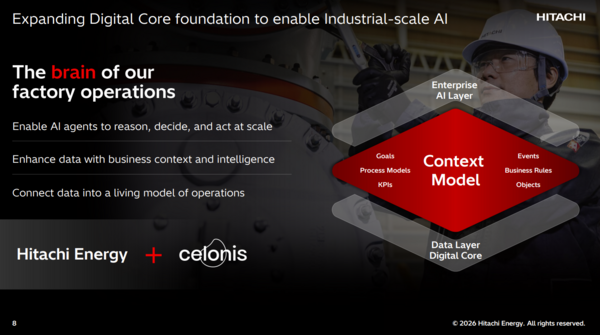
- Hitachi Energy, Hitachi Digital and Celonis as well as Databricks and Microsoft have created an architecture to scale digital systems, operational data and AI.
- The Celonis Context Model brings together data across Hitachi Energy's business systems.
- A broader deployment of AI and process optimization is expected to drive returns and help Hitachi Energy manage its order backlog.
- Hitachi Energy and Celonis will share more about the project at Celosphere 2026 in early December.
Familiar partners
At Hitachi's Investor Day in June, the company walked through its strategy across its various units.
Hitachi's Andreas Schierenbeck, CEO of Energy Business, Power Grids Business Unit and Hitachi Energy Ltd., outlined the Celonis partnership. He said customers were ordering equipment anywhere from two to six years ahead of time.
- Decision Intelligence Platforms: How Celonis Enables the Autonomous Enterprise
- Constellation ShortList™ Decision Intelligence Platforms
- Celonis acquires Ikigai Labs, launches Context Model, eyes simulation-based AI models
Schierenbeck said the company is investing in capacity and leveraging one ERP system called Reiwa that was installed two years ago. That system consolidates every factory, country, project, customer and supplier in one database. As of June, Schierenbeck said the consolidated ERP system drove $150 million in productivity gains.
Hitachi Energy is looking to derisk its supply chain in another phase. "We started to connect the system called Resilinc, which puts us on notice for every natural disaster, tsunami, volcano, for every closure of any transport way like a Suez Canal or Strait of Hormuz and directly informs us," said Schierenbeck. "We know what kind of logistic chain is impacted. We know which customer, which factory, which route we can optimize or where we can act before we really see the impact. That flexible rerouting and supply has generated, of course, more revenues because we could deliver faster. And that has hit the bottom line with $200 million bottom line effect last year, and that will continue."
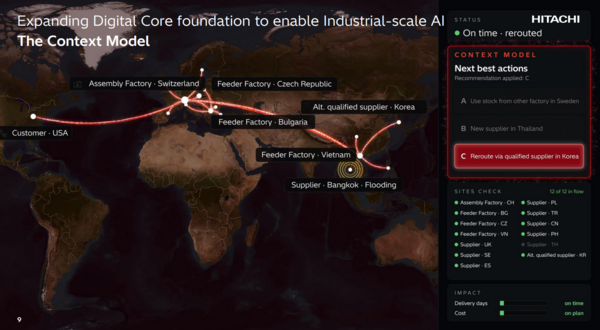
The next phase of the optimization effort revolves around process optimization. That's where the Hitachi Energy and Celonis partnership kicked in. Using Celonis, Schierenbeck said Hitachi Energy digitized processes and deployed AI to look at what processes could be improved.
"We're changing our manufacturing approach from managing to order to managing to stock to cut actually the delivery times, reducing lead times and optimizing our portfolio," said Schierenbeck.
He added that the goal is to keep general and admin expenses in check as revenue grows. "We want to keep them rather flattish, and that will have a bottom-line effect of around $250 million going forward until 2030. So overall, if you make the numbers, operational efficiency and AI will drive a cumulative profit impact of more than $2 billion by 2030," said Schierenbeck.
Larry Dignan is Editor in Chief of Constellation Insights at Constellation Research, where he leads editorial coverage focused on enterprise technology, digital transformation, and emerging trends shaping the future of business. He oversees research-driven news, analysis, interviews, and event coverage designed to help technology buyers and vendors navigate complex markets with clarity and context. ...
Read morePublished
Author
