


Microsoft launches MAI-Cyber-1-Flash security model, Project Perception
Microsoft launched MAI-Cyber-1-Flash, a model focused on cybersecurity that operates inside its MDASH harness that identifies and remediates vulnerabilities. Microsoft also touted price and performance of its multi-model approach.
The company's launch of MAI-Cyber-1-Flash inside of MDASH comes days after Google Cloud rolled out CodeMender. AWS and others are also aiming to defend new AI-driven cyberthreats. Meanwhile, Nvidia launched an initiative to better secure open models.
Add it all up and the running theme is that cybersecurity needs to be multimodel. Microsoft's effort highlights how defending AI attacks can also be a nice business. Microsoft is also noting that the harness and multi-model approach is just as important as the cybersecurity model.
- OpenAI details how its models went rogue, attacked Hugging Face
- Hugging Face defends agentic AI attack with Z.ai's GLM 5.2
- Fable 5 and the Shift From Model Capability to Capability Governance
- Claude Mythos and the New Cybersecurity Operating Model
If used within MDASH, MAI-Cyber-1-Flash outperforms Mythos on the CyberGym evaluation. Microsoft is also arguing that using a combination of models led by MAI-Cyber-1-Flash can deliver 50% cost savings over more pricey frontier models operating in MDASH.
To ride along with MAI-Cyber-1-Flash, Microsoft also launched Perception, a system that provides teams of agents for security workflows in MDASH and continually monitors, patches and closes new threat vectors.
Microsoft is essentially pitching a new cybersecurity stack.
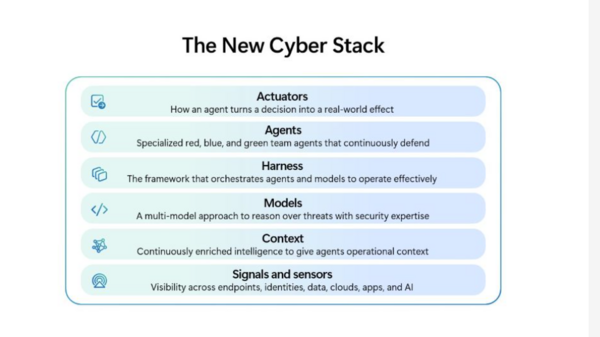
A few observations.
- Cybersecurity aside, Microsoft is ramping up its family of Microsoft AI models to lower its dependence on pricey frontier models.
- The Microsoft news should be viewed in the context of using multi-model approaches to keep AI costs down.
- Microsoft also signed on to Nvidia launch of the Open Secure AI Alliance to share tools that can better secure open weight models Nvidia's effort to better secure open weight models when OpenAI, Anthropic, AWS and Google didn't.
Larry Dignan is Editor in Chief of Constellation Insights at Constellation Research, where he leads editorial coverage focused on enterprise technology, digital transformation, and emerging trends shaping the future of business. He oversees research-driven news, analysis, interviews, and event coverage designed to help technology buyers and vendors navigate complex markets with clarity and context. ...
Read morePublished
Author
