


How UnitedHealth Group sets its AI stack, targets 1,000 use cases
UnitedHealth Group has more than 1,000 AI use cases in play, key technology partnerships and a solid governance framework. The bet: AI returns on individual use cases can add up to millions of dollars and ultimately billions of dollars that UnitedHealth's scale.
The healthcare giant is a sprawling business that has two primary operating units. UnitedHealthcare is the health insurance and benefits division and Optum, which focuses on health services and technology. The company's pharmacy benefit manager, Optum RX, is in the Optum unit along with Optum Health focused on direct care and Optum Insight, a technology and analytics branch.
UnitedHealth Group is projecting more than $25.45 billion in operating earnings in 2026. For the six months ended June 30, UnitedHealth Group reported revenue of $223.75 billion with the majority of that revenue coming from insurance premiums. UnitedHealth Group plans to spend $1.6 billion on AI in 2026.
Simply put, UnitedHealth Group is a massive enterprise that has multiple AI and process optimization use cases to recoup its investment if successful.
"AI technology is helping us move faster. We're using it to improve service interactions, reduce administrative burden and support better decision-making, always in service of improved experiences and outcomes for both patients and care providers," said UnitedHealth Group CEO Stephen Hemsley. "Artificial intelligence technologies applied in practical ways can literally reimagine our enterprise."
Hemsley said AI will impact "virtually everything that we do" and serves as the "operating infrastructure of the future." He added that AI's impact is just starting on UnitedHealth Group's business but will have compounding effects due to the company's scale. AI efforts will accelerate in 2027 and scale through 2028.
"At the group level is every function, HR, finance, legal, everything is really being reimagined in an AI context, which we think will drive much greater precision, greater efficiencies, responsiveness. We think there are significant opportunities there," said Hemsley.
Here's a look at a few of the more than 1,000 active use cases based on comments made during the company's second quarter earnings call:
UnitedHealthcare
Reducing prior authorization volume. Timothy Noel, CEO of UnitedHealthcare Business, said the company is looking to eliminate 30% of prior authorization volume and nearly two-thirds of prior authorization requirements by the end of 2026. "AI is both an enabler and accelerant to this effort," said Noel.
Digital experiences. "Virtually every provider and consumer interaction uses AI. AI gives us the ability to empower our advocates with predictive insights, real-time data, which all leads to more productive interactions and importantly, also lends itself to translating some of those experiences into digital experiences that are oftentimes and most times come with better provider and consumer satisfaction as well. Also key to our ability to proactively identify members that are in distress and reach out to them with concierge-like service models to help them through those moments," said Noel.
In March, UnitedHealthcare launched Avery, a genAI companion available UnitedHealthcare app or myuhc.com. Avery provides self-service and adapts to the user based on benefits and demographics. Avery will be available to about 20.5 million members by the end of 2026.
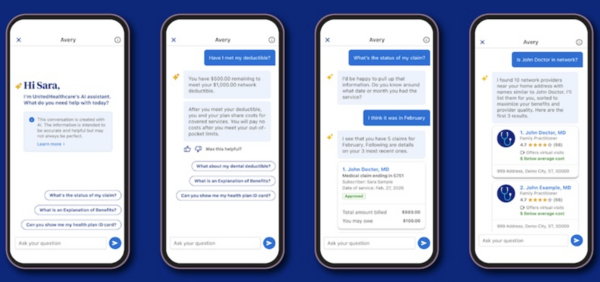
According to UnitedHealth, 90% of members who have used Avery don't require a live call with a human.
Core operations. Noel said complex claims are also being automated with more accuracy which cuts costs and increases turnaround time. Noel added that the effort is "facilitating interoperability with health systems and care providers." UnitedHealth is looking to process 80% of its prior authorizations in real time by the end of 2027.
Noel said the effort "creates kind of a touchless environment, which eliminates a lot of the back and forth between health systems, care providers and health plans, which not only improves experiences, but you can imagine the elimination of the abrasion unlocks a lot of operational efficiencies for both health systems and health plans."
Data and analytics. Noel said UnitedHealthcare will be able to look at more data sets and understand the business better for its commercial and Medicare business. "Our focus is on outlier activity and be able to customize our utilization management programs."
Human in the loop processes. Noel said:
"Clinicians will always be involved in these processes. If services are not authorized, that decision will ultimately be made by a clinician. And the second thing to note and remind folks of is that our contact centers are getting far more efficient, but they will never be fully automated. Engaging with the health care system that we play an important role in will always be deeply personal. We see great opportunity to invest some of the savings that we're getting from these efficiencies and actually enhanced and more concierge service-like models. We're going to always have options for human interactions as we approach this."
Optum
AI-based ambient listening. Optum CEO Patrick Conway said Optum is rolling out AI-based ambient listening to 70% of the company's employed providers and on track to hit 90% by the end of the year. "Patient experience in our care delivery sites is up approximately 5% year over year, and patient access has expanded by nearly 200,000 more patient-facing hours. We are in the early stages of these efforts," said Conway.
Conway said ambient listening can curb burnout. "Let me give you a stat on burnout, 90% reduction using AI and the cognitive burnout for the clinicians. So, when you go visit these clinicians and they talk about how it helps them deliver care better to patients, incredibly meaningful," said Conway.
Clinical workflow improvements. Optum Health will look to embed AI and automation across clinical workflows. The goal is to improve both operations and the clinician experience, said Conway.
AI-enabled coding, real-time interfaces and safety support are key areas for workflow improvements.
Conway said smaller use cases add up. "For care managers, AI makes it 40% faster for that nurse care manager, be more efficient, and also allows him or her to spend more time with patients, more time delivering care in the home or whatever the setting may be," he said.
In Optum Insight, digital prior authorization powered by AI is producing a 96% first-past. If something isn't approved, the process goes to human review.
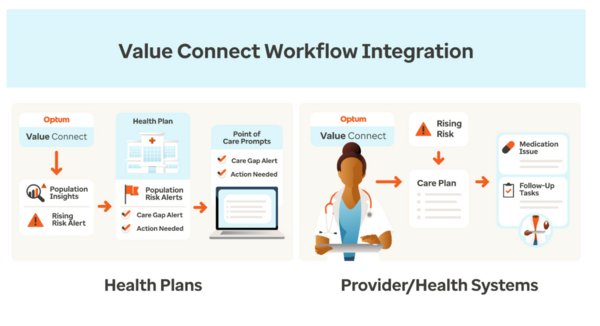
New products and services. Conway called out a platform from Optum Insight called Value Connect. "Value Connect is an AI-driven insights platform integrated into provider workflows and electronic health records to improve value-based care performance. Early client results include a 17% reduction in pharmacy costs," said Conway.
Optum outlined how Value Connect integrates workflows.
Optum Insight CEO Sandeep Dadlani said the company is looking to take its internal use cases and also create external products.
"About a third of our investments this year are going into commercializing all these internal use cases to external products. The prior auth example has been converted into a digital prior auth product, which we launched about a quarter ago under the Optum Real family of products. Year to date, it has, for external entities to UHG, processed about 69,000 prior auths, so it has processed about half a million prior auths and saved 69,000 administrative hours," said Dadlani.
The AI stack and governance framework
To drive returns from AI, UnitedHealth Group created an approach that combines United AI Studio, a proprietary secure AI platform that identifies use cases, as well as an AI review board to ensure accuracy, safety and fairness.
UnitedHealth Group's AI review board consists of clinicians, data scientists, business leaders, privacy and security experts and ethicists.
The framework enables UnitedHealth Group to wrap multiple vendors into its United AI Studio. Here are a few validated vendors in UnitedHealth Group's AI stack:
- Microsoft supports the provider and clinician use cases via its Microsoft Dragon Copilot and Microsoft Foundry. Use cases include clinical documentation, chart intelligence and coverage prediction. Microsoft is supporting Optum Real, an AI platform to reduce admin burden and call center demand for payers.
- Google Cloud and Optum are developing payer-facing AI use cases via Optum Real. Optum cites Google Cloud AI models and infrastructure in benefits, prior authorizations, claim-status and call-center workflows.
- Anthropic and Optum recently announced a partnership to use Cloud to reduce administrative burden. Specific use cases weren't disclosed. Dadlani outlined the partnership on LinkedIn.
- AWS is providing Amazon Connect for conversational and agent-assist systems. The partnership includes Amazon Bedrock, SageMaker and AgentCore. A job listing from Optum highlights a role that "supports migration from Genesys and LivePerson to Amazon Connect." Amazon rolled out Amazon Connect Health in March.
- Databricks is the data foundation for claims, embeddings, vector search and agentic workflows. An Optum job listing outlines Databricks' support role.
Larry Dignan is Editor in Chief of Constellation Insights at Constellation Research, where he leads editorial coverage focused on enterprise technology, digital transformation, and emerging trends shaping the future of business. He oversees research-driven news, analysis, interviews, and event coverage designed to help technology buyers and vendors navigate complex markets with clarity and context. ...
Read morePublished
Author
