


Healthcare value chain eyes agentic AI efficiencies
Healthcare is investing heavily in AI and beginning to shift into agentic AI with the aim of breaking down data silos and becoming more efficient, according to a Deloitte survey.
The Deloitte Center for Health Solutions surveyed 100 US health care technology executives evenly split between health systems and health plans and conducted online focus groups.
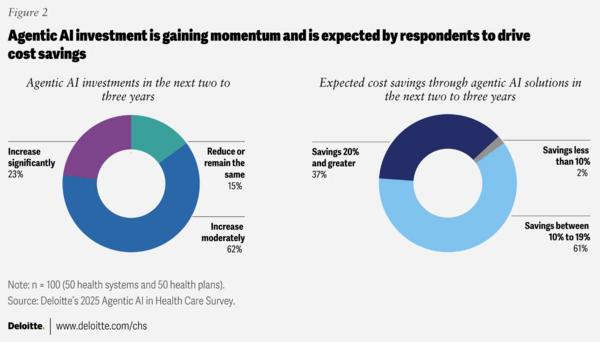
Deloitte found that 85% of health care leaders expect to increase agentic AI investments over the next two to three years with 61% already building agents or implementing initiatives.
In addition, adoption challenges that previously held back healthcare investments are easing. Deloitte noted that 40% of surveyed leaders said technical talent isn't a major challenge. Challenges such as resistance to change and leadership buy-in also eased.
However, Deloitte said 59% of early adopters expect cost savings of more than 20% in the next two to three years.
Healthcare and AI will be a big theme with the Healthcare Information and Management Systems Society (HIMSS) conference coming up in March.
- Healthcare Transformation Summit 2026
- Constellation ShortList™ Population Health Management Solutions
- The Urgent Case For Healthcare Data Interoperability
- Constellation ShortList™ Healthcare Enterprise Resource Planning
Indeed, the healthcare value chain is investing heavily in data and AI transformation.
HCA Healthcare, a large hospital system, said during its fourth quarter earnings call that the company is standardizing data across its hospitals to leverage AI.
"We're investing in our electronic health record transition from one system to another, and we're accelerating into that platform. That's a very important foundational piece for our company in that we're going to be able to standardize datasets across all of our hospitals," said CEO Samuel Hazen.
HCA is focused on administrative efficiency with its revenue cycle and supply chain via AI. Operations will also be optimized.
"We have areas of focus that we think are going to create incremental value for the company and allow us to be better at throughput, asset productivity, scheduling and staffing our hospitals, scheduling and running our ORs and so forth," said Hazen. "There are a lot of good ideas and a lot of tools that we think AI can bring to the operations of our hospitals."
He added that ultimately HCA wants to bring AI and insights to physicians leveraging HCA's proprietary database. Nursing can also benefit from more technology support for day-to-day tasks. "We are all in on the possibilities with artificial intelligence merging with what I call the human intelligence that exists within our facilities," said Hazen.
CVS Health CEO David Joyner said on the company's fourth quarter earnings call: "We continue to focus on improving connectivity between our businesses, using technology to support greater interoperability and facilitate a common experience, which will ultimately make health care easier to navigate."
Joyner laid out the company's plan for AI late last year.
- CVS Health outlines AI-driven ‘engagement as a service’ plan
- OpenAI doubles down on health, targets providers and patients
- AI agents aimed at healthcare, but data interoperability still a big issue
Unitedhealth Group also laid out plans to leverage AI. "We are driving greater operational disciplines in all our business practices, leveraging the use of technology and artificial intelligence broadly and renewing our commitment to innovation, agility and accountability," said CEO Stephen Hemsley on the company's fourth quarter earnings call. "We are clearly embarking on a new age of technology already transforming the way the world operates and health care must participate carefully and fully."
Larry Dignan is Editor in Chief of Constellation Insights at Constellation Research, where he leads editorial coverage focused on enterprise technology, digital transformation, and emerging trends shaping the future of business. He oversees research-driven news, analysis, interviews, and event coverage designed to help technology buyers and vendors navigate complex markets with clarity and context. ...
Read morePublished
Author
