


Elastic sees early traction with Agent Builder, context play, hybrid architecture
Elastic is seeing early traction with its Agent Builder and its platform, which has a hybrid architecture, that's resonating with enterprises.
The company's third quarter earnings and fiscal 2026 outlook were better than expected, but the bigger takeaways revolved around AI agents, Elastic's platform, context and AI demand.
Elastic reported third quarter earnings of 7 cents a share on revenue of $450 million, up 18% from a year ago. Non-GAAP earnings were 73 cents a share. For the fourth quarter, Elastic projected revenue of $445 million to $447 million, up 15% from a year ago, with non-GAAP earnings of 55 cents a share to 57 cents a share. For fiscal 2026, Elastic projected revenue of $1.734 billion to $1.736 billion.
First, Elastic, like other enterprise software companies, has faced the ongoing LLM questions. Chalk it up to the Anthropic panic that has hit multiple SaaS vendors. CEO Ashutosh Kulkarni said:
"AI doesn't displace us. It really depends on us because if you think about these frontier models, they're amazing reasoning engines. Like the way I think about them is they are going to be the operating systems of tomorrow.
But just as operating systems today also require data systems to feed appropriate data and context to these operating systems to actually build applications with, you're going to need the same thing going forward. And our role in this whole ecosystem is to make sure that we can very quickly in real time across all of the petabytes of data that every organization holds, give the right context to these LLMs so they can do their job."
Elastic has championed context as king in an AI-driven stack. Kulkarni said agents are going to talk to each other and in this world Elastic's platform will be working alongside Anthropic Claude Cowork and OpenAI Frontier. The aim for Elastic: Become a critical part of the context infrastructure.
- Elastic's Agent Builder is generally available, Elastic Workflows in tech preview
- Welcome to the context chorus: There’s no AI without context
- Agentic Automation Doesn’t Fail at Reasoning. It Fails at Inputs.
- Constellation ShortList™ Autonomous IT Platforms
Here's a look at the takeaways from Elastic's latest report.
Agent Builder is off to a good start. Kulkarni said Elastic is seeing strong initial demand for Agent Builder, which just went to general availability. Elastic piloted Agent Builder with a global 100 financial group as well as an international entertainment and media company. "We are seeing great traction and adoption within our customer base. Then on top of it, you need workflows because agents are not just about chat anymore. They're not just about conversations. They're about taking precise actions," said Kulkarni.
Hybrid architecture matters in AI deployments. Elastic is seeing customers apply AI on data that's critical and sensitive. "They're choosing or they're preferring to keep the data where it's within their control and environment," said Kulkarni. He added that hybrid workloads don't always mean operating in a data center and can be in Elastic's virtual private clouds.
Navam Welihinda, CFO of Elastic, said:
"There are multiple examples, including this quarter of AI workloads being sold as self-managed and deployed either in the customer's cloud or in their hybrid environments."
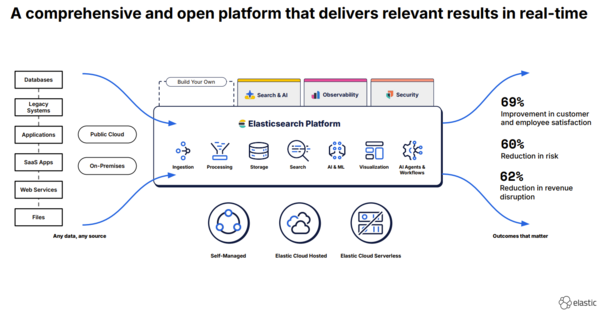
Elastic's vector database, search and security are garnering interest from large enterprises and AI native companies. The company now has more than 3,000 AI customers and more than 470 customers with annual contract value of more than $100,000.
AI deployments are more mature. "The general tone is definitely one of greater enthusiasm for AI. We are seeing the conversations be less evangelism and more about helping them put together these kinds of sophisticated agentic applications," said Kulkarni. "There's definitely been maturity."
Kulkarni said it's still early, but the total number of business processes and workflows that can be automated indicates the "opportunity is still very significant and still ahead of us."
Larry Dignan is Editor in Chief of Constellation Insights at Constellation Research, where he leads editorial coverage focused on enterprise technology, digital transformation, and emerging trends shaping the future of business. He oversees research-driven news, analysis, interviews, and event coverage designed to help technology buyers and vendors navigate complex markets with clarity and context. ...
Read morePublished
Author
