


FedEx Freight eyes AI, simplified stack to unlock growth as independent company
FedEx Freight is about to become an independent company as it is spun off from FedEx. The technology and AI strategy for FedEx Freight will be to simplify operations, reduce customer friction and create an architecture that can leverage AI today as well as future advances.
At an investor day, FedEx Freight made its debut. FedEx will spin off FedEx Freight, which will become a public company on June 1. FedEx Freight is a less-than-truckload (LTL) company and the separation will enable FedEx to focus on its core air-ground express services and network.
The LTL company will have more than 365 locations, 30,000 vehicles and 90% of its revenue from customers that have used FedEx Freight for more than 10 years. FedEx Freight will have annual revenue of $8.7 billion with $1.1 billion in adjusted operating income and operating margins of 12%.
With the separation, FedEx Freight executives said they will be able to optimize processes and deploy IT and AI that's focused on LTL use cases. FedEx Freight will have a data flywheel that will feed its AI strategy. For customer experience, FedEx Freight will feature a specialized CRM system designed for the LTL market.
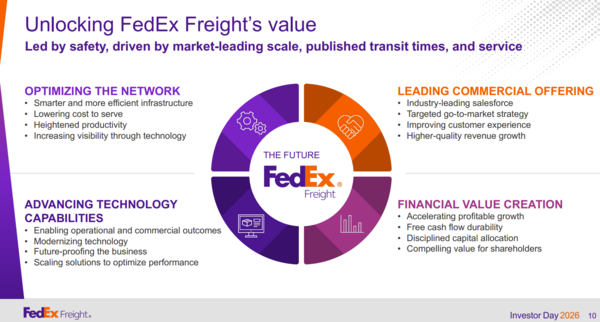
Here's a look at the FedEx Freight plan as an independent company.
Process optimization
At a high level, FedEx Freight plans to optimize its infrastructure, lower the cost to serve, improve productivity and increase visibility via technology.
This optimization includes optimizing the network, docks and fleets. "The collective benefit of these initiatives will continue to lower our cost to serve and improve our service performance. Importantly, these initiatives are fully within our control. They do not depend on macro recovery or volume uplift to generate meaningful benefit," said Clint McCoy, FedEx Freight chief operating officer. "As demand returns, our streamlined network and more efficient cost structure position us for greater operating leverage and margin expansion."

Key initiatives include:
Network: Model historical shipment flows to forecast volume with shipment level data, simulate flows through the hub and spoke model, develop optimized bin structures and lane flows, use proprietary tools to determine most efficient mode (truck or rail) and remove miles from the network.
Machine learning tools have enabled leaders to optimize based on actual and forecasted volume and ultimately reduce handling time.
Dock: Leverage RFID to enhance tracking, lower touchpoints with technology and increase visibility for the data that will lead to more optimization. The company has moved from planning based on weight to cube-based dimensions. McCoy said typically LTL carriers plan based on weight, but using cube-based dimensions captures more data in real time.
Fleet: Match the right asset to the right route and optimize to save fuel. The fleet will also be upgraded.
"We've taken a targeted data-driven approach to reduce the average age of our equipment and ensure we're matching the right asset to the right route," said McCoy. "Using performance insights from our fleet maintenance platform, we identified the most fuel efficient and reliable units and assigned them to our longest mileage runs where efficiency gains deliver the greatest return. We also use that same platform to pinpoint underperforming assets, units with higher maintenance events, lower fuel efficiency or recurring reliability issues and systematically remove them from the fleet."
- FedEx's logistics data spinning up new services, products
- FedEx: Data, optimization, scale help navigate supply chain uncertainty
- Enterprise AI: It's all about the proprietary data
Customer experience
As a standalone company, FedEx Freight will be honing its customer experience game, said Michael Lyons, Chief Specialized Services & Commercial Officer of FedEx Freight.
For FedEx Freight, customer experience revolves around everything from value-added services to simplified contracts to a new CRM system.
Lyons said FedEx Freight is looking to modernize the customer experience. Sixty percent of FedEx Freight's revenue comes from priority shipments with economy shipments, custom critical and freight direct specialty services accounting for the rest of sales.
For instance, Retail Flex is a plan that gives retailers on-time delivery guaranties and accountability for handling units. For business-to-consumer customers, Freight Direct delivers large and bulky items directly to the home or business.
Growth markets include healthcare, grocery and AI data centers.
FedEx Freight also features dimension-based pricing to simplify classification and pricing. "Our next chapter growth will focus on three things: one, strengthening our go-to-market strategy; two, enhancing the customer experience; and three, generating durable, high-quality revenue growth. We don't do one without the other," said Lyons. "At the top of the funnel, we are sharpening our approach by investing in a dedicated LTL sales force. For the customer, we're getting back to the basics, simplifying our offering and back-end processes, making it easier to do business with us."
The company is also investing in a new CRM capability via Salesforce, which is frequently cited as a customer.
Michael Rodgers, CTO of FedEx Freight, said the company is "building modern tools that integrate the freight value chain from sales to operations and throughout the entire customer journey. We'll be leveraging new tools like Agentic AI, machine learning and native capabilities within critical platforms like Salesforce."
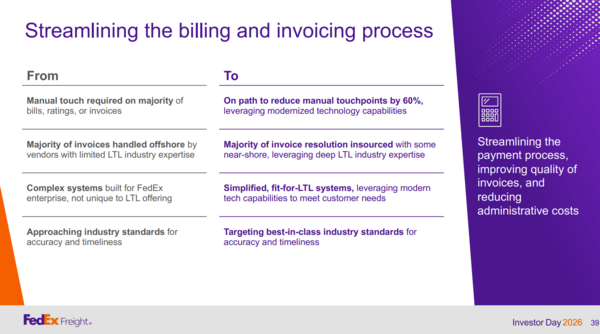
"We have a significant opportunity to improve post-delivery service by modernizing our approach to pricing, rating and invoicing," added Rodgers. "The launch of our fit-for-LTL CRM will ensure all sales, service, marketing and pricing touchpoints are aggregated on one platform. As a result, lead prioritization and wallet share opportunities are front and center, easily accessible by our sales team, driving improved selling performance."
Rodgers indicated that the customer relationship for FedEx Freight includes modernizing pricing and invoicing automation to remove manual intervention. Rodgers said account management also will be optimized. "Our service centers and customer service team will have a unified view of all customer interactions, resulting in improved first-contact resolution," he said.
The tech strategy, AI and stack
Rodgers said that FedEx Freight as an independent company has the opportunity to retire tech debt, simplify and leverage AI-powered by its data flywheel. Rodgers noted the FedEx mantra that the data about a package is as important as the package itself. Here's a look at the tech strategy for FedEx Freight.
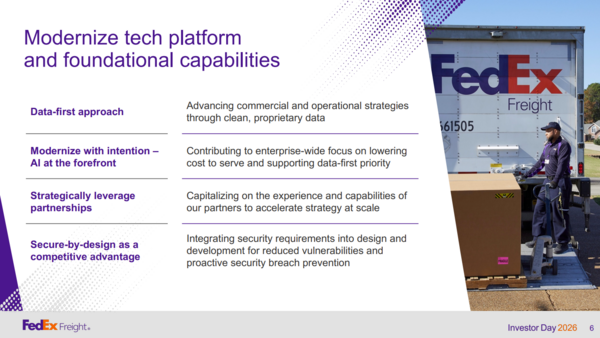
Simplify. Rodgers said FedEx Freight will keep LTL-specific technology while reducing its technology footprint my more than 20%. The company has reduced more than 300 applications already.
Enhance via customer experience and enabling post-delivery service. Processes behind pricing, rating and invoicing will be optimized. FedEx Freight's website will feature a streamlined interface that takes one click to start a shipment.
Leverage AI in phases. Rodgers said FedEx Freight will first start by delivering capabilities offered out-of-the-box by core vendors. He cited Salesforce as a platform that can bring agentic AI tools easily. "Our native Salesforce platform has AI capabilities out of the box. We can deploy those capabilities quickly after separation to drive immediate improvements in customer experience," said Rodgers.
For future-proofing, Rodgers said the company has created "a streamlined, uncluttered, fit-for-LTL tactical backbone" that can incorporate new technologies as the market changes. FedEx Freight is also working to exit FedEx systems within the first 18 months of independence to reduce IT costs and then invest in growth initiatives.
"We'll modernize legacy applications by leveraging best-of-breed platforms and rapidly updating existing software with advanced AI capabilities. This is an important point because we see AI as a critical enabling technology," said Rodgers.
As for the AI plans, FedEx Freight is planning the following:
- Leverage native AI capabilities that are already in core platforms from strategic vendors such as Salesforce, Microsoft and Oracle.
- The company is going to develop custom AI tools to improve its logistics efforts.
- Deploy AI agents to refactor legacy applications.
- Use AI to develop differentiation capabilities.
The technology stack will include the following key vendors.
- Salesforce for CRM and service as well as Agentforce.
- Microsoft for Azure and cloud migration.
- Oracle for ERP systems.
- Accenture for integration and strategy.
"The freight spin-off has allowed us to take a fresh approach in shedding technical debt, modernizing enterprise platforms and building new capabilities that are critical to our future. There's been a lot of benefits from the spin process. It's helped us generate valuable well-architected data that we can use to continually improve the customer experience. It's improved clarity and enhances insights for our business partners and it informs the foundation for the deployment of AI across the organization," said Rodgers.

Larry Dignan is Editor in Chief of Constellation Insights at Constellation Research, where he leads editorial coverage focused on enterprise technology, digital transformation, and emerging trends shaping the future of business. He oversees research-driven news, analysis, interviews, and event coverage designed to help technology buyers and vendors navigate complex markets with clarity and context. ...
Read morePublished
Author
