


Defense Logistics Agency CIO: Agentic AI a business change, not IT project
Adarryl Roberts, Chief Information Officer at the Defense Logistics Agency, said agentic AI is a business change and shouldn't be viewed as just an IT project. And to make agentic AI work, you'll need to first start with making your data ready to be used by AI.
Roberts, speaking at Google Public Sector 2026, also emphasized that CIOs shouldn't wait for perfect data. Focus on making steady progress instead. "Our focus is becoming digital first from a supply chain perspective," said Roberts. "Agentic AI is the North Star. Our focus isn't on replacing our workforce. We really see agentic AI as a force multiplier where we have human enabled AI decisions."
The Defense Logistics Agency (DLA) is the logistics combat support agency and moves 99% of the US military's consumables. DLA has massive scale with 8,600 global suppliers, more than 26,000 employees, $244 billion in active contracts managed, 10,000 contracts awarded per day and 5 million line items managed.
DLA in August 2025 signed a $48 million contract with Google Public Sector to modernize its operations. Google Public Sector's remit is to provide DLA an AI-ready cloud foundation to save money and improve operations.
Google Public Sector's deal with DLA includes deploying the DLA Enterprise Platform that'll be rolled out in phases:
- The initial phase will migrate DLA's infrastructure and data to Google Cloud.
- DLA will deploy tools such as Google's BigQuery, Looker and Vertex AI.
- The system will have a secure-by-design infrastructure and threat intelligence provided by Google Cloud's roster of security services.
The DLA efforts with Google Public Sector are ongoing and part of a broader data and AI transformation effort. DLA has had a steady cadence of data and AI updates throughout 2025 including DLA Energy's use of AI, white papers about supply chain use cases and how AI is the new gunpowder.
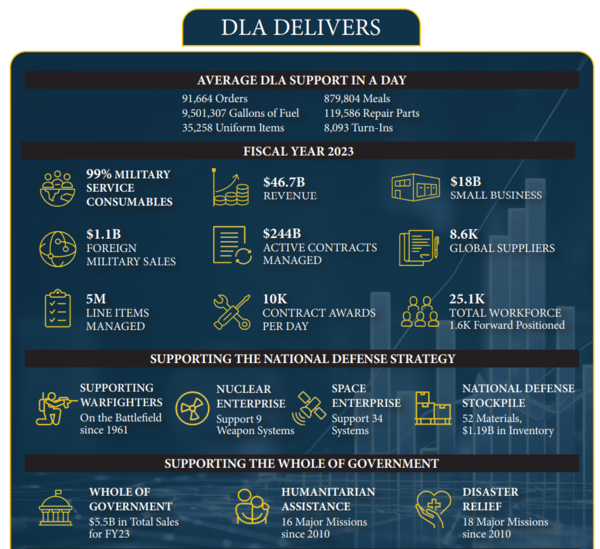
DLA's data lessons
Roberts said DLA had to "buy down 30 years’ worth of technical debt." DLA realized during the COVID-19 pandemic that it largely outsourced its data efforts to contractors.
"We realized we didn't really understand our business processes," explained Roberts. "We contracted out a lot of that work and we needed to take control of our data and start building our data fabric."
DLA's approach is to have government staff making the decisions, but augmenting the agency with innovation from industry.
To produce data that's AI ready, Roberts said it is creating a "single authoritative source of data instead of having to go to various systems."
He added that there's a sprawling mix of transactional and unstructured data that can be leveraged for AI.
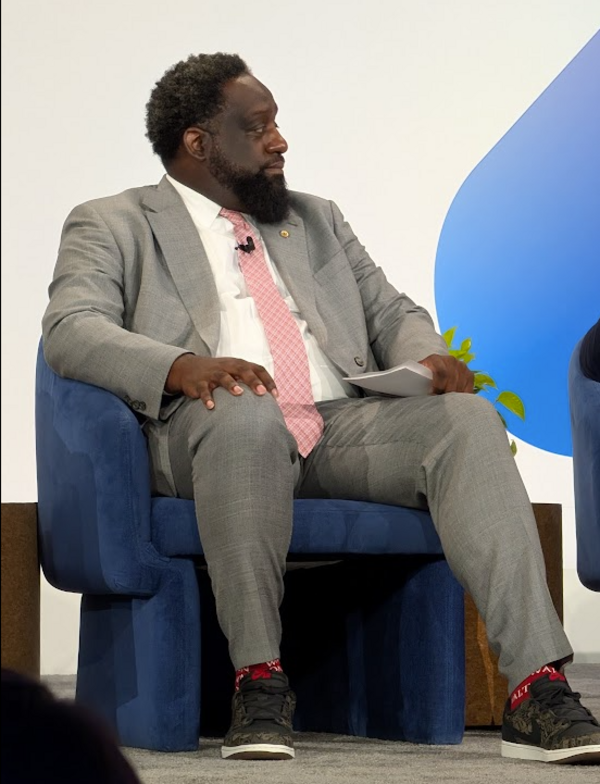
Roberts said the goal for DLA is to become more predictive with continuous data modeling and ultimately find signals that can speed up decisions. For instance, Roberts said DLA wants to procure weapon systems that'll be needed later with upfront purchases. Data on troop movements can be used to forecast supply chain impacts.
AI agents will have a big role going forward and they will be governed.
Roberts said DLA's AI transformation will draft off GenAI.mil, which brought an AI overlay across the military branches. "GenAI.mil is accelerating the learning curve and acumen of our workforce," said Roberts.
The big picture
The DLA's efforts to move toward AI agents leveraging a data fabric align with broader efforts across the US government. Andrew Mapes, Principal Deputy Chief Digital and Artificial Intelligence Officer, Office of the Secretary of Defense Chief Digital & Artificial Intelligence Office, also spoke at Google Public Sector Summit 2026.
Mapes said his group's mission is to scale AI capabilities and an enterprise data layer. "Historically, the chief data officer function was a person off to the side knocking on doors trying to get buy-in. Now the doors are getting knocked down, and it's keeping up with the pace of the demand," said Mapes. "That comes with the expectation from the top that you are going to share your data, you're going to expose your data, and the data is going to be used to inform decision making."
GenAI.mil, which is powered by Google Gemini, can illustrate how data sharing makes the whole stronger. Mapes added that "the tools we have today are really unlocking all of those reform initiatives we had six and seven years ago, but now we're sprinting across multiple lines of effort."
Roberts' emphasis on agentic AI being a transformational business change that comes from the top was emphasized at a DLA town hall with DLA’s new director, Air Force Lt. Gen. David Sanford.
Sanford, who spoke just a few days after Roberts at the Google Public Sector Summit 2026, said DLA's transformation is guided by using data and automating. Sanford said DLA's data fabric will be used throughout the agency along with a set of tools to manage and analyze the supply chain. Employees will also be able to make decisions faster when armed with the right data, said Sanford.
"You’re going to have the data, you’re going to have the tools, and supervisors up and down the chain are going to have to be comfortable with empowering their employees to be able to act on that data,” said Sanford, who reiterated that AI-powered automation will be a force multiplier. "Just because we’re going to have some automation doesn’t mean we’re looking to let anybody go. We’re looking to make you more effective."
More from Google Public Sector Summit 2026:
- NOAA's huge data, cloud migration to Google Public Sector sets up AI plans
- How Google Public Sector’s RISE unit works: Show don’t tell
- Google Public Sector customers: Data foundation eases AI bottlenecks
- Accenture Federal Services, Google Public Sector roll out Gemini Launchpads
- Google Public Sector launches Gemini for Government Services, sees AI agents as integration accelerator
- Security at machine speed has its growing pains
Larry Dignan is Editor in Chief of Constellation Insights at Constellation Research, where he leads editorial coverage focused on enterprise technology, digital transformation, and emerging trends shaping the future of business. He oversees research-driven news, analysis, interviews, and event coverage designed to help technology buyers and vendors navigate complex markets with clarity and context. ...
Read morePublished
Author
