


NOAA's huge data, cloud migration to Google Public Sector sets up AI plans
The National Oceanic and Atmospheric Administration is betting that a move to the cloud as well as a healthy dose of artificial intelligence will enable it to distribute its weather and forecasting data out faster. First, NOAA is looking to wrangle data, speed up research and process information wherever it is stored.
Dr. Neil Jacobs, Under Secretary of Commerce for Oceans and Atmosphere, spoke at Google Public Sector Summit 2026 and outlined how NOAA is tacking its current challenges. NOAA named Google its primary provider of high-performance computing infrastructure for its Weather and Climate Operational Supercomputing System (WCOSS).

Under the partnership, NOAA is moving its operational Numerical Weather Prediction (NWP) supercomputer from on-prem to Google. The timeline will run from early 2027 and be completed in December 2027. NOAA will also use Google DeepMind models and Google machine learning tools as well as big data services including BigQuery storage and Google Earth Engine.
Here's a look at the to-do list:
Wrangle the data: NOAA ingests data from multiple sources covering weather, water, climate, deep-sea exploration and space weather using satellites, ships and hurricane hunter aircraft. "People talk about having a big data problem. We have a huge data problem," said Jacobs, who added that weather forecasting is a top priority.
Deleted data is the issue. Jacobs said to get satellite and model output to forecasters in time, NOAA lowers the resolution. The problem? The detail that's cut can't be recovered and that wastes money spent on high-resolution instruments. "Trapped data isn't my biggest problem," said Jacobs. "The problem is actually the data we've deleted and will never get back.
Data storage is in multiple places and hard to distribute. Jacobs said:
"Almost all the data we have is free and publicly available. The problem is getting it to the public. We also share it with other international centers so the entire planet is dependent on this information."
More from Google Public Sector Summit 2026:
- How Google Public Sector’s RISE unit works: Show don’t tell
- Google Public Sector customers: Data foundation eases AI bottlenecks
- Accenture Federal Services, Google Public Sector roll out Gemini Launchpads
- Google Public Sector launches Gemini for Government Services, sees AI agents as integration accelerator
- Security at machine speed has its growing pains
The plans
Jacobs said the strategy for NOAA revolves around moving data to the cloud. Jacobs said NOAA has worked on premises, but to process data where it resides and make it accessible to AI models a move to the cloud is needed.
NOAA's plan is to move most of its applications to the cloud and leverage efficient AI models. "We have millions of lines of Fortran and just in the last few years, we've transitioned some of this over to AI-based systems that are incredibly efficient," said Jacobs.
He added that the forecasts are probabilistic and NOAA drives confidence in a forecast from ensembles, or multiple versions of the same forecast. Jacobs said NOAA is also working with DeepMind and its GraphCast model.
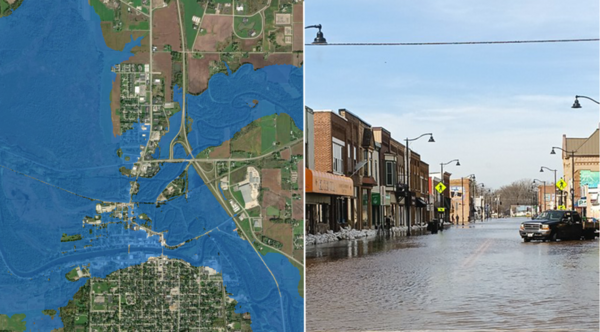
The move to the cloud is also designed to build resiliency into the forecasting architecture, which is tied to physical offices.
Jacobs said moving NOAA's forecasting software stack to the cloud will happen "within a couple of years." Storage has already moved to the cloud. NOAA also will preserve full resolution by processing data wherever it is stored and use the cloud for both compute and storage.
AI forecasting with DeepMind's GraphCast will also accelerate. Ultimately, Jacobs said NOAA will digitize old records and open up the archive.
Jacobs said his approach is to take a different approach, not a slightly better one. "We get siloed in thinking about making a better mousetrap and then not focusing on what's coming up behind us in the rearview mirror with a completely different way to solve a problem," said Jacobs. "Push the problem out in the community and say 'you may know a better way to solve it'"
Larry Dignan is Editor in Chief of Constellation Insights at Constellation Research, where he leads editorial coverage focused on enterprise technology, digital transformation, and emerging trends shaping the future of business. He oversees research-driven news, analysis, interviews, and event coverage designed to help technology buyers and vendors navigate complex markets with clarity and context. ...
Read morePublished
Author
