


AWS sees Q2 boom with sales growth of 37%
Amazon Web Services delivered 37% revenue growth in the second quarter amid strong demand for a $169 billion annual run rate.
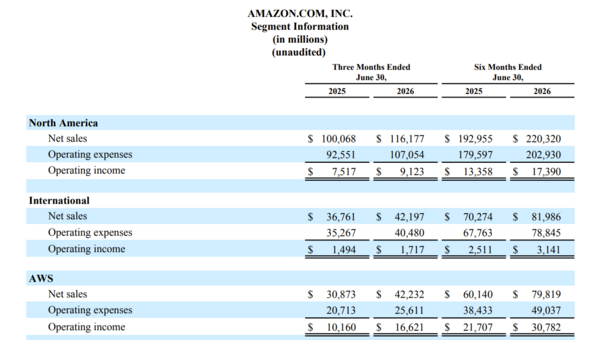
AWS delivered second quarter operating income of $16.6 billion on revenue of $42.2 billion. AWS' sales growth continues to accelerate sequentially. AWS is 21% of Amazon's total sales.
The results landed as Amazon reported second quarter net income of $62.6 billion, or $5.75 a share, on revenue of $200.6 billion, up 20% from a year ago. Second quarter earnings included a $53.4 billion gain from Anthropic.
- Google Cloud revenue growth in Q2 up 82%, nearly hits $100 billion annual run rate
- Microsoft Azure Q4 revenue surges 41%, tops $100 billion in annual revenue
Google Cloud and Microsoft also reported investment gains from Anthropic as well as OpenAI.
Wall Street was expecting Amazon to report earnings of $1.82 a share on revenue of $196.47 billion.
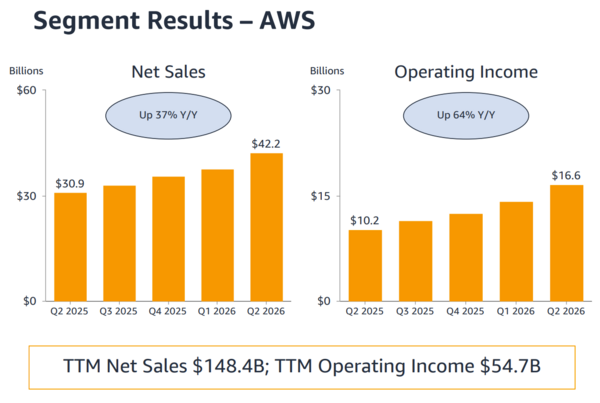
As for Amazon's other units, North America operating income was $9.1 billion on revenue of $116.2 billion, up 16% from a year ago. International operating income was $1.7 billion on revenue of $42.2 billion, up 15% from a year ago.
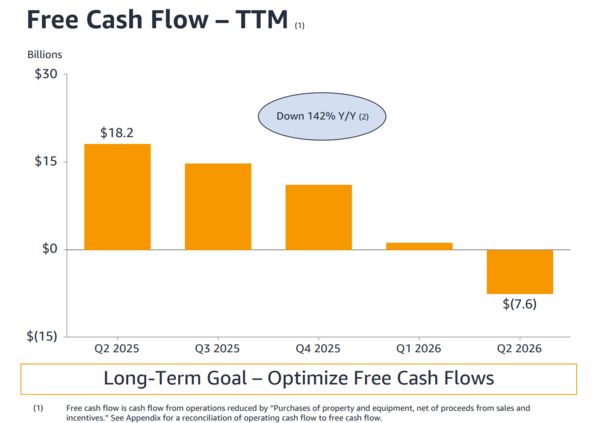
Despite the strong operating results, Amazon's free cash flow for the trailing 12 months was negative $7.6 billion due to capital expenditures.
Amazon CEO Andy Jassy said AWS demand is "booming" and the growth was the fastest in 18 quarters. He added that AWS' AI and semiconductor sales have run rates of more than $25 billion each.
On a conference call, Jassy said agentic AI is starting to drive demand as our its custom silicon. Jassy also said enterprises are focusing on security and AI inference efficiency.
Jassy added that Amazon will see returns from its capital spending. Servers and networking will break even within 3 years and a life span of 5 years to 6 years.
Amazon will spend $220 billion on capital spending largely due to memory costs. Data center spending will monetize in roughly two years.
Choice quotes include:
- "We have clear line of sight to strong financial returns. I'll explain why. There are two major parts of the investment: the data centers and the servers and networking equipment that go into them. These have different capital cycles. Data center capital is spent starting two years before we can put servers into them to start monetizing. Once a data center opens with servers plugged in, we start generating significant revenue right away, and then get to monetize these data centers for 30 plus years without having to spend that startup capital again. Servers and networking equipment operate on a shorter cycle. We typically purchase these a few months before putting them into service, so we have strong visibility into customer demand before we trigger the spend. If the demand isn't there, we won't spend the capital. For servers and networking equipment, on average, it takes a little less than three years to break even on that investment. The servers currently have a useful life of at least five to six years, and most of our AI capacity these days is being contracted for at least five-year terms. That means that we're driving significant free cash flow on the servers and networking equipment in the two to three years after we break even."
- "Customers choose AWS because we offer the broadest capabilities. They want their AI inference to reside near their other applications and data, and more of it resides in AWS than anywhere else. And because AWS has the strongest security and operational performance, we're seeing strong growth across both AI and non-AI, what we call core, and growth in one is driving growth in the other. Growth in AI drives core because post-training reinforcement learning and agent tool use is mostly done on CPUs versus AI accelerators."
- "We have a unique offering that customers are excited about. As we've been saying for 18 months now, technically competent companies are going to build their own foundation models-not the really big frontier models, but smaller models that leverage their proprietary data."
- "Even after you've built an agent, you have a lot of muck to worry about. A production agent needs somewhere secure to run, memory so it holds context, identity so it can act on a user's behalf, tools and data to connect to, and a way to watch what it's doing once real traffic is stitching all that together reliably is hard, and it stalled many production deployments."
As for the outlook, Amazon projected third quarter sales between $197 billion to $202 billion with operating income between $22.5 billion to $26.5 billion.
Larry Dignan is Editor in Chief of Constellation Insights at Constellation Research, where he leads editorial coverage focused on enterprise technology, digital transformation, and emerging trends shaping the future of business. He oversees research-driven news, analysis, interviews, and event coverage designed to help technology buyers and vendors navigate complex markets with clarity and context. ...
Read morePublished
Author
