


Solutions and Empathy, Not Fear: When Companies Might Be Spreading Terror Instead of Remedies

I’m writing this the morning after September 11th.
I woke up thinking about the tragedy of the Twin Towers and all the people who were injured and lost their lives from those events twenty-five years ago.
At least 2,753 innocent people died at the World Trade Center: 184 at the Pentagon, and 40 in Pennsylvania.
These numbers do not include those who might have later died either from health-related effects as first responders dealing with the aftermath of that destruction, or as professionals who died in the military and national security response that followed.
And then I think of the events of the last week – now in September 2026 – where words and conjured images of possible death and destruction have been spread. When news anchors, internet influencers, and podcasts hosted speakers who pronounced their vision of AI-induced terror that might impact not just a few locations, but purportedly the extinction of all humanity.
The reason I am writing this, the day after the twenty-fifth anniversary of the tragic events of 9/11, is because the AI-existentialism coverage seems to be fixated on a terror of our own creation that somehow AI might be the end of humanity. Yet such fears and existential anxieties are literally of our own creation.
Unlike the actual tragedy of 9/11, conjured images of mass human extinction due to what AI might become have not actually happened. These visions may not ever happen. We can and should take actions in the now and near future to avoid such possibilities.
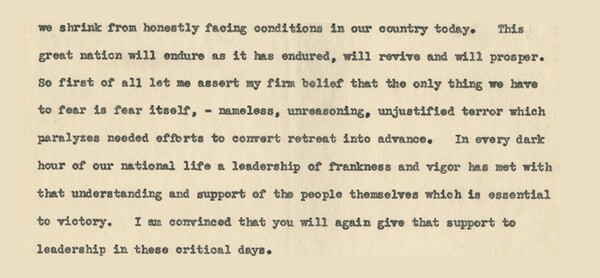
We need to remember “… that the only thing we have to fear is fear itself, - nameless, unreasoning, unjustified terror which paralyzes needed efforts to convert retreat into advance…” as proclaimed by President Franklin D. Roosevelt in 1933. We should apply this same focus to the challenges of our now.
In my professional opinion, end-of-humanity fears about (generative) AI are unjustified distribution of anxieties and terror which paralyze our minds and constrict our sense of human agency in an uncertain world. They’re equivalent to the “railway madness” of the mid-1800s, as I’ll highlight more in detail later.
Constructive solutions and empathy are needed, including practical steps to address better approaches to developing and using AI. Most importantly we need to remember the next sentence of FDR’s 1933 inaugural address, namely: “In every dark hour of national life a leadership of frankness and vigor has met with understanding and support of the people themselves.”

When The Only Thing We Have to Fear is Fear Itself
If the purpose of terrorism is to introduce fear and instability into societies to bring about the intended outcomes of the terrorists, it’s disconcerting now to see analogous fear and instabilities being injected into our modern-day discourse without scrutinizing whether such alleged future scenarios lack grounding in reality.
Make no mistake, digital systems including AI can sadly cause harm. AI chatbots have tragically curated information and provided responses to human prompts that appear to have resulted in human suicide and death. In our immediate now, generative AI can create deepfakes that can rob people of their dignity and spread inaccurate information about people. Humans could query and provide prompts to AI systems to cause harm intentionally or unintentionally. Generative AI can mislead and provide information that prompts anger, fear, and division in societies.
Which means that we, as human communities, definitely should address the here-and-now unfair harms and risks of gross negligence that can come with use of AI.
Yet this is precisely my concern: when narratives shift from our here-and-now to purported existential fears with no practical solutions – that looming terror of a future unknown paralyzes communities and policymakers from pragmatically addressing what can be done in our immediate present.
Having responded to terrorism events including the events of 9/11 and anthrax in 2001, terrorism, to a degree, tragically “works to disrupt societies” because it is the unknown threats that supposedly loom around us. This is especially true for bioterrorism's ability to prompt fears, anxieties, and terror because we cannot see possible biological material.
An online-influencer who says there is a bioweapon that has been spread amongst multiple public places – even if there is no actual bioweapon – could have a similar disruptive effect on societies as if there really was one. With the near-instantaneous information ecosystems that we have today, a video claiming this could easily “go viral”. People would become fearful and anxious.
Responders would be forced into exhaustive efforts to disprove a negative, while bad actors hijack our fear of invisible things we cannot that might injury or death. Officials will have to tell people that there’s no reason to be afraid, yet they would be doing so at a time when trust within and across human societies is fairly low.
Unknown, unquantifiable threats that we don’t know if they’ll happen prompt humans individually and collectively to feel uncertain, unstable, and unable to have meaningful agency in our lives.
Which is why I find the current state of discourse regarding AI and societies disconcerting. They’re resulting in the spread of fear and terror even if that’s not what is intended. Even if one assumes good faith on the part of individual actors claiming to believe that AI might purportedly cause the extinction of all humanity – what these actors are not doing is putting forward practical, pragmatic solutions to reduce the risks that have not happened and may not ever happen.
When Companies Might Be Spreading Terror Instead of Remedies
With certain AI-existentialism discussions nowadays, it is as if someone came to us and said there’s a risk that while we’re sleeping, our house or our neighbor’s house might catch on fire, and we won’t know about it until it is too late to avoid harm or loss of life.
Now imagine if someone called for a “pause” on living in homes and items that might cause sparks without offering actionable defenses like better engineering practices, smoke detectors, and fire extinguishers. Instead, hypothetical persons kept on amplifying the fear and terror that your home could go up in flames while you were sleeping and you could be killed.
This is what calls for AI pausing or slowing down also seem like: completely missing a broader set of action-oriented solutions.
Getting the entirety of the human world to comply with a global pause is geopolitically unlikely. Access to open-weight models proliferates already beyond the jurisdiction of any single country, including GenAI models available via the Dark Web.
The crucial question is not whether advanced AI capabilities will proliferate, but whether we will build the physical-world defenses and rapid response infrastructure that protect individuals, communities, and companies regardless of which GenAI models benign or harmful actors choose?
My fundamental concern is this: anyone broadcasting online or in-person that they think a future risk exists needs to ask themselves what three practical, pragmatic steps societies can do to reduce that risk.
Folks cannot be problem holders or apocalyptic-voyeurs and resort to spreading fear, terror, and anxieties in communities.
Ideally, we need to encourage these practical, pragmatic questions to be asked by the press and media influencers if they host anyone opining on existential risks too. We also need to encourage more critical unpacking of both the claims of existential risks being near and such solutions.
At the moment, several AI discussions want to focus on the possibility of recursive self-improvement as a grave concern, where an AI might gain the ability to improve itself faster and faster. Very few discussions pause and ask:
1. Generative AI (GenAI) relies fundamentally on vast corpora of training data. How does a model rewrite its own core algorithmic architecture purely through data pattern-matching?
2. The underlying mathematics of GenAI can destabilize when trained on poor-quality feedback. If a GenAI model trains on its own outputs, how does it avoid recursive model collapse without human review and filtering?
3. GenAI does not produce worldviews or have a sense of facts or axioms about the world. How would GenAI recursively self-improve given these limitations?
If asked by the press and media influencers, these and several other questions might help us better level-set AI-existentialism discussions. Yet such questions might result in lengthy interviews that would not get fully read by more people. Alternatively, such nuanced interviews wouldn’t be promoted by AI algorithms (ironically) as being sufficiently provocative to go “viral” in our social media and video feeds.
When Humans Experience Moral Panics
Public desire for short soundbites restricts nuanced rational discussion on these topics. As claims of existential risks and terror associated with AI get distributed online, our human brains start to miss the here-and-now problems and issues with GenAI that we should be asking companies to fix. We get tunnel vision, our creative problem-solving thinking abilities diminish. We become fixated on future unknown, unquantifiable potential risks.
Yet humanity has had moral panics before.
In the mid-1800s, as train speeds increased, so did widespread fears about the effects of traveling at speeds over 50 miles per hour. People worried that such speeds might cause suffocation in tunnels or impact various aspects of women’s health. These proved to be public myths not grounded in reality, even though some serious medical gazettes published studies detailing purported health risks that were later disproven.
Media sensationalism at the time stoked such fears of physical harm. In reality, going faster than 50 miles per hour did not result in any of these issues. The technological panic, dubbed “railway madness”, was a result of the tension between technological advancement and human vulnerability. Misconceptions that train speeds could impact women’s health, including uterine displacement, reflected existing gender biases and limited medical knowledge.
Fears of the unknown aggravated people with existing anxieties and emotional trauma and fueled a general social moral panic that trains faster than 50 miles per hour threatened human communities.
By the start of the 20th century, these “railway madness” concerns of the mid-1800s were seen for what they were: psychological distress and societal anxieties. Which is the same empathy that we need to bring to our current now in 2026.
I celebrate that we live in a society where, by and large, folks are free to believe what they want to believe as long as that belief does not harm or hurt someone else. I hope that the folks appearing on the news or in articles really are “true believers” in what they claim, however just because they strongly believe something does not make them correct.
We should have empathy that, similar to the “railway madness” tied to human psychological distress and anxieties, similar circumstances may be happening now. We also should have empathy that concerns about how GenAI will impact how we think, work, and interact are also valid.
We should engage in broader public discussions driven not by fear, but by an attentiveness to listen and learn with a de-mystification of what AI is, can do, and how it is advancing. Treating AI as opaque, nebulous, and unquantifiable only stokes more fears that may not be grounded in reality.
A Leadership of Frankness, Understanding, and Support of the People
GenAI has here-and-now issues that we should address, and we should address them with practical, pragmatic solutions. We also should hold companies liable if and when their models cause harm, because liability is an important part of societies holding organizations responsible just as much as paying for services delivered are too.
When GenAI models demonstrably result in harmful deepfakes, digital discrimination, and mental health crises today, are corporate calls for “safety” that omit the words “we accept liability” woefully insufficient? Are companies attempting to anthropomorphize and blame GenAI for harms incurred, while also creating barriers that protect incumbent market positions from open-weight competition and newer approaches to AI?
We should not let claims of AI “Terminator-like” terror hijack our thinking and actions.
AI-existentialist claims require nuanced and detailed review in ways unfortunately often not supported by our (ironically) AI-mediated information ecosystems, where angry or fearful content often goes viral compared to nuanced and grounded discourse.
Sadly, it could be that spreading excessive fears and terror about AI might prompt some people’s anxieties to spill over to anger and violence. This is why we should not let the sensationalism of our now prompt us to lose a sense of human agency and human hope for the future.
Looking back at the last two decades, our global information ecosystems might have “rewarded” individuals who pronounced doom or observed problems – but didn’t actually map out the path to actionable solutions in the current moment. Anger and fear went viral. Nuanced discussions, let alone practical solutions, were and continue to be lost. We need to invert that paradigm, to be focused more on hearing proposals, pitches, and actions that can and are being done.
We should require anyone claiming existential risks to bring three action-oriented solutions doable today. We should contrast pragmatic proposals with calls for either an "AI pause" or "AI slowdown" that requires global cooperation that doesn’t exist, in addition to enforcement mechanisms that no international body possesses, while doing nothing to protect us if even one major actor defects.
No one should live in terror, because terror not only restricts our thinking; it can erode the quality of and length of our lives.
We also need to have empathy for and engage people who have legitimate concerns that GenAI might erode their life’s work when it comes to producing creative content, intellectual property, or a job that they previous thought was secure and are now displaced by what GenAI can do.
When we humans have focus and purpose, our stress levels go down. When we don’t have a sense of purpose, a sense of identity, or feel like we lack agency, our biological stress levels go up, and empirical studies show this can harm long-term physical and mental health both individually and collectively as communities.
In our current “now”, advancing at sixty minutes per hour, we do have choices tied to the potential future directions AI might take.
We can replace fear and terror with grounded empathy and practical actions today. There is pragmatic work we can and should be doing today to build better people-centered futures.
Onwards and upwards together.
Dr. David Bray is the 2026 inaugural recipient of the Marconi Society's Excellence in AI for global leadership. He is both Chair of the Accelerator and a Distinguished Fellow at the non-partisan Stimson Center as well as Principal and CEO at LeadDoAdapt Ventures, Inc. David previously served as a non-partisan Senior National Intelligence Service Executive, as Chief Information Officer of the Federal Communications Commission, and IT Chief for the Bioterrorism Preparedness and Response Program. Business Insider named him one of the top “24 Americans Changing the World” and he has received both the Joint Civilian Service Commendation Award and the National Intelligence Exceptional Achievement Medal. The U.S. Congress invited him to serve as an expert witness on AI in September 2025. He also advises corporate Boards and CEOs on navigating the convergence of AI, cybersecurity, and geopolitical risk.

Stimson Center & LeadDoAdapt Ventures
Business Insider named Dr. David A. Bray one of the top “24 Americans Who Are Changing the World” and he was named a Young Global Leader by the World Economic Forum in 2016. He has served in a variety of leadership roles in turbulent environments, including bioterrorism preparedness and response from 2000-2005. In 2019, he was invited to give the AI World Society Distinguished Lecture to the United Nations on UN Charter Day. In 2025, he was invited to be an expert witness before a public Congressional hearing on AI to help inform AI policies. In 2026, the Marconi Society selected him as inaugural winner for global leadership and Excellence in AI. ...
Read morePublished
Author