


Qualcomm outlines cloud to edge vision for AI
Qualcomm laid out a vision where AI workloads are hybrid between the cloud and edge devices such as smart glasses, smartphones and wearable devices. The conduit for these AI workloads will ultimately be 6G.
At the Snapdragon Summit, Qualcomm CEO Cristiano Amon said AI will remake every device you wear, come complete with AI agents and be proactive with you in real time.
For Amon, the Qualcomm vision was partially about talking up Snapdragon and outlining its role going forward. In the big picture, Qualcomm's take on edge devices handling a big chunk of the AI workload is notable. Why? The current AI thinking revolves around brute force compute, billions if not trillions of dollars spent on AI data centers and cloud delivery.
"We envision AI to be both cloud and edge. The edge complements the cloud. It’s immediate. It’s personal. It has context. And there’s one important thing about the edge: that’s where the data originates and then where AI becomes yours," said Amon.
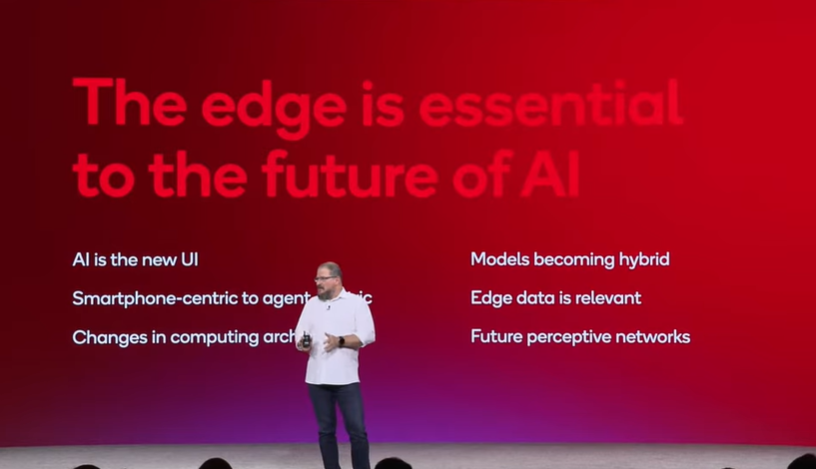
Amon argued there will be a new compute architecture for AI that is cloud and edge. He also noted that foundational models are already designed to be in the cloud and edge and will ultimately be the UI.
- Qualcomm acquires Alphawave for $2.4 billion
- Qualcomm fleshes out Dragonwing with fixed wireless access platform
In addition, the data collected at the edge will be more critical than what was used to train models. This edge AI data will be what personalizes the experience, acts on your behalf and has context.
Amon was talking about personal computing experiences, but it isn't much of a leap to understand how sensors at the edge are going to impact enterprise use cases too. "The importance of edge data is massive. It’s the best kept secret," said Amon.
The conduit for these cloud to edge hybrid AI workloads will be the network in between. Amon touted 6G networks and pre-commercial devices ready as early as 2028.
"6G is designed to be the connection between the cloud and the edge devices. The difference between 5G and 6G is the network of intelligence connecting the edge and the cloud, merging the physical and the digital, providing connected experiences,” said Amon.
A big part of the AI at the edge strategy revolves around Snapdragon and the chips on devices.
Snapdragon 8 Elite Gen 5
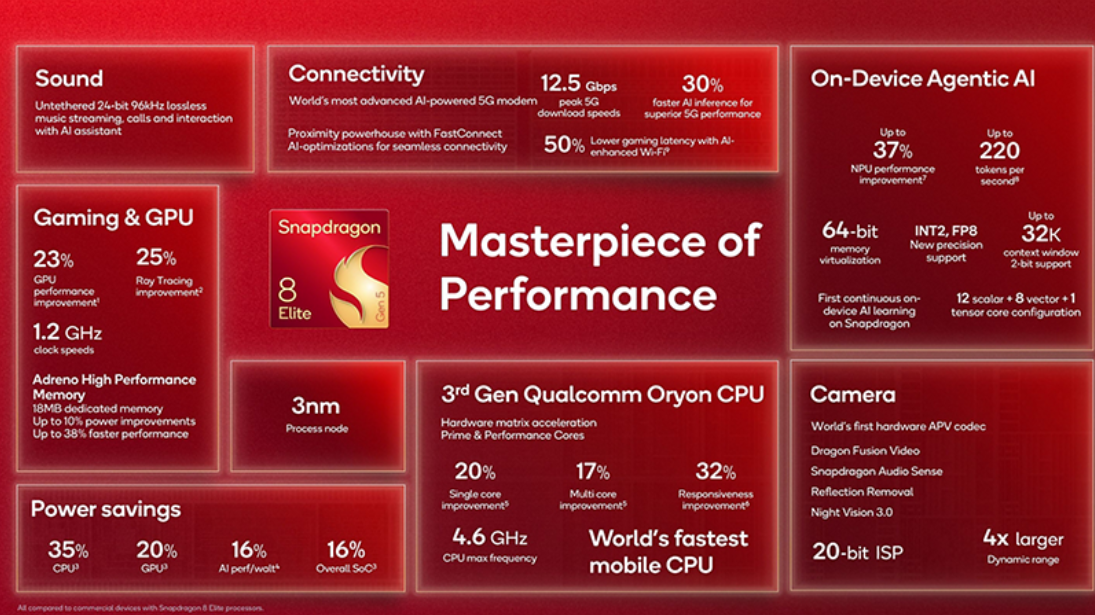
Qualcomm announced the 3rd Gen Qualcomm Oryon CPU and Snapdragon 8 Elite Gen 5, which is billed as the fastest mobile system-on-a-chip.
Key points:
- Snapdragon 8 Elite Gen 5 will enable fast multitasking and app switching as well as long-game play.
- The platform enables AI agents to work across apps via continuous on-device learning and real time sensing and multi-modal models.
- Snapdragon 8 Elite Gen 5 has performance gains across the Oryon CPU, a 20% performance boost, Qualcomm Adreno GPU with a 23% boost for gaming, and Qualcomm Hexagon NPU with 37% faster performance.
Snapdragon X2 Elite Extreme and Snapdragon X2 Elite
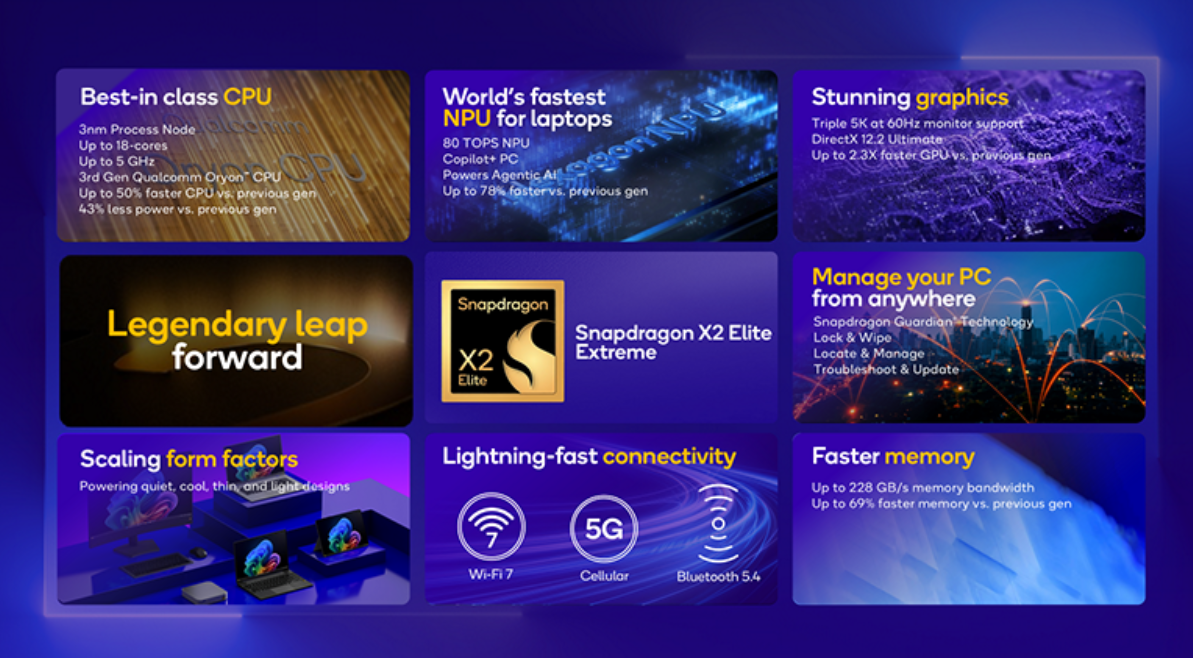
Qualcomm rolled out new processors for Windows 11 PCs and can deliver 80 TOPS of AI processing. It's also the first Arm processor to run at 5 GHz.
Snapdragon X2 Elite Extreme is designed for premium PCs and is aimed at agentic AI, data analytics and professional media editing.
Devices powered by the Snapdragon X2 Elite family will be available in the first half of 2026.
The launch of Qualcomm’s next-gen processors indicates a move upmarket to target creative pros and data engineers.
Larry Dignan is Editor in Chief of Constellation Insights at Constellation Research, where he leads editorial coverage focused on enterprise technology, digital transformation, and emerging trends shaping the future of business. He oversees research-driven news, analysis, interviews, and event coverage designed to help technology buyers and vendors navigate complex markets with clarity and context. ...
Read morePublished
Author
