


Palo Alto Networks acquires Chronosphere for $3.35 billion, reports strong Q1
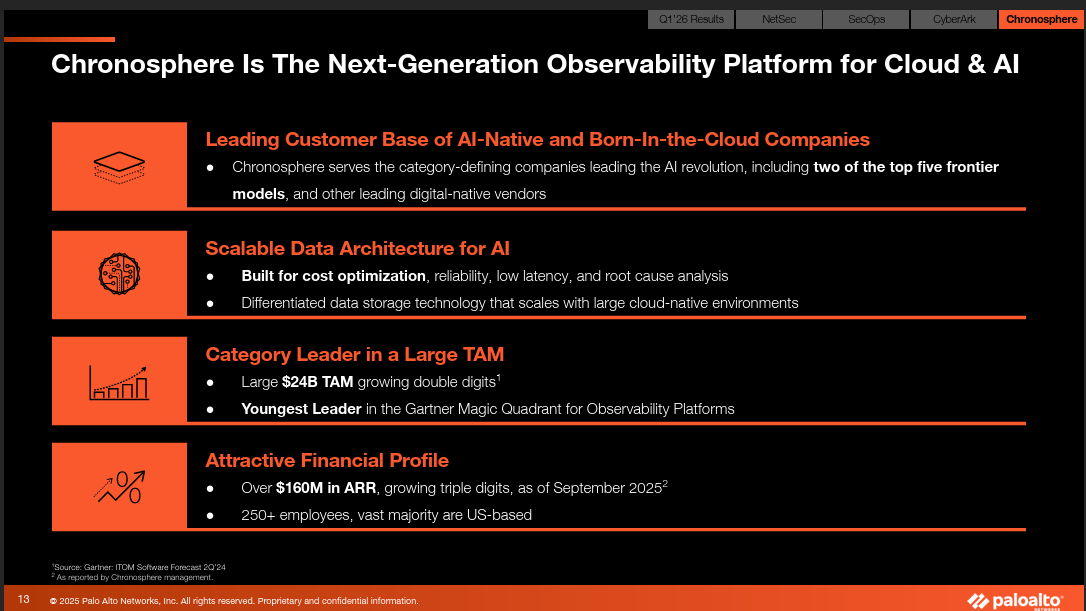
Palo Alto Networks reported better-than-expected first quarter results and said the company landed total platform customers. Palo Alto Networks also said it will acquire Chronosphere, an observability platform, for $3.35 billion.
The security company reported first quarter earnings of $334 million, or 47 cents a share, on revenue of $2.5 billion. Non-GAAP earnings for the first quarter were 93 cents a share. Wall Street was expecting Palo Alto Networks to report non-GAAP earnings of 89 cents a share on revenue of $2.46 billion.
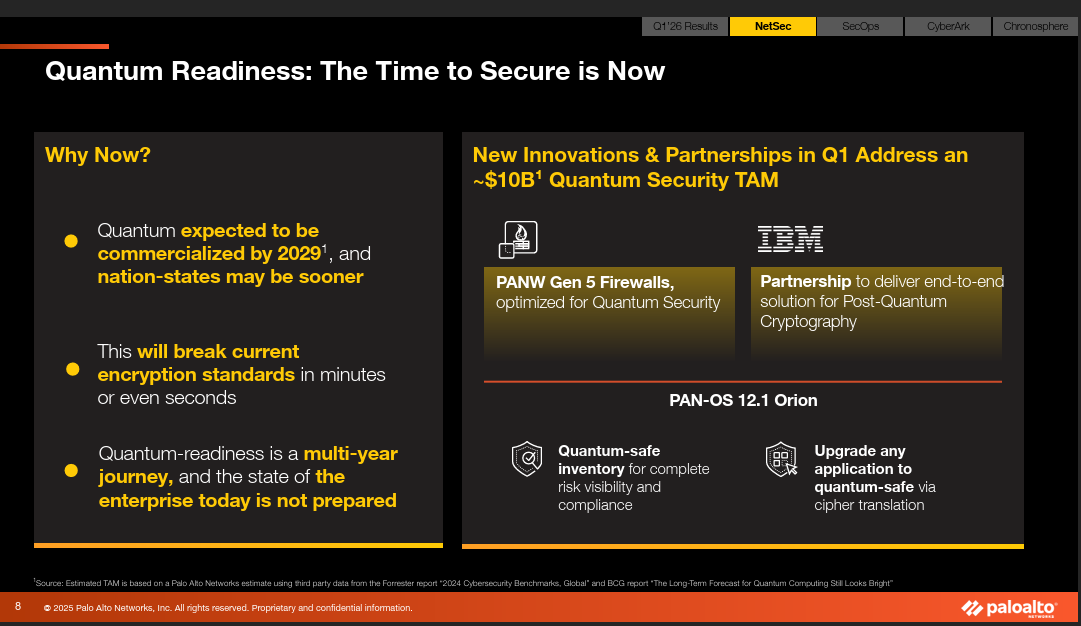
Ahead of the earnings, Palo Alto Networks and IBM said they will launch a joint offering focused on quantum-safe security. The companies will combine IBM's Quantum Safe Transformation services with the network-level, cryptographic intelligence from Palo Alto Network's platform.
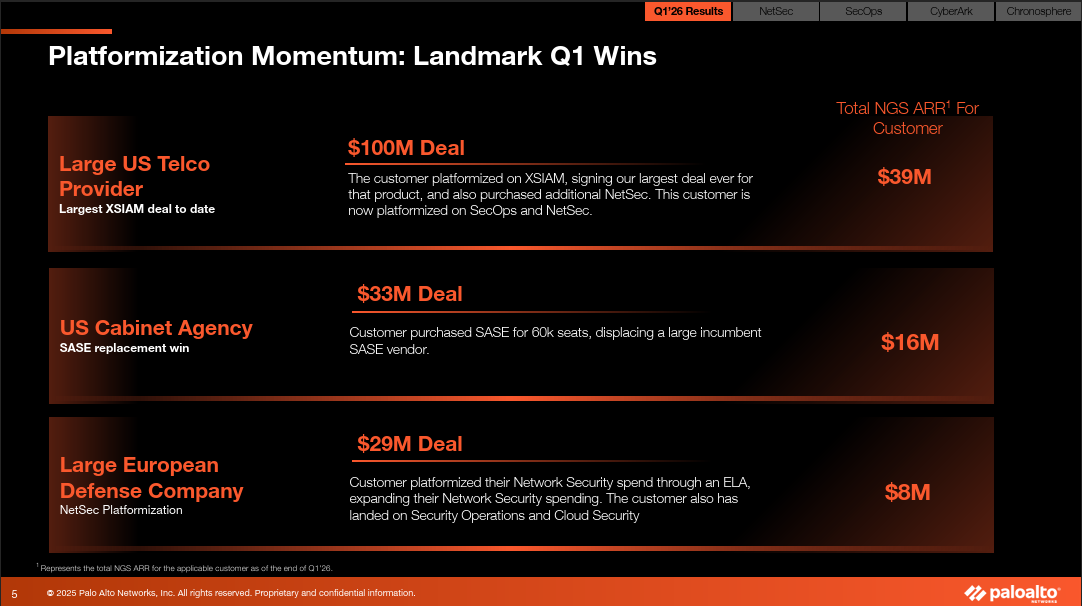
CEO Nikesh Arora said the first quarter was marked by "significant platformization wins." Palo Alto has been beefing up via acquisitions with Chronosphere as well as CyberArk. Chronosphere has annual recurring revenue of $160 million as of Sept. 30.
As for the outlook, Palo Alto Networks said revenue will be between $2.57 billion to $2.59 billion, up 14% to 15%. Non-GAAP earnings will be between 93 cents a share to 95 cents a share.
For fiscal 2026, Palo Alto Networks is projecting non-GAAP earnings of $3.80 a share to $3.90 a share with revenue of $10.5 billion to $10.54 billion, up 14%.
On a conference call, Arora said:
- "AI is exposing the cracks in our enterprise architectures, which do not have robust security. Patches are incomplete, platforms are missing. There is a plethora of point products across the enterprise. This gap is exactly where attackers thrive. They're testing how far they can exploit the model. They're running prompt injections, jail breaks, model manipulation. And now we're seeing the next phase, autonomous AI agents being leveraged into the attack chain."
- "Our messages to customers is clear, real-time visibility and security are essential for infrastructure. This reality necessitates a paradigm shift in the industry."
- "Quantum computing has seen significant innovation over the last year. We're getting more and more optimistic on the arrival of quantum and expect it to be commercialized by 2029. As is widely known, quantum computing has the ability to break current encryption across technology stacks. Enterprises have less than 5 years to get their states to quantum readiness. There is a fear that some nation-states will have quantum compute capability sooner than 2029."
Larry Dignan is Editor in Chief of Constellation Insights at Constellation Research, where he leads editorial coverage focused on enterprise technology, digital transformation, and emerging trends shaping the future of business. He oversees research-driven news, analysis, interviews, and event coverage designed to help technology buyers and vendors navigate complex markets with clarity and context. ...
Read morePublished
Author
