


A look at the intersection of AI and customer experience
Artificial intelligence and customer experience are a common intersection on earnings conference calls as enterprises. Companies are looking to connect the dots between lifetime value of a customer, driving revenue and hybrid approaches that meld technology and humans.
Here's a look at some of the CX efforts detailed in recent days.
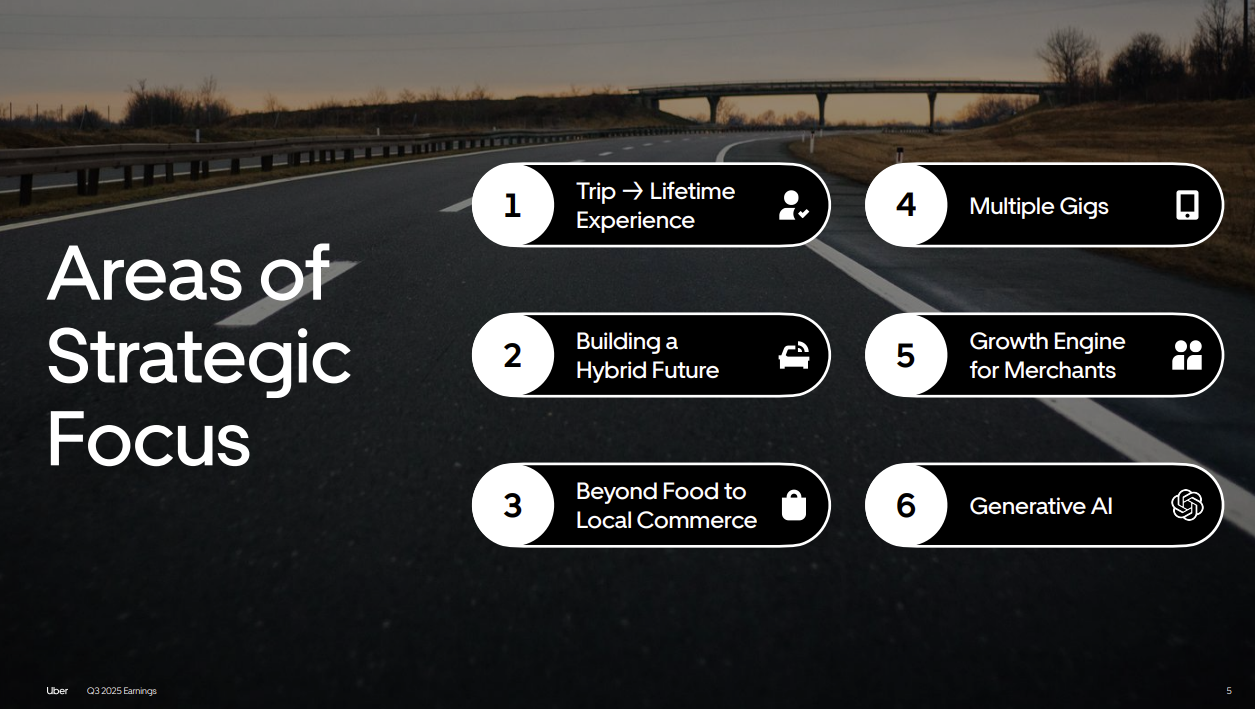
Uber: Lifetime experience
Uber is on track to support about 14 billion rides in 2025, but the goal is to drive cross platform usage and engage consumers over a long period. Think lifetime experience over lifetime value even though the two categories are closely related.
Note the nuance of lifetime experience messaging from Uber CEO Dara Khosrowshahi. Lifetime value of a customer is a common metric that revolves around the total predicted revenue a company can get from an entire relationship. LTV is transactional.
Lifetime experience is a view that Uber can go from providing rides to multiple services over time. In theory, lifetime experience could be more valuable and lead to deeper customer relationships.
"At its core, Uber is a trips machine built to make rides and deliveries happen affordably at scale," explained Khosrowshahi. "While an exceptional trip experience will always be core to who we are, we’re now expanding our focus beyond the next trip—to consumers' entire lifetime experience with Uber. Taking this lifetime view means thinking more holistically about how people engage across our platform—sometimes making investments that may reduce short-term results but strengthen long-term loyalty, or prioritizing actions that benefit the platform overall, even if one business line bears an immediate cost."
Khosrowshahi said Uber One is one program designed to encourage cross-platform engagement. Consumers who engage across Uber's services have 35% higher retention rates and spend three times as much as those who don't.
- Nominate CX leaders for our 2026 AX100 | 2025 AX 100 leaders
- CCE 2025: What the CxOs are saying about CX, AI, process
- Constellation ShortList™ Customer Experience (CX) Operations Services: Global
Lifetime experience also accounts for new services Uber may add in the future. Today, it has a small base of consumers using multiple services, but you could play out a scenario where rides, delivery and maybe healthcare are delivered over a lifetime. On the flip side, Uber is seeing 9.4 million gig workers work across the platform for rides and delivery. Most Uber workers are focused on one task.
Khosrowshahi said: "Over the coming years, we will change both by converting couriers to drivers and vice-versa, and by further extending our flexible earnings model beyond rides and delivery. For example, we recently announced that we will be piloting digital tasks in the Uber Driver app, powered by Uber AI Solutions. The pilot will give drivers more ways to earn during downtime by completing tasks like uploading or tagging photos to help train AI models. Our ambitions here are much larger, and you will see us lean into this opportunity in the years ahead."
Takeaway: Consider lifetime experience efforts to drive traditional lifetime value of a customer.
Match: Growth depends on experience flywheel
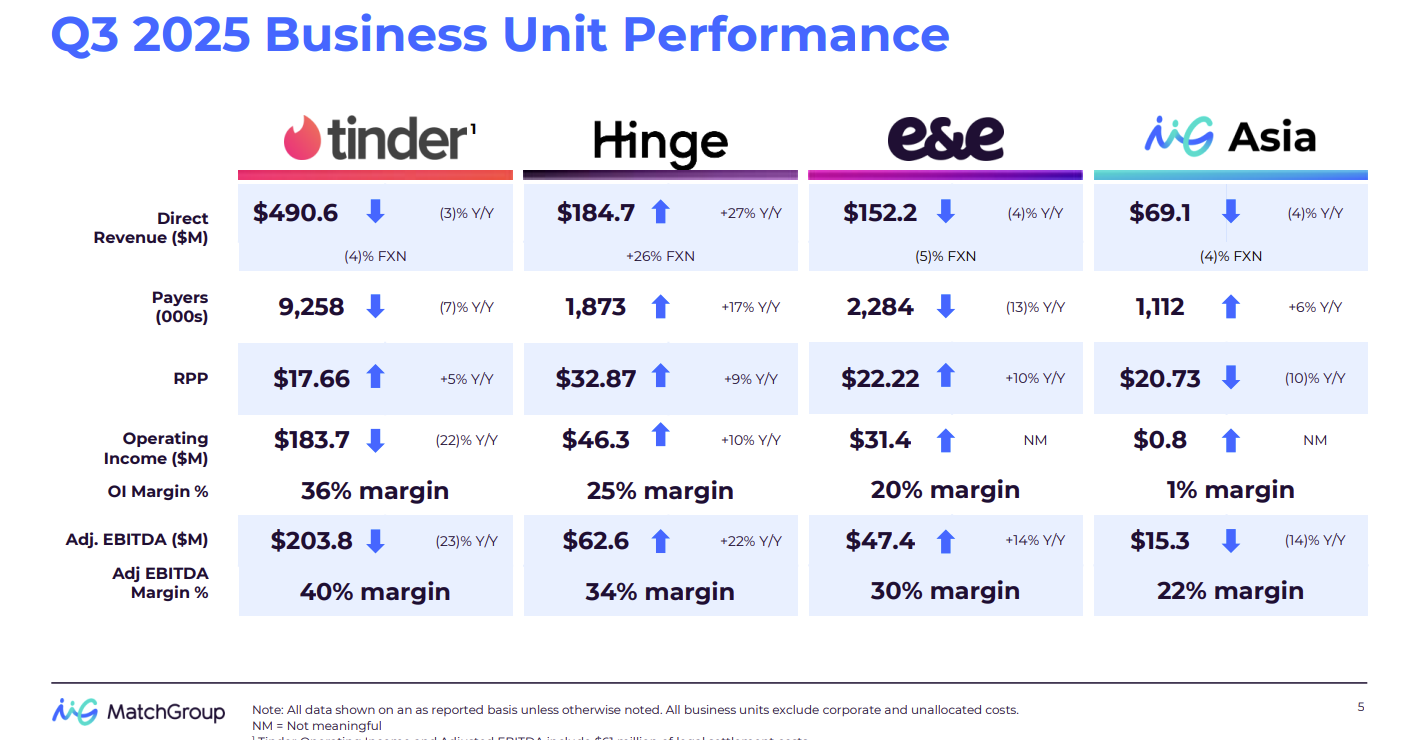
Match Group CEO Spencer Rascoff said the company is leveraging AI across its brands, notably Tinder, Hinge and Match, to reboot growth with experiences that lead to outcomes--and presumably more revenue. Match is planning to launch a revamped Tinder in the Spring.
Rascoff refers to the turnaround as a reset, revitalize and resurgence. The reset is complete and the latter two parts are underway.
"We believe our business model thrives when user outcomes improve. Better outcomes, driven by higher quality experiences, better matches and more meaningful connections, build confidence in our product and drive new users through positive word of mouth. User success builds trust in the category and in Match Group's apps," said Rascoff. "By getting the user experience right, we will further deliver real success stories, which we use in marketing to amplify growth by driving new user acquisition and reactivations. Our marketing strategy, especially at Tinder and Hinge, is focused on fueling category consideration bringing in new and lapsed users through product-led storytelling that reflects real experiences happening across our brands."
Match estimates there are 250 million actively dating singles worldwide not currently on dating apps. Match is looking to reengage 30 million lapsed users and attract 220 million first timers. However, Match has a Gen Z problem. Enter a series of AI efforts with many of them revolving around trust and authenticity on the platform.
For instance:
- Tinder will get Chemistry, an AI-driven interactive matching feature that learns users from via questions and with permission learns from their camera roll to understand interests and personality. Chemistry is designed to combat "swipe fatigue" and surface a few highly relevant profiles each day. The feature is live in New Zealand and Australia.
- Hinge has AI-first features including Conversation starters, which are personalized prompts for first message. The tool has resulted in 10% more likes with comments and stronger engagement.
- Tinder's Face Check feature verifies that users are real and match their profile photos. It will roll out in the US and is required for new users in California, Colombia, Canada, India, Australia and Southeast Asia. "We have seen a 60% reduction in user views of profiles later identified as bad actors, and a 40% decrease in reports of bad actor activity," said Rascoff.
What was notable in Match's third quarter call is how experience experiments on the interface and new features have hampered revenue as well as user growth.
Takeaway: The lesson from Rascoff appears to be to play the long game with experience.
Hinge Health: Physical therapy experiences
Hinge Health sits at the intersection of digital health with its network of physical therapists. The challenge is providing experiences that are "about the elegant unification of digital and in-person care," said Hinge Health President James Pursley.
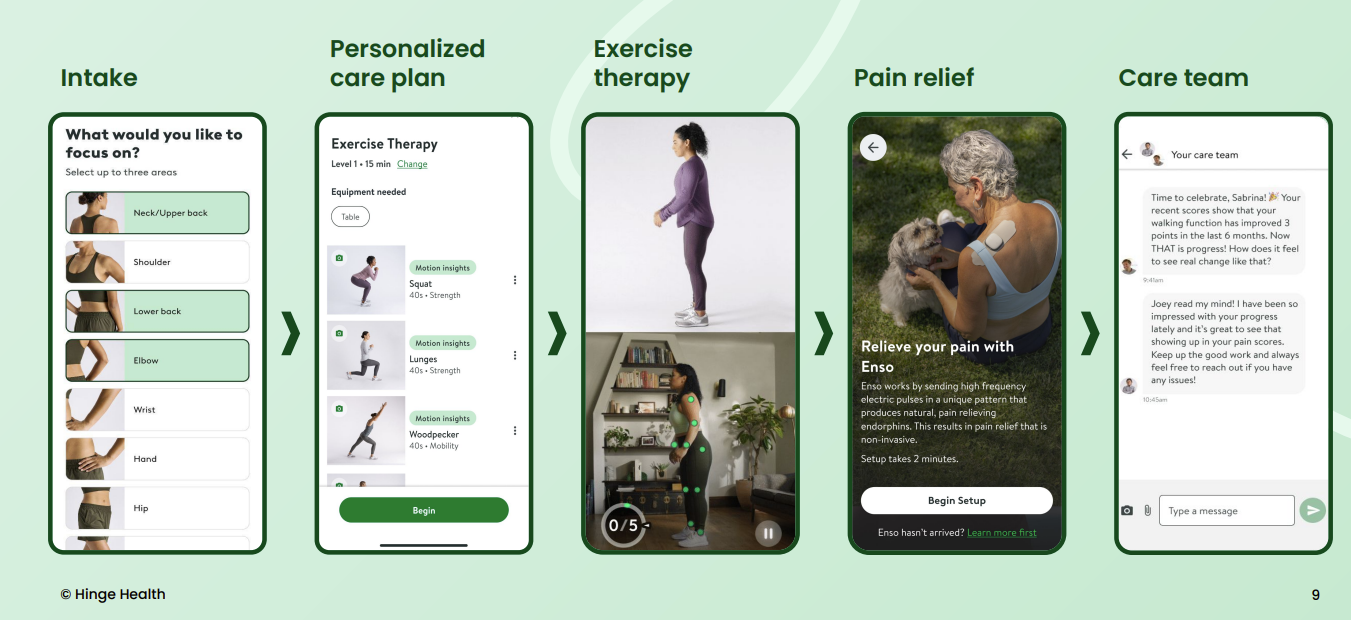
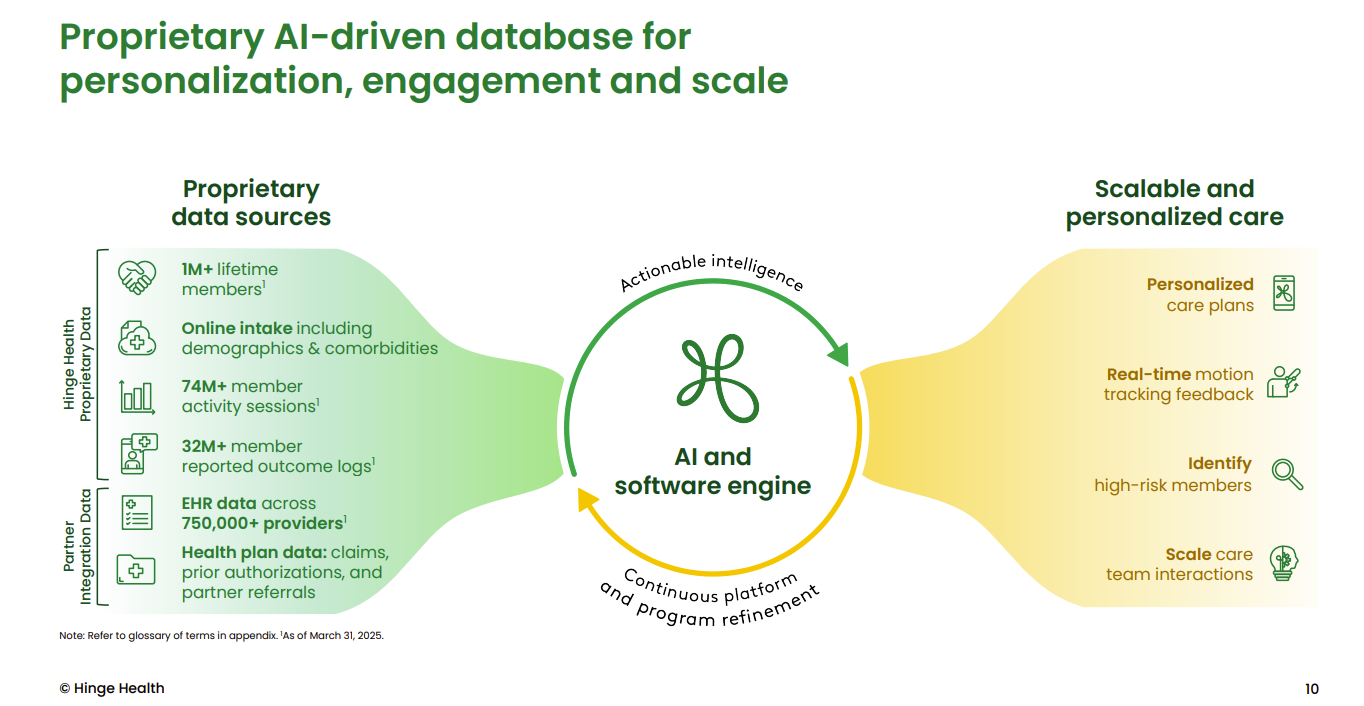
The company is leveraging AI to provide a digital PT experience with a hybrid approach that brings in humans when needed. Daniel Perez, CEO of Hinge Health, said the company is focused on multiple AI efforts that impact experiences. Hinge Health's third quarter revenue was $154 million, up 53% from a year ago.
"Everything we do is centered around the triple aim, using technology to transform outcomes, experience and costs in health care," said Perez.
AI experience efforts include:
- Robin, Hinge Health's AI care assistant, provides movement analysis. Robin is a 24/7 companion and when someone has a pain flare up, the AI assistant can gather data and details and alert physical therapists so care can be delivered faster. In the near future, Robin will be able to provide instant support and proactively check in with members.
- Hinge Health is using proprietary TrueMotion Vision technology to analyze movements. TrueMotion Vision captures joint angles, symmetry and endurance across a battery of movements. That data is combined with targeted questions to assess joint health.
- The company has leveraged AI internally to be more efficient on developing product features. Perez said the focus is on developer experiences. AI adoption is close to 100% and "we've seen a 32% improvement in developer experience scores from April through October," said Perez.
Takeaway: AI and automation improves experience, but the option for human touch matters to bring it home.
Comcast: Integrated approach
Comcast knows it has to improve its customer experience in the long run. Technology integration and AI will play a big role.
Speaking on Comcast's third quarter earnings call, Comcast President Michael Cavanaugh said the cable provider is using AI to self-optimize network performance and its own WiFi gateway to offer seamless performance.
"We're taking meaningful steps to simplify the customer experience across all channels. Our new AI engine now supports agents, technicians and customers through assisted chat, phone, our website and our AI-enabled Xfinity Assistant platform," said Cavanaugh. "We also launched a program that connects customers to a live agent in seconds, which is now available to half of our customer base. It's still early, but we're moving fast and executing with focus towards a simpler, smarter and more seamless customer experience."
Takeaway: Comcast sees tech support, ease of installation and customer service on the same continuum.
More CX:
- Digital Asset Management: The Last Mile Of CX Delivery
- CR CX Convos: Shelly Chiang, Adobe
- AI, Decision Velocity, and the Future of Marketing | CR CX Convo
- AI Roadblocks in CX and How To Thrive Because of Them
- Constellation Research Ambient Experience Summit 2025: 10 CX takeaways on people, data, AI
- Will CX suffer from an overreliance on AI?
Larry Dignan is Editor in Chief of Constellation Insights at Constellation Research, where he leads editorial coverage focused on enterprise technology, digital transformation, and emerging trends shaping the future of business. He oversees research-driven news, analysis, interviews, and event coverage designed to help technology buyers and vendors navigate complex markets with clarity and context. ...
Read morePublished
Author
