


Anthropic: Claude eyes real world impact, industrial use cases
Anthropic is looking to infuse its Claude models into industrial use cases, but those real world applications carry more risk and require domain expertise.
Speaking at the IFS Industrial X Unleashed conference in New York, Anthropic's Garvin Doyle, Applied AI Lead, said it's one thing to apply AI to industries like financial services and software development but another game entirely in real world settings.
"The Anthropic vision is to facilitate the safe transfer of AI across the economy," said Doyle. "The risk is elevated when you bring AI into the real world, into the factories, plants and field operations."
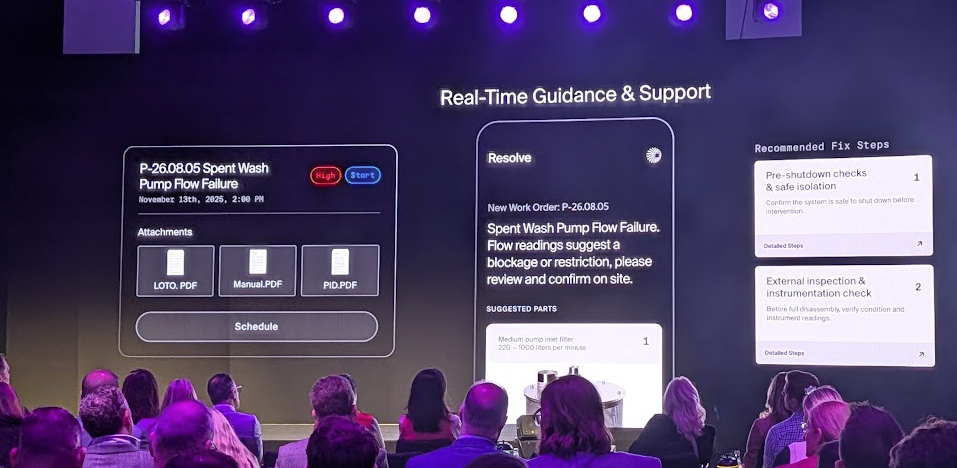
Doyle was on stage with Kriti Sharma, CEO at IFS Nexus Black, talking about industrial AI. IFS Nexus Black, a team of forward deployed engineers, has partnered with Anthropic and used its Claude models to launch Resolve, a system for industrial AI use cases.
"Building for the real world is fundamentally different," said Sharma.
IFS and Anthropic announced a broad partnership focused on taking Claude to industrial AI use cases. William Grant & Sons, the distillers behind Grant's whisky and Hendrick's gin, is a flagship customer of IFS Nexus Black and Anthropic via Resolve. The distillery has used Resolve to predict failures before they happen and estimates that it will save £8.4 million annually at one site.
Doyle said AI today has largely stuck to the digital domain since it's easier to simulate behaviors. "When you translate to the real world there are a lot of problems and challenges that we just haven't traversed yet," said Doyle. "Getting information in the real world requires working through SCADA systems, looking at diagrams and interacting with subject matter experts with institutional knowledge that hasn't been codified in a digital system."
As a result, industrial AI requires information, actions and prerequisite behaviors before data is incorporated into a model, explained Doyle. Once that expertise is incorporated into a model, improvements can scale in heavy industries like other sectors.
Doyle said incorporating AI into the real world will drive real business value. "A lot of the conversation today has been grounded in not building solutions but in adding as many AI buzzwords as possible," he said. "Real business outcomes are not just about technology. It's the evaluations, the subject matter expertise and the feedback loop to the underlying technology and the interface layer that connects them. One aspect doesn't drive a solution. It's the cohesion of all of the aspects."
Other key points from Doyle:
- "Fundamentally, Anthropic is an enterprise AI company," he said. "Competitors are very excited about consumer features but we focus squarely on the enterprise and what that entails. We can't create systems that are so constrained they are only step by step workflows that negates AI benefits, but we need to have some guardrails so these things can operate." See: OpenAI, Anthropic increasingly diverge as strategies evolve
- AI hit an inflection point in March of 2025 due to reasoning capabilities in models. Today models are constrained to narrow tasks, but will be combined with subject matter expertise for broader reach. "As we extend codified training examples for economically valuable tasks, the model is going to get pervasively better at everything outside of the digital domain too," said Doyle.
- "There's so much opportunity in the field and what we can do radically different," he said.
Larry Dignan is Editor in Chief of Constellation Insights at Constellation Research, where he leads editorial coverage focused on enterprise technology, digital transformation, and emerging trends shaping the future of business. He oversees research-driven news, analysis, interviews, and event coverage designed to help technology buyers and vendors navigate complex markets with clarity and context. ...
Read morePublished
Author
